


Custom Baseball Belts and Socks: Team Order Guide

The first game is on the calendar, the jerseys are nearly approved, and one small detail can still make the team look unfinished: players arrive in mismatched belts and socks. A complete order of custom baseball belts and socks should do more than match a color swatch. It should account for player sizing, accessory type, quantity, wear, replacement needs, and the production timeline.
What belongs in a complete baseball accessories order?
A complete accessory order starts with belts and socks, then adds the information that keeps every player covered: accessory type, team colors, size counts, quantities, spares, delivery date, and reorder plan. Treat the accessories as part of the uniform system, not as an afterthought added after jerseys and pants are already approved.
Coaches often start with the visible pieces of a uniform, such as the jersey, pants, and hat. Belts and socks finish the look, but they also affect whether a player can move comfortably and whether the team appears consistent in photos, warmups, and competition. The right order makes those decisions at the same time as the rest of the uniform.
Start with the accessory list
- Belts:
confirm the belt style, color, size range, buckle or closure, and whether the option is stock or custom-eligible.
- Socks:
choose the height, color pattern, material, size range, and whether every roster group needs the same style.
- Stirrups or alternate socks:
include them only if the uniform design and league expectations call for a layered look.
- Replacement pieces:
set aside a plan for new players, lost items, exchanges, and mid-season wear.
The phrase custom baseball belts and socks can describe a coordinated team purchase, but it does not mean every accessory is decorated in the same way. A product page may include custom socks alongside stock belts or stock socks. Confirm what can be customized, what is selected by color and size, and what will be supplied as a standard item before you send the order for approval.
That distinction protects the team from an avoidable surprise. It also gives the supplier a clear question to answer: do you need a decorated accessory, a team-color accessory, or simply an accessory that matches the approved uniform?
Accessories should still be approved alongside the main garments. Review the custom baseball uniform options first, then use the accessory list to complete the look. If the program wants a bundled starting point, compare the baseball uniform packages before finalizing belts and socks.
How should you match belts and socks to the uniform?
Match accessories to the uniform's dominant color, trim, and pant style before choosing quantities. Use the approved jersey and pants as the color reference, then confirm how the belt and sock colors will look together under game lighting. A simple accessory approval image can prevent a costly color mismatch.
Color coordination is more than choosing the same named color. Navy, royal, scarlet, maroon, and graphite can look different across fabric types and lighting conditions. If the jersey has piping or a contrasting side panel, decide whether the accessories should reinforce the main color or echo the accent.
Use a simple color approval process
- Identify the dominant uniform color.
Use the jersey body and pants as the starting point, not a phone photo taken under indoor lighting.
- List accent colors.
Note piping, sleeve trim, waistband details, and any color that appears in the team mark.
- Choose the accessory role.
Decide whether the belt and socks should blend into the pants, match the jersey, or carry the accent color.
- Review one complete look.
Ask for the proposed belt and sock colors beside the jersey and pants before the team approves the order.
- Record the decision.
Save the approved color names, product descriptions, and any reference image with the order file.
For a traditional baseball look, a dark belt with matching socks can create a clean visual line from the jersey to the pants. A contrasting sock can make piping or trim stand out, but it also makes color accuracy more important. If the team uses knickers, the socks become more visible and deserve the same design attention as the jersey.
Do not let each coach or parent choose a slightly different version of the same color. One person should own the final accessory decision, and the approval should be based on the complete uniform rather than a single belt or sock shown in isolation.
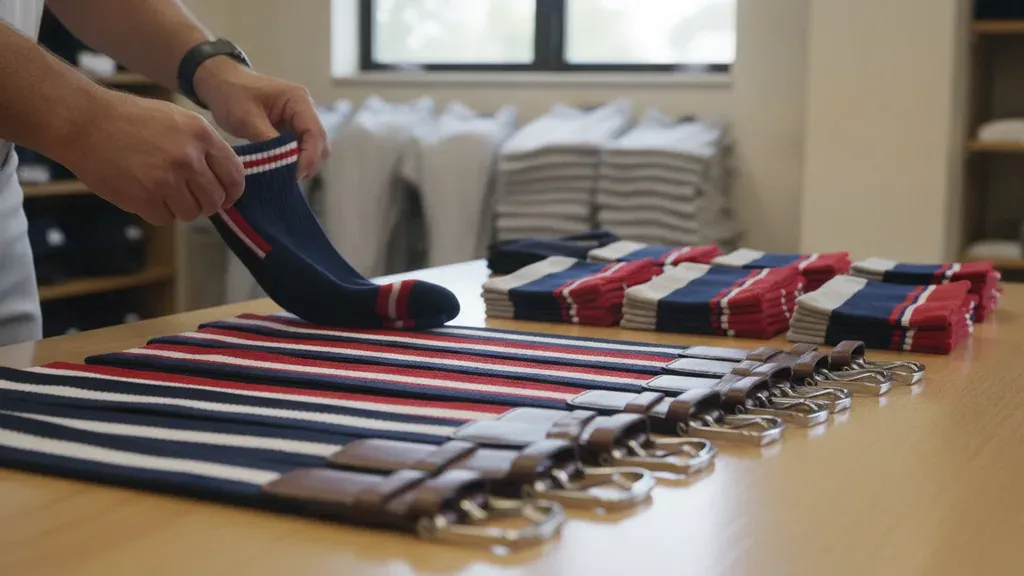
Sort accessory options by size and color before collecting the final roster counts.
What should coaches check when choosing team socks?
Choose team socks by function, visibility, size coverage, and season demands. Look for moisture management, ventilation, arch support, and cushioning when those features fit the program. Then map the supplier's size bands to the roster instead of assuming one youth or adult size will fit everyone.
Socks sit close to the skin and receive repeated stress during practices, games, washing, and travel. A visually strong sock that does not fit the roster can create complaints before the season is underway. Ask the supplier which construction details are available and which size bands cover the players on your roster.
Evaluate construction, not just appearance
Uniforms Express lists custom baseball socks with Stay Cool Moisture Management, arch support, ventilation channels, and a half-cushioned foot. The listed material composition is 77% nylon, 15% elastic, and 8% Sta-Cool. Those details give a coach useful questions to ask about comfort and durability without requiring the team to guess from a product photograph.
Next, compare the size chart with the actual roster. The listed sock bands are S for 7 to 9, M for 9 to 11, L for 10 to 13, and XL for 13 to 16. Because size bands overlap, use the player's normal shoe size, the supplier's measurement guidance, and the intended fit to make the final call. Do not automatically order every player into the same size because the team is using one jersey size.
Check the game-day uniform system
Will the socks be worn with open-bottom pants, knickers, or another pant profile?
Do players need a consistent over-the-calf appearance?
Will the team use one sock for games and another for practice?
Should the order include a small number of replacements in the most common sizes?
Does the league or school have a color expectation that limits the design options?
These questions keep the sock choice connected to how the players actually dress. They also reduce the chance that a team approves an accessory based on a flat product image, then discovers that the height, stretch, or visible color does not work with the approved pants.
How do you size belts for a full roster?
Size belts from the players' actual waist measurements or the supplier's belt chart, then count sizes by roster rather than ordering a uniform quantity in one size. Add a documented replacement plan, especially for youth teams where players grow and for programs that expect mid-season additions.
Belts are easy to overlook because they look simple, but an incorrect belt size can be uncomfortable, difficult to adjust, or visibly inconsistent. Ask whether the belt is measured by waist range, total length, or an adjustable construction. Confirm the available size range and the color before you approve the accessory order.
Build a belt sizing worksheet
Roster information. | What to record. | Why it matters. |
Player identifier. | Initials or roster number used internally. | Connects the selected size to the correct player. |
Waist measurement. | Measurement taken using the supplier's guidance. | Prevents guessing from age or jersey size. |
Belt size. | Supplier size or adjustable range. | Creates a clear order quantity by size. |
Color. | Approved belt color and finish. | Keeps every player aligned with the uniform. |
Replacement note. | Spare need or expected new-player need. | Supports a practical reorder plan. |
For youth teams, the roster can change quickly. A belt that fits at the start of the season may need adjustment later, and a new player may arrive after the original order is closed. Keep the original size record and ask how repeat orders are handled. If the belt is a stock item, confirm availability and color matching before promising a replacement to a family.
For high school and travel programs, the bigger risk is not growth alone. It is fragmented ordering. One assistant coach may order belts while another orders socks, and neither keeps the final color and size record. Assign one owner for the accessory worksheet. Have the head coach or athletic director approve the final count.
How many belts and socks should a team order?
Use the approved roster to calculate one complete set per player, then decide separately how many spares the program needs. Custom socks may have a minimum quantity per size, so a roster count should be grouped by size before approval. Keep extra pieces targeted to likely exchanges and new players.
Quantity planning is where an accessory order becomes a team order. Start with the final roster, not the preliminary interest list. Count every player who needs a game set, then separate the quantities by sock size and belt size. If the program also needs practice accessories, keep those counts in a different line so the game order remains easy to verify.
Use these quantity controls
- Final roster count:
remove duplicates, inactive players, and players who are receiving a different uniform set.
- Size distribution:
total socks and belts by size, not just by team.
- Minimums:
confirm whether custom socks have a minimum per size. Uniforms Express lists a minimum of 12 pairs per sock size for its custom sock option.
- Spare policy:
choose a small, intentional reserve for exchanges, new players, and high-wear sizes rather than adding random extras.
- Repeat-order record:
save the product, color, size, and decoration details so a later order does not restart the selection process.
A minimum per size can affect which sock option is practical for a small team. If the roster does not reach the minimum in one size, ask whether a stock option, a different size grouping, or a broader program order is appropriate. Do not combine sizes simply to hit a quantity requirement if the result creates a poor fit.
Belts may follow a different quantity rule from socks, particularly when the available belt is stock. Confirm the product-specific minimum, color availability, and reorder policy before you place the order. A supplier should be able to tell you exactly which assumptions belong in the quote or order confirmation.
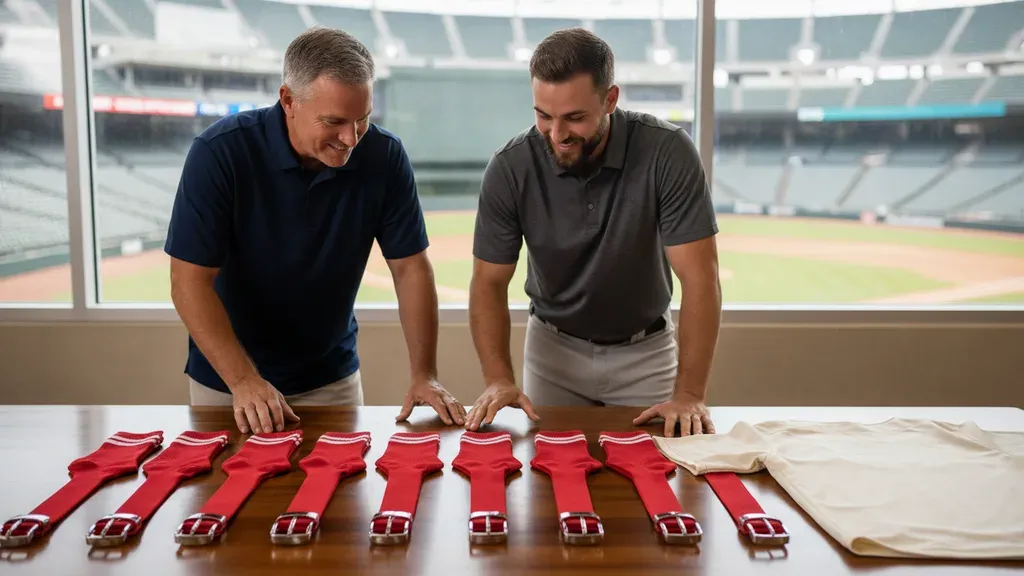
A final accessory review helps coaches approve one consistent team order.
When should you order custom baseball belts and socks?
Set the order date from the first game backward, allowing time for design approval, roster collection, size corrections, production, shipping, and inspection. Uniforms Express lists four weeks for new custom sock orders and two weeks for repeat orders, so confirm the current schedule before committing to a game date.
The right deadline is not the day the order is submitted. It is the day the team has enough time to correct a size, color, or quantity issue without putting the first game at risk. Work backward from the date the accessories must be in the players' hands.
A practical accessory timeline
- Six to eight weeks before the first game:
approve the accessory direction, confirm colors, and ask for the current production timeline.
- Five to six weeks out:
finalize the roster and collect sock and belt sizes using the supplier's guidance.
- Four to five weeks out:
review the quote or order summary, verify minimums, and approve the final quantities.
- During production:
keep the approved design, size sheet, and order contact in one place.
- Before distribution:
inspect the shipment by player, size, color, and quantity. Report any issue before game day.
For new custom sock orders, the baseball accessories page lists a four-week lead time. Repeat orders are listed at two weeks, but a repeat timeline still depends on the exact product, size, color, quantity, and current production schedule. Treat those figures as planning guidance, not a substitute for a written confirmation tied to your order.
If your season is close, ask about available options immediately. Uniforms Express emphasizes direct manufacturing control, team support, and fast production pathways, but a rushed solution should still be checked for fit, color, and quantity. The goal is not simply to receive accessories quickly. It is to receive a complete set that is ready to distribute.
What should you approve before submitting the order?
Approve one final accessory summary that shows the product, color, size counts, quantities, minimums, delivery date, and reorder plan. The approver should compare it with the jersey and pants, confirm the supplier's current lead time, and retain the written record for the coach, administrator, and families.
Before submitting, ask a second person to review the order. A coach may know the uniform design while an athletic director or team manager catches a quantity or budget-process issue. That second review is especially useful when several teams share a color family but use different sock heights or belt styles.
Final approval checklist
Primary keyword and product path: the order clearly identifies the needed baseball accessories.
Accessory scope: belts, custom socks, stock socks, stirrups, or replacement pieces are listed separately.
Color approval: belt and sock colors match the approved jersey and pants.
Size counts: every player is assigned a size, and totals reconcile to the roster.
Minimums: any per-size minimum for custom socks is understood and met.
Timeline: the current production and shipping schedule is confirmed in writing.
Inspection plan: one person will check the shipment before distribution.
Reorder plan: the team knows who handles new-player and replacement requests.
If you need help translating a roster into an accessory order, use the Uniforms Express baseball accessories page or its virtual help path. Provide the sport, team level, roster count, first-game date, approved colors, and any existing uniform details. Specific information lets the team specialist recommend a workable path without making you repeat the entire order process.
Frequently asked questions about custom baseball belts and socks
Most accessory-order questions come down to customization, sizing, minimums, timing, and replacements. Confirm those details against the current product page and your roster before approval. The answers below provide a practical starting point, but the supplier's written order confirmation should control the final decision.
Are baseball belts and socks always custom products?
No. A team can order coordinated accessories without every item being decorated. Uniforms Express lists custom socks as well as stock socks, stock belts, and stirrups. Ask which accessory options are custom-eligible, which are selected by color and size, and whether the product you chose matches the team's approved uniform.
What sizes are listed for custom baseball socks?
Uniforms Express lists S for shoe sizes 7 to 9, M for 9 to 11, L for 10 to 13, and XL for 13 to 16. Use the current supplier guidance and each player's normal shoe size before finalizing the size counts. The overlapping bands make a roster review important.
Is there a minimum quantity for custom socks?
The Uniforms Express baseball accessories page lists a minimum of 12 pairs per size for its custom sock option. A smaller roster may need a stock option, a different size plan, or a broader program order. Confirm the current minimum before approval because product requirements can change.
How long do custom baseball socks take?
The product information lists four weeks for new custom sock orders and two weeks for repeat orders. Those timelines should be confirmed against your exact colors, sizes, quantities, artwork, and first-game date. Leave additional time for approval, shipping, and inspection rather than planning to the last possible day.
Should a team order spare belts and socks?
Usually, a team should create a targeted spare plan rather than adding an arbitrary number of extras. Consider likely exchanges, new players, high-wear sizes, and whether the program has multiple teams sharing the same color. Record every spare by product, color, and size so it is usable when needed.
What information should I send when requesting help?
Send the team level, roster count, approved uniform colors, jersey and pant style, sock and belt size distribution, first-game date, and whether the order is new or a repeat. That information gives a Uniforms Express specialist the context needed to discuss the right product path and current timing.


Comments