


Custom Hockey Jerseys: Design Guide for Ice and Roller Teams
- Geoff Samuels

- 2 days ago
- 12 min read
A hockey jersey has to do more than display a team name. It must hold up through equipment friction, repeated washing, fast movement, and the pressure of a season deadline, while giving ice or roller players a consistent team identity. The right choices start before artwork is finalized: match the fabric and decoration method to how your team plays. Where the jersey will be worn, and how long it needs to perform.
Custom hockey jerseys give ice and roller teams control over fit, colors, logos, names, numbers, fabric performance, and decoration. Uniforms Express offers five primary decoration methods, including tackle-twill, sublimation, screen print, heat press, and embroidery, so each design can balance durability, appearance, breathability, and team needs.
That flexibility makes the design process practical rather than purely visual. Once your team has a clear purpose for its jerseys, the investment can reinforce unity on the bench, on the ice, and in the community. For coaches, athletic directors, and team managers, a well-planned order removes guesswork, avoids costly reprints. And gives every player a uniform that fits, performs, and arrives in time for the season. Here is why those team-level benefits matter before you compare design details and production options.
Why Custom Hockey Jerseys Matter for Your Team
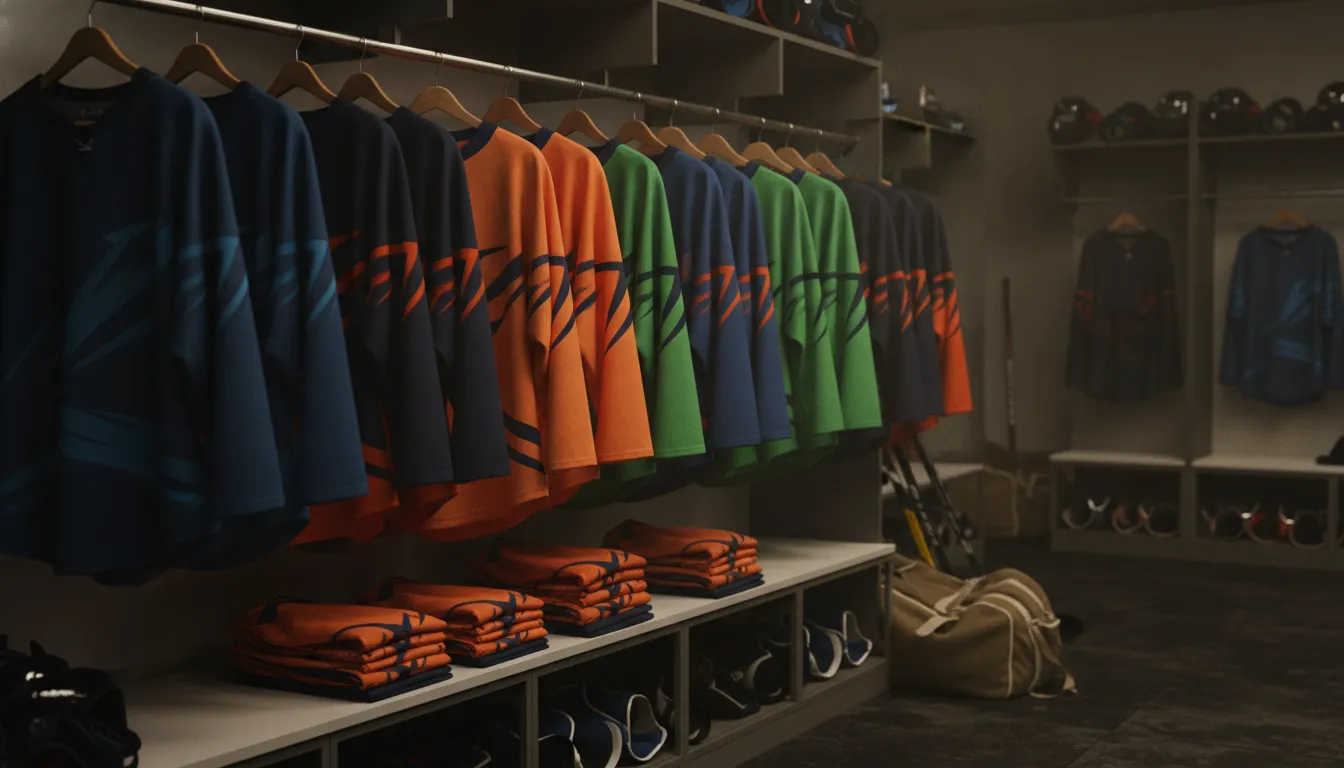
Custom hockey jerseys give a team more than a coordinated game-day outfit. They create a recognizable identity, help players feel connected, and present a professional image every time the team takes the ice. For youth leagues, high school programs, and adult beer leagues, a cohesive jersey can turn separate players into a unified team.
A visible identity builds team culture
A team's colors, crest, numbers, and name communicate who it is before the first faceoff. A consistent look helps players represent the same program, whether they are arriving at the rink, warming up, or competing in a tournament. That identity becomes especially valuable for youth and school programs, where several age groups or teams may share the same organization. Distinctive uniforms make the program easier to recognize and give players something meaningful to wear.
Custom details also create continuity from season to season. A familiar color scheme can connect a new roster to the coaches, alumni, and families who built the program. Names and numbers add personal ownership while keeping the broader team identity intact.
Unity matters when the game gets demanding
Hockey requires fast decisions and close coordination. Players still need individual skill, but they also need to trust that everyone is working toward the same objective. Wearing a shared design reinforces that sense of belonging. It gives a new player an immediate visual connection to teammates and helps a developing league feel organized from the start.
That shared appearance can support morale before the game begins. Players often take greater pride in representing a team when their jersey feels intentional rather than generic. For recreational teams, that pride can make the season more enjoyable. For competitive and school programs, it can reinforce standards around preparation, conduct, and representing the organization well.
A professional look supports every level of play
A cohesive uniform makes a program look prepared on the ice and around the rink. Matching jerseys help coaches, families, spectators, and opponents identify the team quickly. They also create a stronger visual presence in team photos, league promotions, and school athletics coverage. The same principle applies across formats: an ice hockey team may need a traditional game-ready look. While a roller hockey team may prioritize a lightweight design suited to its equipment and playing environment.
Uniforms Express supports both ice and roller hockey teams with a range of styles and customization options. As a vertically integrated direct manufacturer, the company maintains control over quality and delivery while producing custom jerseys in as little as two weeks. That combination helps programs move from an approved design to a consistent team look without treating uniforms as an afterthought.
Custom Hockey Jersey Design Options: From Colors to Logos
Design choices shape how your team looks on the ice and how easily players are identified in motion. Start with a clear color system, then coordinate the logo, numbers, names, patches, and stripes. The best design is distinctive without sacrificing contrast, readability, or consistency across ice and roller hockey uniforms.
Team colors are the foundation. Choose a primary color, a secondary color, and an accent rather than treating every available color as equally important. Color-blocking can make the jersey look faster and more defined, especially when panels, shoulders, and side sections share a deliberate pattern. Check the design against both light and dark backgrounds so numbers and logos remain easy to see during play.
Logo placement should support the jersey rather than compete with it. The main crest usually works best on the front, while a smaller mark can add identity to the shoulder or sleeve. Keep supporting graphics proportionate to the crest and leave enough open space for player information. For teams with multiple jersey colors, use the same logo treatment across each version so the set still looks unified.
Make names and numbers easy to read
Player names and numbers need strong contrast and generous spacing. Select a number style that can be recognized from the stands, then use the same type treatment throughout the roster. A name plate can sit above the number on the back, while sleeve numbers can help identify players from the side. Confirm spelling, numbering, and roster changes before production. Uniforms Express offers several decoration methods, including tackle-twill, sublimation, screen print, heat press, and embroidery, so the treatment can match the design and performance goals.
Use details that distinguish team roles
Captain and alternate-captain patches provide a simple way to distinguish leadership without changing the main uniform design. Place them consistently and keep their colors compatible with the crest, numbers, and trim. Sleeve stripes can reinforce the team's visual identity, frame the arms, and connect the jersey to matching socks or warm-ups. They should repeat the primary color structure instead of introducing an unrelated pattern.
Ice and roller hockey may call for different design emphasis. Ice uniforms need to remain legible beneath protective equipment and at rink distance, while roller designs should stay cohesive with the team's lighter, faster visual profile. In both settings, consider the full kit: jersey, socks, pants, helmet, and goalie equipment. Goaltender jerseys often need a distinct colorway or stronger visual separation from teammates and opponents, while preserving the same crest and design language.
When the elements work together, tackle-twill, sublimation, and other decoration options look intentional from every angle. Sketch the complete front, back, and sleeve layout before choosing decoration, then review a roster-ready proof to catch contrast or placement issues early.
What Fabric Is Best for Custom Hockey Jerseys?
For most teams, 100% polyester interlock or pique knit is the best choice for custom hockey jerseys. Both fabrics balance durability, breathability, and moisture management. Add mesh reinforcement in high-wear areas, then adjust the weight and ventilation for the sport: ice hockey requires room and resilience over pads. While roller hockey may benefit from a lighter, more breathable build.
Polyester interlock and pique knit performance
Polyester is a practical foundation for a jersey that needs to withstand repeated practices, games, washing, and contact with equipment. It resists stretching and holds color well, while the knit construction gives the garment enough flexibility for skating and stick movement.
Interlock has a smooth, consistent surface and a comfortable hand, making it a strong all-around option for team uniforms. Pique knit has a more textured structure that can support airflow and a classic athletic feel. The better choice depends on the desired weight, fit, and ventilation, not simply the fabric name.
Moisture management matters because hockey combines intense bursts of movement with protective layers that can trap heat. In one study, polyester jerseys were more effective at moisture management than cotton jerseys during high-intensity exercise (PubMed). The knit structure also affects comfort characteristics such as moisture wicking and air permeability, according to textile research from North Carolina State University (textile research published by NC State).
Reinforcement for shoulders, elbows, and other high-wear zones
A durable jersey is not only about the main body fabric. Shoulders and elbows experience frequent friction from pads, boards, falls, and stick contact, so mesh or other reinforced material in these zones can extend the garment's useful life. Reinforcement should support movement rather than make the jersey feel stiff or excessively heavy.
Construction choices should also account for what players wear underneath. Research on high-intensity intermittent exercise found that undergarment composition can affect thermoregulatory responses when athletes wear hockey equipment (PubMed). That makes breathability and layering part of the uniform decision, not an afterthought.
Choosing fabric for ice hockey versus roller hockey
Ice hockey jerseys are typically worn over shoulder pads, elbow pads, chest protection, and other substantial gear. They need a cut with enough ease for layering, durable shoulder and elbow zones, and ventilation that helps manage heat without compromising coverage. A slightly more substantial interlock or reinforced construction can be appropriate for teams facing heavy equipment friction.
Roller hockey players typically wear less protective equipment, so a lighter jersey can improve airflow and reduce excess material during play. Pique knit or a lighter polyester construction may suit that environment, especially when paired with strategically placed mesh. In both sports, prioritize a flexible fit, reliable moisture management, and reinforcement where the jersey actually takes wear. The right custom hockey jerseys are built around how your team plays, not just how the design looks on a screen.
Sublimation vs. Stitched Decoration: Which Is Right for Ice and Roller Teams?
Short answer: Sublimation is usually the better fit for roller hockey teams that want lightweight jerseys, unrestricted color, and breathable all-over graphics. Stitched tackle-twill is often the stronger choice for ice hockey teams seeking a traditional raised look and substantial decoration. The right decision depends on contact, equipment friction, design complexity, and how the jerseys will be used.
For custom hockey jerseys from the Uniforms Express builder, decoration is more than a visual preference. It affects how the jersey feels under pads, how the design holds up through practices and games, and how closely the finished uniform matches your team's identity. Uniforms Express offers five primary decoration methods: tackle-twill, sublimation, screen print, heat press, and embroidery. The first two are the most useful starting points when comparing a performance-focused jersey with a classic stitched appearance.
Choosing for ice hockey
Ice hockey jerseys need to work with shoulder pads, elbow pads, gloves, and frequent contact with boards and opposing players. Tackle-twill can be a strong choice when your team wants a bold crest, raised numbers, and a classic hockey look. It gives the uniform visual weight and makes key elements easy to identify from the stands. Sublimation remains a practical option for ice teams with complex artwork or a lightweight design priority, particularly when the graphic needs to cover large areas without adding patches.
Choosing for roller hockey
Roller hockey generally places a higher premium on mobility, ventilation, and a lighter jersey feel. Sublimation is often the natural fit because it supports detailed, all-over designs without layering bulky decoration onto the fabric. A clean, integrated print also works well for teams that want coordinated color transitions or distinctive patterns. For a simpler logo, screen print or heat press may be appropriate, while embroidery is better reserved for select details rather than the main jersey graphic.
Start with the team's playing environment, then match the decoration to the design. Uniforms Express controls manufacturing and delivery directly, helping teams select the method that fits their sport, artwork, and season schedule.
How to Design Custom Hockey Jerseys for Your Team
Designing custom hockey jerseys is easiest when you settle the roster, color system, artwork placement, decoration method, and final proof in that order. Gather complete player information first, then work with your manufacturer to turn the approved concept into production-ready jerseys. Uniforms Express can produce custom jerseys in as little as two weeks.
Define the roster and collect sizes
Start with the full roster, including player names, numbers, positions if relevant, and the number of jerseys each person needs. Confirm whether the order includes coaches, goalies, practice players, or spare jerseys. Collect sizes using the manufacturer's current size chart rather than relying on assumptions from another brand. Hockey jerseys are worn over protective equipment, so the correct fit should allow room for pads without becoming unnecessarily loose.
Choose colors that stay clear on the ice
Select a primary jersey color, a contrasting secondary color, and an accent color only if it improves recognition. Check the palette under bright rink lighting and against the white ice surface. Numbers and names must remain easy to read from the stands. So avoid placing dark artwork on a dark base or using thin accents that disappear at a distance. If your team has home and away uniforms, confirm that the two designs are visibly distinct before artwork is finalized.
Place logos, names, and numbers precisely
Decide where the main crest, shoulder logos, player names, and numbers will appear. Use your league, tournament, or school requirements as the authority for number size, location, and contrast. Send clean, high-resolution logo files and identify any captain or alternate-captain markings. Your design team can then check that every element is proportional, centered, and positioned consistently across the roster instead of simply placing artwork wherever space remains.
Confirm the decoration method
Match the decoration method to the artwork and the way the jerseys will be used. Uniforms Express offers tackle-twill, sublimation, screen print, heat press, and embroidery. Sublimation may suit an all-over, multi-color design, while stitched or applied decoration can create a more dimensional treatment for selected logos and lettering. Confirm the method for each element, including names and numbers, before approving the order so the final look and expected durability are clear.
Review and approve the design proof
Before production, inspect the proof as if you were checking a finished jersey. Verify every spelling, number, color, logo, placement, size, and front-versus-back detail. Ask for corrections in writing and do not approve until the roster and artwork are correct. The proof is the final checkpoint that prevents avoidable production errors. Once approved, Uniforms Express uses its vertically integrated manufacturing process to maintain control over quality and delivery, with custom jerseys available in as little as two weeks.
Ordering Custom Hockey Jerseys: Sizing, Timeline, and Budget Considerations
Order custom hockey jerseys by confirming how players will wear them, measuring against the supplier's size chart, and allowing time for roster details and approvals. Ice teams need room over pads, while roller teams may prefer a closer fit. A clear order plan helps protect comfort, deadlines, and the team budget.
Choose sizes for the sport, not just the player
Start with the current Uniforms Express sizing chart and compare each player's measurements rather than relying only on small, medium, or large labels. Ask players to measure the chest, waist, and torso according to the chart's instructions, then record the result in one roster document. This reduces last-minute substitutions and gives the manufacturer a clean production list.
Ice hockey jerseys are normally worn over shoulder pads and other protective equipment, so the jersey must provide enough ease for unrestricted movement without becoming excessively loose. A player who wears a medium shirt may need a larger ice jersey. Roller hockey jerseys are generally worn over lighter equipment, making a more athletic or closer fit practical for many teams. Confirm the intended equipment setup before approving sizes, especially for goalies or players between sizes.
Build the timeline around approvals
Uniforms Express can produce custom jerseys in as little as two weeks, supported by vertically integrated manufacturing that keeps quality and delivery under direct control. That production speed guarantee is valuable, but the clock still depends on receiving accurate artwork, approved colors, player names, numbers, sizes, and payment or order authorization. Submit those details early and assign one person to consolidate team corrections.
Have a fixed game date? Ask about rush capability before placing the order. A rush request should include the event date, delivery location, final roster deadline, and whether every player needs a complete set. The sooner the production team can evaluate those constraints, the more clearly it can confirm what is realistic.
Keep a full team order within budget
Ask about order minimums and bulk discounts at the quoting stage. Requirements can vary by product and decoration method, so do not assume a single-jersey replacement follows the same rules as a new team order. Combining the team's jerseys in one coordinated order may simplify production and improve the opportunity for volume pricing.
To stretch the budget, use one core design across the roster, limit unnecessary decoration changes, and finalize the player list before production. Compare the cost of a durable, easy-care decoration method with the cost of replacing inconsistent or short-lived pieces later. If the team needs more than jerseys, ask whether matching apparel can be planned together so colors and artwork stay consistent. Uniforms Express offers five primary decoration methods, including tackle-twill, sublimation, screen print, heat press, and embroidery, allowing the order to be matched to the team's priorities.
Frequently Asked Questions
What is the difference between sublimation and tackle twill for hockey jerseys?
Sublimation puts the design into the fabric, making it a strong choice for detailed, full-color graphics with a smooth finish. Tackle twill adds raised fabric letters, numbers, or logos for a traditional, dimensional look. The right option depends on your design, performance priorities, and team style.
What fabric is best for custom hockey jerseys?
Choose a performance fabric that supports breathability, durability, and comfortable movement under equipment. Polyester is commonly selected for moisture management, while the knit structure affects comfort and air permeability. Ice and roller teams should also consider where the jersey will experience the most friction.
How long does it take to produce custom hockey jerseys?
Uniforms Express can produce custom jerseys in as little as two weeks. Your actual schedule depends on design approval and order details. So start early enough to allow time for reviewing artwork, confirming sizes, and receiving the finished uniforms before the season.
What decoration methods are available for hockey jerseys?
Common options include tackle twill, sublimation, screen print, heat press, and embroidery. Each creates a different look and performance profile. A design with extensive color and detail may call for a different method than a simple name-and-number application.
Do I need to provide my own jersey design?
No. You can bring an existing concept, team colors, logos, and uniform requirements, or start with the design process. Share your ice or roller hockey needs, and the production team can help translate them into a practical jersey layout for approval.
Ready to Design Your Custom Hockey Jerseys?
With your team colors, decoration preferences, and on-ice or roller hockey needs in mind, the next step is turning your ideas into a clear jersey plan. Request a quote to review your options and start designing custom hockey jerseys for your team. Get started with your custom hockey jersey design.


Comments