


Custom Baseball Pants for Teams: Fit, Color and Reorders

The wrong pair of pants can turn a straightforward team order into a season-long nuisance. A waistband that does not sit comfortably, a trim color that clashes with the jersey, or one missing size during a late roster change can create extra work for a coach. The best custom baseball pants for teams are chosen as part of a repeatable system for fit, color approval, quantities, and future reorders.
This guide is for coaches, athletic directors, and team managers who need a practical way to compare pants styles, collect dependable measurements, approve a coordinated look, and save the details that make fill-in orders easier. Use it alongside the baseball uniform sizing guide when you are measuring a full roster.
What should teams decide before choosing baseball pants?
Before selecting team baseball pants, confirm the roster, intended fit, pant style, team colors, trim details, decoration requirements, deadline, and approval process. Separating those decisions early helps coaches compare suitable options instead of approving a sample that cannot be matched across the full roster or reordered later.
A team order is easier to manage when the decision-maker separates product choices from information that belongs on the roster. Start by naming the job the pants need to do. A youth recreational team may prioritize a forgiving fit and simple replacement process. A high school or travel program may want a more consistent professional look across home and away uniforms. A college program may need a detailed approval trail for colors, trim, and player information.
Use this pre-selection checklist:
- Roster scope:
Identify the teams, age groups, player count, coaches, and any expected additions.
- Uniform relationship:
Decide whether the pants will match one jersey, a home and away set, or multiple uniform packages.
- Fit preference:
Choose whether the team is considering open-bottom pants, knickers, or more than one option by uniform set.
- Color plan:
Record the base color, piping or trim color, and any approved accent colors.
- Deadline:
Work backward from the first practice or game, leaving time for proof approval, measurement checks, production, shipping, and distribution.
- Reorder owner:
Assign one person to keep the approved design, size records, and supplier communication together.
Uniforms Express offers baseball pants in open-bottom and knicker styles, with options that include white, gray, and custom colors. Product availability, sizing, and decoration details can change by style, so the product page and an order conversation should be the final reference before approval. Avoid treating a photograph or an old order as the complete specification.
It also helps to decide whether the pants are being purchased alone or as part of a broader set. If jerseys, hats, socks, and accessories need to coordinate, compare the complete look before locking the pants. The baseball uniform packages page can help a program review the larger equipment picture without losing sight of the pants-specific decisions.
Which baseball pants fit works for your roster?
Open-bottom pants offer a traditional full-length silhouette and are a flexible choice for teams that want coverage at the ankle. Knicker pants stop below the knee and are commonly paired with high socks. The best choice depends on the team look, player comfort, league expectations, and whether one style must serve a varied roster.
Fit is not just a matter of choosing adult or youth sizing. Coaches should evaluate how the waistband, rise, leg shape, hem, and movement feel when players run, slide, squat, and warm up. A pair that looks correct on a hanger can feel different once a player wears it with the rest of the uniform.
Decision | What to review | Order note to save |
Open bottom or knicker | Overall silhouette, sock visibility, and how the hem works with the team's uniform look. | Approved style name and a photo or product reference. |
Waist and length | Natural waist measurement, inseam, and the player's preferred amount of movement room. | Measurement date and the final size selected from the supplier chart. |
Youth or adult range | Age group, growth expectations, and whether the same design must cover multiple size ranges. | Size range by team and any players requiring a separate fit review. |
Game and practice use | Whether one pair will handle frequent practice use or whether the order needs separate game and practice plans. | Quantity by use, player, and uniform set. |
Measure players in lightweight clothing with a flexible tape, and keep the process consistent. For pants, record the natural waist and inseam rather than relying on a player's usual casual clothing size. A player who falls between chart sizes should be reviewed against the intended fit and garment cut. Document the final choice instead of allowing a last-minute verbal change to replace the approved roster.
Youth rosters deserve an additional checkpoint. Players can grow between design approval and delivery, but ordering oversized pants for everyone can create mobility and appearance problems. Set a final measurement date, note players who may change sizes, and ask the supplier how late roster or size updates can be handled. That planning is more dependable than assuming every change can be made after production begins.
Do not use the pants guide as a substitute for the supplier's current chart. The Uniforms Express sizing charts and product information should be the final comparison point, especially when a roster combines youth and adult sizes.
How do you coordinate baseball pants color and trim?
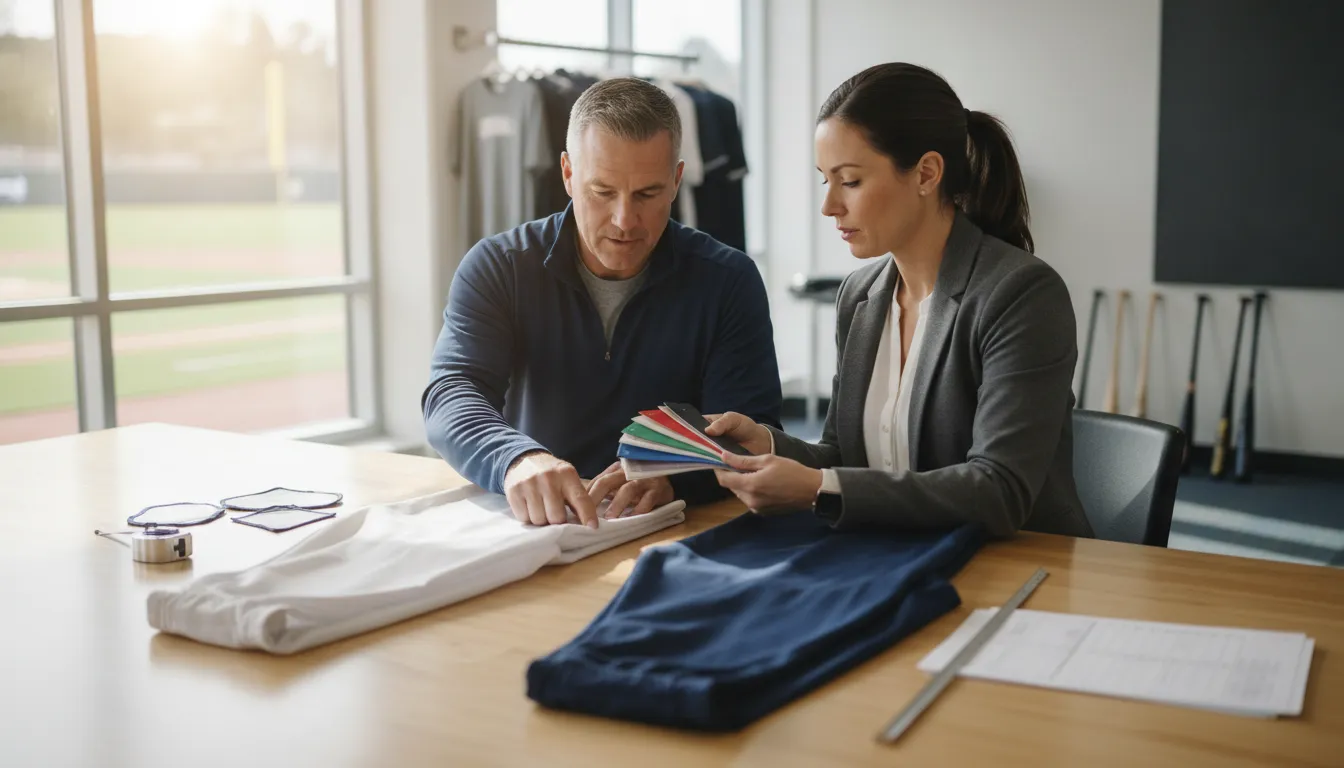
Coordinate baseball pants by approving the base color first, then checking piping, side trim, waistband details, and the colors used on jerseys and hats. Review the combination in the same lighting and on the same product references whenever possible. Save the approved color names or references so a later reorder does not rely on memory.
Color decisions often fail because teams approve each garment separately. A white pant with navy piping may look right next to one jersey but compete with a second jersey, jacket, or hat. Build a simple uniform palette before requesting a final proof:
Write down the primary, secondary, and accent colors in plain language.
Identify which color belongs on the pant body and which belongs on piping or trim.
Compare the pants beside the approved jersey, not beside a different screen image.
Check how the combination looks in daylight and under typical field or indoor lighting.
Confirm whether the same palette must match another uniform set, hat, jacket, or accessory.
Save the final proof and the supplier's color references with the roster record.
Uniforms Express positions its baseball offering around coordinated team apparel, including color-matched jerseys, hats, and pants. That makes the pants a useful anchor for a complete team look, but it also raises the value of a careful proof review. A coordinator should mark exactly what is approved and what remains open rather than approving a general concept and assuming every production detail will follow.
Decoration and construction choices can affect the visual balance as well. Tackle-twill lettering, sublimation, screen print, heat press, and embroidery each produce a different appearance and feel. Pants may not need the same decoration as a jersey, but trim, piping, and the base color should be reviewed as part of the complete design. If the team is ordering a package, compare the custom baseball jersey options with the pants before the final approval.
What should a team order approval checklist include?
A team pants approval checklist should connect the approved design to the exact roster and quantities. Confirm the style, color, trim, size for every player, names or numbers if applicable, shipping details, deadline, proof status, and authorized approver. A clean checklist reduces rework because every change has an owner and a record.
Use one shared order record rather than separate messages from coaches, parents, and players. The record can be a spreadsheet or team management document, but it should be easy to audit before the order is released. Include these fields:
Team, season, uniform set, and order date
Approved pant style and product reference
Base color, piping, trim, and any decoration notes
Player name, jersey number, waist, inseam, selected size, and measurement date
Quantity for each size, plus a clearly labeled spare or replacement plan
Final artwork or proof link and the date it was approved
Shipping address, receiving contact, and the date the team needs the order
Name of the person authorized to approve changes
Review the order in two passes. The first pass checks the design: style, color, trim, and coordination with jerseys and hats. The second checks the roster: every player, every size, every quantity, and any late additions. Do not mix those passes. Design approval can make a roster error easier to overlook, while a roster review can distract from a small but important trim change.
Before payment or final release, ask what happens if a player changes size, a new player joins, or an item needs replacement. Clarify the timing, the saved design information, and the process for a fill-in order. Teams that ask these questions early have more options than teams that wait until a missing pant is needed before the next game.
How can teams plan dependable baseball pants reorders?
Plan reorders by saving the original product reference, approved proof, color details, size chart used, roster history, and supplier contact in one location. Record why each reorder is needed and confirm whether the replacement must match an existing production run. This creates a practical handoff when a new manager takes over.
Reorders are not simply smaller versions of the first order. A replacement player may need a different size, a new coach may inherit the account, or the team may add a second set. The goal is to make the original decision easy to reconstruct without asking players to remember what the team approved months earlier.
Keep a reorder record with:
The exact pant style, base color, trim, and product reference
The original order date and season or uniform-set name
The approved proof and any color references used
The size chart version or link used for the first order
The current roster, new player information, and requested quantity
Any notes about fit changes, replacement reasons, or alterations
The supplier contact and the date the reorder was requested
Ask the supplier to confirm whether the replacement will be matched to the existing design and what information is needed to process it. Do not assume that a product title alone preserves every trim or color decision. If the team has multiple pant styles, label each record clearly, for example, "2026 home knicker" or "2026 away open bottom," rather than storing everything under a generic baseball pants label.
Reorder planning also helps with budget and inventory conversations without requiring a team to publish a price in its public guide. Track how many spares were purchased, which sizes were used most often, and whether late additions required a separate shipment. Those notes can make the next season's quantity plan more accurate while keeping the focus on the team's actual experience.
What is the simplest workflow for ordering team baseball pants?
The simplest workflow is to set the uniform goal, compare pants styles, measure the roster, approve colors and trim, review a complete order record, and save the proof for reorders. Assign one decision-maker and one final measurement checkpoint. Then confirm timing and shipping details before releasing the order.
- Set the use case:
Identify the team, uniform set, season deadline, and expected quantity.
- Compare styles:
Review open-bottom and knicker options against the team's look and player needs.
- Measure consistently:
Collect waist and inseam information using the same process and a current sizing chart.
- Coordinate the palette:
Approve the pant body, piping, trim, and relationship to jerseys, hats, and accessories.
- Review the proof:
Have the named approver confirm the exact product and design before release.
- Audit the roster:
Check every player, size, quantity, and shipping detail in a second pass.
- Save for the next order:
Store the proof, measurements, color references, and supplier communication where the next manager can find them.
This process keeps a team order focused on decisions that can be verified. It also gives Uniforms Express's team-uniform specialists the information needed to help compare product paths, confirm current availability, and discuss timing for the program's deadline.
Custom baseball pants for teams FAQ
Teams usually get the best results when they decide the pant style, measure players consistently, coordinate colors with the full uniform, and save the approved order details. The answers below cover the practical questions coaches and team managers should resolve before submitting an order or requesting a reorder.
Should a team choose open-bottom or knicker baseball pants?
Choose based on the team's preferred silhouette, sock visibility, player comfort, and the look that needs to coordinate with the jersey and other gear. Open-bottom pants provide full-length coverage, while knickers stop below the knee and are commonly styled with high socks. Review the current product options before deciding.
How should coaches measure players for baseball pants?
Use a flexible tape and measure the natural waist and inseam consistently, with the player standing naturally in lightweight clothing. Record the date and compare every measurement with the supplier's current sizing chart. Do not rely only on a player's usual casual clothing size.
How can a team keep baseball pants colors consistent?
Approve the pant body, piping, trim, and related jersey or hat colors together. Save the final proof and any supplier color references in the team order record. When a replacement is needed, send those references with the new player or size information instead of describing the color from memory.
What information should be saved for a baseball pants reorder?
Save the product reference, style, color and trim details, approved proof, size chart used, original order date, roster history, and the supplier contact. Add the new player's measurement, selected size, quantity, and reason for the reorder. Ask the supplier to confirm the replacement matches the existing design.
When should a team order custom baseball pants?
Start early enough to complete design approval, roster measurement, proof review, production, shipping, and distribution before the first game. The right lead time depends on the product, customization, season demand, and order readiness. Confirm the current timing with Uniforms Express before setting the team's final deadline.


Comments