


Embroidered Team Hats vs Patches: Durable Finish Guide

Choosing a finish for team hats is not just a branding decision. Coaches, athletic directors, and team managers also need to consider logo detail, cap fabric, player comfort, care, replacement needs, and the conditions those hats will face throughout a season.
When comparing embroidered team hats vs patches, embroidery usually creates a lower-profile mark integrated into the cap, while a patch adds a distinct raised or textured layer. The better choice depends on the artwork, desired look, cap construction, and how the hats will be worn and maintained.
Neither finish is automatically the more durable option in every situation. Attachment method, stitch or edge construction, fabric, washing, and everyday wear all affect performance. Start by looking at how each approach changes the hat's surface, visual identity, and practical use for your team.
How Embroidered Team Hats vs Patches Differ in Real Team Use
Embroidered team hats place the logo directly into the cap, creating a low-profile finish that follows the fabric. Patches add a separate emblem with its own edge, texture, and construction. For a team order, the better choice depends on logo detail, the look you want, how the hat will be used, and how clearly the decoration should stand apart from the cap.
Direct embroidery becomes part of the hat's front panel. That makes it a natural fit for team names, initials, mascots, and marks that should look integrated with the cap. The result is usually a stitched surface rather than a separate layer, so the logo's scale, lettering, and stitch-ready artwork matter. Fine details may need to be simplified during proofing to remain readable at cap size. A practical custom hat embroidery design review can help managers assess those details before approving production.
A patch creates more visual separation. Its border can frame a mascot, badge, or bold graphic, while the patch material and edge treatment contribute to the overall appearance. That added relief can support a retro, collectible, or distinctly branded look. But it also means the team is evaluating the patch construction and attachment method as well as the cap itself. The reviewed customer information does not establish a single standard for patch materials, attachment, or performance.
Available patch designs vary in construction. For example, a NIST profile describes one patch maker using leather, PVC, and fabric patches that are primarily hand-stitched. That is a specific maker's example, not a universal description of patches. A sportswear patent likewise describes one design using layered fabric and coating components with an adhesive sheet. Those examples show why a buyer should ask how a proposed patch is made and secured instead of assuming every patch behaves the same way.
The identity decision is often just as important as the technical one. Embroidery can keep a clean, established look across matching caps and uniforms. A patch can make the logo feel more dimensional or visually independent from the cap fabric. Neither finish is automatically the right answer for every roster. Coaches and managers should compare the actual artwork, cap surface, player use, care expectations, and replacement plan. Uniforms Express documents custom headwear with embroidery, while patch availability and patch specifications should be confirmed separately rather than assumed.
Which Finish Holds Up Better Through a Full Season?
Neither embroidery nor patches is automatically the more durable choice. A full-season result depends on the hat fabric, stitch density, patch edge or attachment method, sweat and abrasion, washing, and storage. Compare the complete construction and care requirements rather than choosing by the finish name alone.
Direct embroidery is integrated into the cap panel, while a patch is made separately and then attached. That difference affects how each finish responds to flexing, repeated contact, moisture, and eventual repair. It also means that a patch comparison is only as reliable as the construction details supplied for that specific patch.
How embroidery and patches can differ over a team-hat season
Factor
Construction
Embroidery: Thread is stitched directly into the cap panel. The result follows the panel's shape and becomes part of the decorated surface.
Patches: A separate piece is attached to the cap. Materials and attachment can vary widely, so confirm whether the example is stitched, bonded, or uses another method.
Durability variables
Embroidery: Assess cap fabric, backing, stitch density, raised areas, and whether the panel flexes at the logo. Heavy rubbing can affect exposed thread over time.
Patches: Assess patch material, edge finish, bonding or stitching, and how the patch handles bending. A leather, PVC, or fabric patch may behave differently; an NIST profile describes one maker using all three materials and primarily hand-stitching patches, not a universal standard.
Care
Embroidery: Follow the cap's care instructions and avoid unnecessary heat, harsh agitation, or aggressive scrubbing across the stitches.
Patches: Care must protect both the patch surface and its attachment. One PubChem patent record describes a particular layered sportswear patch with fabric, coating, and adhesive components, so its care and performance should not be applied to every patch design.
Repair or replacement
Embroidery: Damage to thread may require assessing the logo and cap panel together. A replacement usually means decorating another cap rather than changing only a detached component.
Patches: A separated or damaged patch may be replaceable as a component, but removal can affect the cap surface. Confirm whether the attachment method permits clean repair before ordering.
Visual profile
Embroidery: Usually gives a direct, integrated look with thread texture and a profile shaped by the stitches and cap panel.
Patches: Can create a distinct border, surface, or relief that separates the logo from the cap fabric. The effect depends on the selected patch design and materials.
Specific evidence should stay specific. The PubChem record claims that its described patch design remained attached after 50 or more washes, but that statement belongs to that patented construction, not to patches as a category. For any team order, ask what the proposed finish is made from, how it is attached, and which care instructions apply.
Then match the finish to the season's actual conditions. A hat worn daily in practice may face more sweat, friction, and repeated washing than a hat reserved for games or travel. If players will share storage bins or frequently adjust the front panel, surface relief and edge exposure deserve extra attention. A careful proof should show the logo at its intended size, because tiny lettering and crowded details can create stress points or require a different construction choice.
The best decision is the one that remains attractive and serviceable for the way the team will use it. Request construction and care details with the artwork proof, and treat any durability statement as tied to the exact cap, finish, attachment, and maintenance plan being considered.
When Does Embroidery Make More Sense for a Team Hat?
Embroidery is usually the better choice when a team needs fine lettering, a low-profile mark, and a consistent look across several cap styles. It works especially well for names, initials, and straightforward logos that should feel integrated with the hat rather than placed on top of it. The right choice still depends on the artwork, cap construction, and how the hats will be used.
Fine lettering is one of the clearest reasons to consider embroidery. Stitches can follow the shape of a short team name, player role, or compact monogram without adding a separate border or backing around the design. Very small details still need to be reviewed carefully, since thin lines and crowded artwork may not translate cleanly at cap scale. A proof is important before production, particularly when the logo includes narrow lettering or several colors. The custom hat embroidery design guide can help teams prepare artwork for a clearer stitched result.
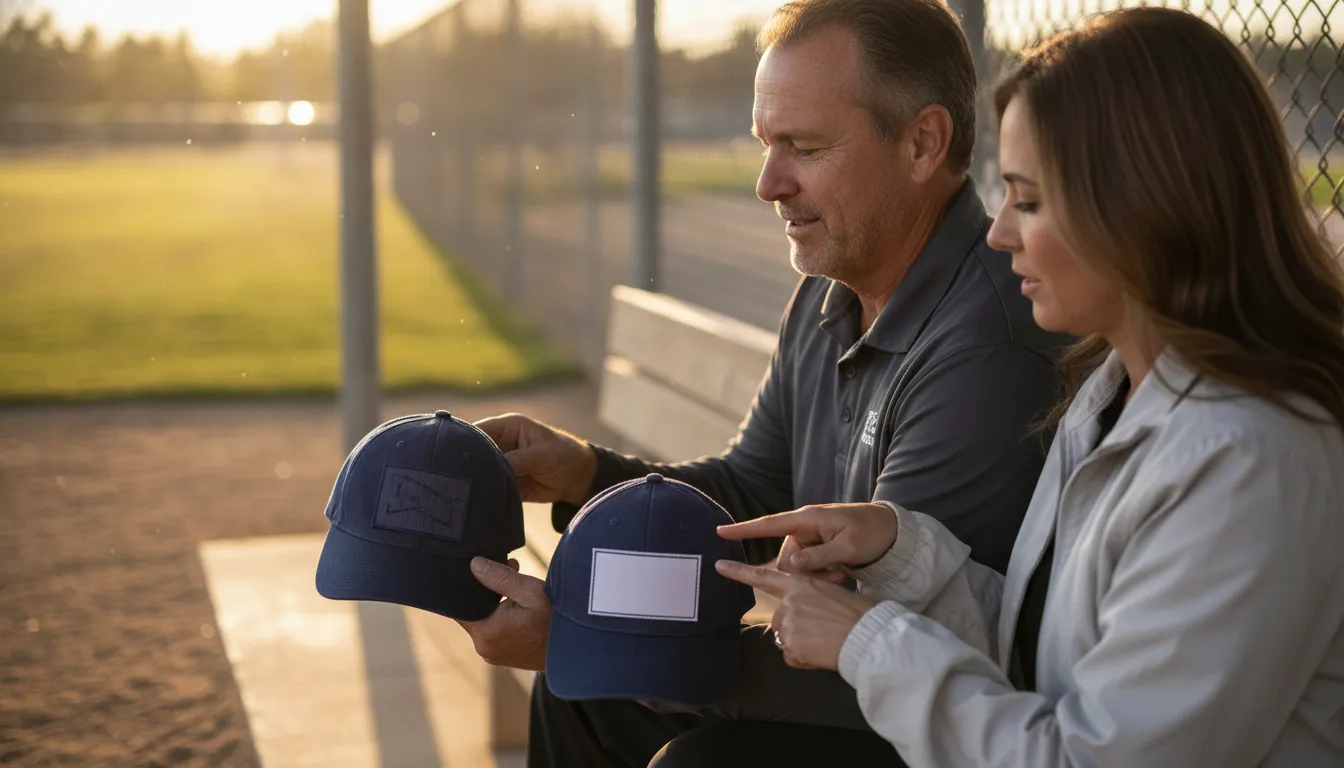
Embroidery also suits teams that want a low-profile finish. The decoration becomes part of the cap's front panel, which can create a neat, uniform appearance for coaches, players, and staff. That visual continuity matters when the same identity needs to carry across game-day headwear, practice gear, and other team apparel. It is not a promise that every embroidered design will look identical on every fabric, so the logo, thread colors, placement, and cap material should be reviewed together.
Cap compatibility is another practical consideration. Uniforms Express lists Richardson hats with front embroidery across Flexfit, mesh-back, cotton-twill, stretch-woven, and snapback models. Richardson Custom Express options also include front embroidery, with select customization for details such as buttons and eyelets. You can review the available Richardson team hats while comparing fit, crown structure, and the space available for your mark.
Choose embroidery when the priority is precise lettering, a clean team identity, and decoration that complements the cap rather than becoming the focal texture. Before ordering, confirm that the artwork has enough space, the chosen crown supports the intended placement, and the proof reflects the exact colors and proportions your team expects.
When Are Patches the Better Design Choice?
Patches can be the stronger visual choice when a team wants a bold, tactile emblem, a retro-inspired look, or clear separation between the design and the cap fabric. They may suit simple mascot marks and large shapes especially well. The decision still depends on verified patch construction, attachment method, cap compatibility, and care expectations.
A patch creates a distinct layer on top of the hat. That separation can make the decoration feel more like a badge than part of the cap itself. It can work well for a vintage baseball identity, an oversized mascot, a camp or league emblem, or a design that benefits from a defined border. The raised surface also gives the logo a physical quality that direct stitching may not provide.
Choose patches for visual impact, not by default
Consider a patch when the artwork depends on a strong silhouette, contrasting edge, or dimensional feel. Broad shapes and simplified marks are often easier to recognize in this format than small details packed into a stitched field. A patch can also create stronger contrast against the crown when the team wants the decoration to read as a separate badge.
That look is not automatically the best fit for every cap. Think about how the patch will sit on curved fabric, whether its edges will remain flat, and how its weight affects the hat's appearance and comfort. Ask for a physical or detailed production sample when the finish is central to the team's identity. Confirm the attachment method rather than assuming that every patch is sewn, bonded, or reinforced in the same way.
Verify the construction before approving the design
Patch materials and attachment systems vary. A NIST profile describes one patch maker using leather, PVC, and fabric patches that are primarily hand-stitched. That is a specific business example, not a universal standard for patch hats.
One sportswear patent record on PubChem describes a different patch design using layered fabric and coating components, along with adhesive layers. Its abstract claims that particular design remained attached after 50 or more washes. Treat that as a claim about the described construction, not a promise that all patches will perform that way.
Before choosing this finish, ask who is producing it, how it is attached, what care instructions apply, and how repairs or replacements would be handled. If the answers are unclear, a bold appearance is not enough reason to commit. The right choice is the one whose construction matches the team's use, artwork, and expectations.
How Should Coaches Compare Fit, Care, and Order Timing?
Compare the whole hat, not just the decoration. The right choice depends on how the cap fits athletes, how its fabric and logo will be cared for, whether the roster may change, and when the team needs delivery. A clear proofing process and realistic production window can matter as much as the finish itself.
Start with the cap's intended use. A coach outfitting players for daily practices may prioritize a secure fit, breathable construction, and easy care. A team ordering sideline headwear may give more weight to logo placement, color coordination, and a consistent appearance across age groups. Ask whether athletes will wear the hats during active play, travel, fundraising events, or mostly around the facility. Those conditions help narrow the useful cap styles before you compare embroidery with patches.
Match the fit and fabric to the roster
Fit can be especially important when one order serves athletes with different preferences. Richardson options listed by Uniforms Express include Flexfit, mesh-back, cotton-twill, stretch-woven, and snapback models. A snapback offers adjustability, while a fitted or stretch option may create a more uniform look when sizing is accurate. Mesh and lighter constructions may suit warm-weather use, but the best selection still depends on the team's wear conditions and desired appearance.
Also review the cap's construction details, not only its front panel. Richardson Custom hats allow selection of the crown, button, eyelets, and visor. Select Richardson Custom Express options include button and eyelet choices, and one Flexfit option features piping. These details affect the finished identity of the hat, logo placement, and how easily the design works with the available surface. You can compare cap construction and Richardson team hats before approving artwork.
Plan care, proofing, and roster changes together
Ask for care guidance that matches the selected cap and decoration. Confirm whether the team should hand wash, spot clean, air dry, or avoid heat. Do not assume every fabric or attachment responds identically to washing. A simple care note can reduce avoidable wear, especially when hats move between players, coaches, and parents.
Roster changes deserve attention before production. Confirm quantities by size or adjustable style, identify replacement needs, and decide whether every hat uses the same logo placement. Review the proof for spelling, artwork scale, thread colors, and the relationship between the mark and the cap's seams. If a player name, number, or season detail may change, ask whether that element belongs on the hat at all.
For additional design context, review these high-quality custom baseball caps and the broader guide to durable custom team hats. The goal is not to select a label based on reputation alone. It is to confirm that the cap, decoration, care plan, and replacement approach work as one order.
Build in the production window
Order timing should begin with the first event where the hats must be ready, then work backward through artwork preparation, proof approval, production, shipping, and a small buffer. Uniforms Express lists Richardson Custom hats at 6-8 weeks and Custom Ultra options at 8-10 weeks. These are listed windows, not a reason to postpone proofing. Ask which option fits the deadline, confirm the current schedule, and leave room for roster or artwork corrections before approving the order.
A Practical Finish Checklist for Your Team Hat Order
For most team orders, the right finish follows the logo, cap, use conditions, and schedule rather than a universal winner. Compare embroidered team hats vs patches by reviewing how the mark should look, how the hat will be worn and cared for, and what your supplier can confirm before production.
- Define where and how the hats will be used.
Decide whether they are for daily practices, game-day uniforms, travel, fundraising, staff gifts, or a short-term event. Frequent wear and repeated cleaning make construction and care instructions especially important. A simple use case also helps you avoid choosing a decorative treatment that does not fit the team's routine.
Choose the cap before finalizing the decoration.
Review the crown shape, visor, closure, fabric, and fit your players prefer. A front logo must sit cleanly on the available panel, while a structured cap may present a different visual surface than a soft, unstructured style. Uniforms Express lists more than 15 hat styles in its broader range, so start with the cap profile that suits the team instead of treating the finish as a separate decision. The
team-uniform ordering guidance
can help organize those choices.
- Evaluate the artwork at the actual imprint size.
Check lettering, thin lines, small details, and the number of colors. Embroidery can be a practical choice for a clean, low-profile team mark, while a patch may be considered when a bold, tactile badge is central to the design. Ask for a production-ready proof and confirm that the mark remains legible without relying on details too small to reproduce well.
Select the finish and verify its construction.
Ask what is included, how the decoration is attached, and what care guidance applies. Do not assume every patch uses the same materials or attachment method, and do not treat general claims about one patch design as a guarantee for every product. If embroidery fits the artwork and cap, review
as part of the ordering process.
- Confirm quantities, sizes, and replacement needs.
Match the order to the current roster, coaches, and support staff, then allow for late additions or replacements where practical. Record the approved logo, cap style, finish, colors, and quantities so a future reorder has a clear reference rather than relying on memory.
- Confirm the proof and production schedule in writing.
Review every visible detail before approval, including placement, proportions, colors, and cap specifications. Ask for the current production window and work backward from the first practice, tournament, or team event. This matters because listed timing can vary by option. For example, the Richardson Custom range lists 6-8 weeks, while Custom Ultra options list 8-10 weeks.
Make the final decision against the team's priorities.
If logo clarity, a low-profile appearance, and direct branding lead, embroidery may be the better fit. If the visual goal is a distinct badge-like effect, investigate patch specifications carefully before committing. For a broader starting point, browse
and ask which available option best matches your artwork and order requirements.
Frequently Asked Questions
Which finish gives a team hat a cleaner, lower-profile look?
Direct embroidery usually creates a stitched design that follows the cap surface, so it suits teams seeking a streamlined appearance. A patch adds a separate layer with its own edge and texture, which can make a logo feel bolder or more dimensional.
Are embroidered team hats more durable than patches?
Neither finish is automatically more durable in every situation. Results depend on the hat fabric, stitch or attachment method, logo size, wear conditions, and care routine. Ask how the selected finish is constructed and consider whether the hat will be worn through practices, travel, and repeated washing.
How should the finish affect cap fit and sizing?
Choose the cap style and fit before judging the decoration. Flexfit, mesh-back, cotton-twill, stretch-woven, and snapback hats can feel different even when they carry the same logo. Check crown shape, closure or stretch, and visor preferences so the finish does not distract from a comfortable team-wide fit.
What care instructions should coaches give players?
Follow the care guidance for the specific hat and decoration rather than assuming every custom cap can be treated alike. Avoid unnecessary heat, harsh handling, and machine methods that can distort the crown or stress stitching and patch edges. Share the instructions with players before distribution.
How early should a team order custom hats?
Build in time for artwork review, cap selection, proof approval, quantities, roster changes, and production. Custom hat schedules vary by style and decoration, so confirm the current timeline before setting a uniform deadline. Ordering earlier also leaves more room to address fit concerns or replacement needs.
Choose the Finish That Fits Your Team
The right hat finish depends on your logo detail, preferred texture, cap style, and how your team will wear and care for the hats. Reviewing those choices together can make the order easier to plan and help you select a practical look for coaches, staff, and players. View custom baseball hats and request help choosing the right team-hat finish for your next team order.


Comments