


Best Custom Soccer Jersey Provider: A Coach’s Selection Guide

A jersey order that arrives late or looks different from the approved design can leave a coach scrambling just before the first match. Choosing the best custom soccer jersey provider means checking more than a design gallery: confirm how the supplier handles fit, decoration, proofs, production timing, and questions from your team.
What should a coach look for in the best custom soccer jersey provider?
A strong provider makes the whole order easier to manage, from the first design decisions through delivery. Compare the supplier’s product range, customization process, proofing steps, sizing support, communication, and timeline commitments. The best fit is the supplier whose process matches your roster, season deadline, and level of customization—not simply the one with the most dramatic mockup.
Start by clarifying what “best” means for this order. A club replacing one team’s jerseys may care most about a consistent look and simple reordering. A school outfitting several squads may need a clear way to keep colors, numbers, and names coordinated across multiple groups. A new team may need more guidance to turn an idea into an order-ready design.
Then ask the provider to explain its process in plain language. Who helps resolve design questions? What does the team review before production? How are sizes and quantities recorded? What date does the supplier use when discussing delivery, and what could affect that date? Specific answers are more useful than broad assurances.
Uniforms Express makes custom soccer uniforms and offers several decoration approaches across its sports apparel work, including sublimation, screen printing, heat press, embroidery, and tackle twill. Because the right method depends on the garment and artwork, ask which options apply to the specific soccer jersey you are considering. You can review the custom soccer uniform options and compare them with the details your team needs.
How can teams compare providers before requesting a quote?
Use the same checklist with every supplier so you can compare the substance of each offer. Ask about garment choices, artwork and proof review, the ordering workflow, sizing guidance, production timing, and support after submission. A written comparison helps coaches spot missing details early and choose a provider whose process is clear enough for the whole team to follow.
What to compare | Question to ask | What a useful answer should clarify |
Jersey options | Which jersey styles and customization choices are available for this order? | The actual garment choices and which decoration options apply to them. |
Artwork and proof | What design proof will we review, and what must be approved? | How the team checks colors, placement, names, numbers, and spelling before production. |
Roster and sizing | How should we submit sizes, quantities, and player details? | A defined format and a way to catch missing or inconsistent information. |
Timing | What date should we plan around, and when does the production timeline begin? | The start point, expected milestones, and any conditions that could affect delivery. |
Communication | Who should the coach contact if the roster or artwork changes? | A clear contact path and instructions for handling revisions or questions. |
Reorders | What information should we keep for a future order? | Whether artwork and order details can be referenced and what the team must resupply. |
Do not compare a detailed proposal with a vague promise as though they were equivalent. Ask each provider to identify what is included and what remains for your staff to do. For instance, a team may need to supply a finished logo file, confirm each player’s number, or approve a final proof. Make those responsibilities explicit before the order is submitted.
Look at the handoffs, too. A provider may offer a design tool, but the coach still needs to know who checks the submitted artwork and how the final proof is delivered. Ask whether feedback should come from one designated team contact, how many rounds of changes the process allows, and whether an alteration to the roster affects the approval or delivery schedule. These are practical workflow questions, not fine print to leave until the last day.
Check whether the supplier’s response addresses your actual order rather than a generic example. If the team has several age groups or squads, ask how separate rosters and designs will be distinguished. If you have a school or club color standard, explain how important a close match is and ask how the supplier handles it. A useful answer will identify the next step and information needed from you, rather than leave you guessing about what to send.
One coach can keep the comparison manageable by recording each answer in a shared decision sheet. Add the date of the conversation and the person who supplied the information. Then discuss any tradeoffs with the athletic director or team administrator before the team commits. This simple record helps prevent a choice based on one attractive feature while overlooking a requirement that matters more once ordering begins.
Also consider whether the supplier’s catalog supports the complete look you have planned. If the team needs coordinated tops and other uniform pieces, ask whether those items can be selected together and how color matching is handled. Uniforms Express lists soccer uniforms for teams; reviewing the product path can help you frame questions about the specific pieces in your order.
Which design and decoration details should teams settle first?
Resolve the core design choices before collecting the final order details. Decide on the base style, team colors, crest placement, player names or numbers, and any additional marks. Then ask the provider to show how those choices will appear on the selected garment. This sequence reduces avoidable revisions and gives the coach one clear design to circulate for approval.
Build a short design brief before opening a configurator or contacting a supplier. Include the team’s preferred colors, any existing crest or artwork, the intended placement of names and numbers, and whether every player needs the same layout. If you are starting from a reference image, say which parts are essential and which can change. A reference helps explain the goal; it does not replace a production-ready proof.
- Color:
List the primary and secondary colors and identify any existing team standard you need to match.
- Artwork:
Gather the current crest and any other approved graphic files. Confirm that the team has permission to use them.
- Names and numbers:
Decide whether they are required, where they belong, and who will verify spelling and numbering.
- Decoration:
Ask what methods suit the chosen garment and design. Uniforms Express offers decoration methods such as sublimation, screen printing, heat press, embroidery, and tackle twill; options vary by product.
- Approval:
Choose one person to consolidate feedback and provide the team’s final sign-off.
Keep the approval review practical. Check the front, back, and any sleeve or side placement shown. Read every name and number individually, inspect the color relationships, and confirm that the crest is the intended version. Ask what happens if you identify an error or request a change. The provider should explain how revisions are handled before the order moves forward.

If your team wants to explore layouts before finalizing a brief, the online uniform builder can be a useful place to organize visual ideas. Treat a preview as a design aid, not a substitute for confirming the order details and approving the supplier’s final proof.
How should coaches collect sizes, quantities, and player details?
One organized roster is safer than a stream of individual messages. Set a deadline for players or families to provide the required details, then have one team administrator check the entries before sending them to the supplier. Confirm the provider’s size chart and ordering format first, because guessing from a past jersey or another brand can lead to a poor fit.
Build a roster sheet with one row per player and only the fields the provider requests. Typical fields may include player name, jersey size, quantity, and requested number or name personalization. Keep a separate notes column for questions, but do not let unconfirmed preferences turn into production instructions. Mark any undecided entry clearly and resolve it before the team approves the order.
Get the supplier’s current sizing information for the selected garment.
Tell players how and when to check measurements, using the chart’s own instructions.
Collect each player’s requested size and personalization through one form or spreadsheet.
Check for blank fields, duplicate numbers, spelling differences, and quantities that do not match the roster.
Have a second person review the final list, then save the approved version with the design proof.
Uniforms Express provides team uniform sizing charts that can help coaches direct families to the relevant reference. The coach should still verify that the chart corresponds to the garment being ordered, and should ask the provider when an unusual fit question remains. A size chart is a planning aid, not a guarantee that every player will prefer the same fit.
Keep the records together after submission. Save the final roster, proof, order confirmation, and the name of the person who approved each. That file helps answer questions during production and gives the team a cleaner starting point for future replacements. For teams planning a broader order, reviewing how complete uniform packages are presented may also prompt useful questions about coordinating multiple pieces, though the final package details should be confirmed for soccer.
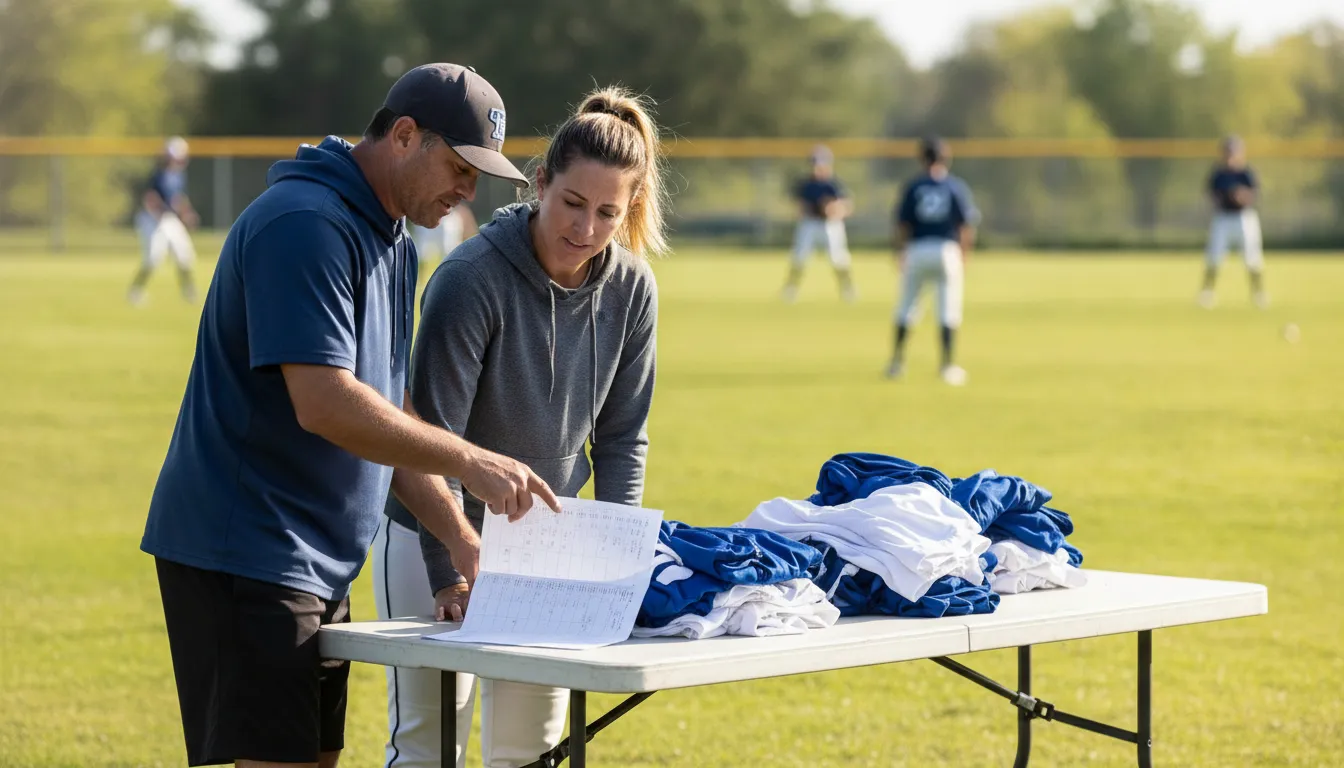
Assign one person to own the roster and one person to check it, even if both are coaches or administrators. Separating entry from review makes it easier to catch a typo, a repeated number, or an outdated size before the information is sent. Keep a clear “final” version and date it. When a player joins or leaves, update the record rather than forwarding a message that could be mistaken for the approved list.
For orders with personalization, confirm the exact convention the team wants to use. Some teams use surnames, some use given names, and some leave names off entirely. Settle punctuation, capitalization, and number assignment before approving artwork. If a jersey is intended for a goalkeeper or another role with a different design requirement, identify that need early and ask whether it changes the available garment or decoration choices. Avoid assuming that a standard field-player option automatically covers every role.
Finally, decide who will receive and inspect the shipment. That person should know the expected delivery date, the order contents, and the provider’s contact path if something appears inconsistent with the approved records. Having a named receiver makes it more likely that questions are raised promptly and routed with the proof and roster available.
How can you assess a provider’s timeline without guessing?
Ask for timing in stages instead of relying on a single general estimate. Clarify what date starts the clock, whether artwork approval and complete roster details are required first, and what happens if the team changes its design or quantities. Then compare the stated schedule with your first match, not just the date you hope to place the order.
Work backward from the date uniforms must be in hand. Allow time for roster collection, design decisions, proof review, corrections, and delivery. Build a buffer for the ordinary delays that can come from incomplete information or late approvals. The precise schedule depends on the order and supplier, so get the current timing for your specific products and ask whether rush options are available if the calendar is tight.
Uniforms Express describes custom uniforms as potentially game-ready in as little as two weeks, but timing is order-dependent and should be confirmed for the team’s products and circumstances. Do not treat a general turnaround statement as a promise for every design, quantity, or delivery date. Ask for the expected timeline, what it assumes, and how rush production is handled and priced before making a commitment.
When a supplier gives an estimated timeline, ask whether it begins after the team approves the proof, after all sizes and quantities are confirmed, or at another defined point. Ask which events could change the schedule and how the provider will notify your contact if a milestone moves. Record the answer alongside the first-match date. A timeline is only useful if your staff knows what actions must happen on time to keep the order moving.
Make the schedule visible to the people who control approvals. Give the design reviewer and roster manager their own deadlines, then set an earlier internal cutoff than the supplier’s final due date. This leaves a little room to resolve missing details without forcing the team to approve a proof it has not checked carefully. If your team has a fixed event, tell the supplier that date at the start of the conversation and ask for a realistic assessment before you select a product.
A city recreation listing offers a modest example of why teams should clarify exactly what a uniform-related program includes: Dunwoody’s adaptive soccer event listing says the program provides a soccer ball and jersey. That is a program detail, not a supplier comparison or a production standard; see the city’s adaptive soccer listing for its stated details. For your own order, confirm garment specifications and delivery directly with the provider.

What should be in your final provider decision?
Choose the provider whose written answers address your team’s actual needs and whose ordering steps you can manage. A polished design alone does not establish that sizes, decoration, delivery, and communication are covered. Before you commit, review the complete order with the person who will own the process, then resolve every open question in writing.
To keep budget comparisons useful without relying on outdated price examples, define the same scope before asking for quotes. List the number of jerseys, the design and decoration requirements, any names or numbers, the selected garment, and the delivery destination. Ask each supplier to state which requested elements are included and which are optional or billed separately. The purpose is to compare like with like, not to force a team into the lowest initial figure.
Ask how a roster change affects the quote before approval and whether adding or replacing an item later follows a different process. Do not assume a reorder will have identical terms: confirm that directly when the time comes. If a provider discusses a discount or special offer, ask what conditions apply and whether they affect the exact products and quantities you need. Put any applicable terms in the written quote so the coach and administrator are working from the same information.
Use this final check before submitting:
The selected jersey and related items are identified clearly.
Colors, crest, decoration, placement, and any personalization are shown on the proof.
The roster, sizes, quantities, names, and numbers have been checked against the team list.
The coach knows what approval is required and who is authorized to provide it.
The provider has explained the timeline, its starting conditions, and any rush option or associated charge that applies.
The team knows how to contact the provider about an issue or change.
The final design and roster files are saved for reference.
Uniforms Express has an overview of its company and experience for buyers who want to learn more about the supplier. You can also review its team uniform guidance as you prepare questions. Use those resources alongside a direct discussion of your team’s particular jersey order, timeline, and customization needs.
Frequently asked questions
These answers cover common decisions teams face when comparing jersey providers. Confirm product-specific details with the supplier before submitting an order, especially for sizing, decoration options, production timing, and any charges tied to special requests.
How do we choose between different custom soccer jersey providers?
Compare the same details with each supplier: garment options, available decoration, proof and revision process, sizing support, delivery timing, and communication. Request clear answers in writing, then choose the provider whose process fits your roster and season schedule rather than choosing on a mockup alone.
How should players choose jersey sizes?
Use the current size chart for the exact garment under consideration and follow its measurement instructions. Collect each player’s choice in one roster, check for missing entries, and ask the supplier about uncertain fit questions. Avoid assuming that the same size will fit identically across different styles or brands.
Which decoration method should our team select?
Start with the artwork, jersey, and look you want, then ask the provider which decoration methods are suitable for that product. Options can include sublimation, screen printing, heat press, embroidery, or tackle twill, depending on the garment and design. Review the final proof to confirm placement and appearance before approval.
How long does a custom soccer jersey order take?
Timing varies by product, order details, approval timing, and supplier capacity. Ask when the production clock starts, what the estimate assumes, and when the order is expected to arrive. If the season is close, ask whether a rush option is available for your specific order and what it costs.
How should we plan our uniform budget?
Since prices change by product and order details, request a current written quote rather than relying on an old price or a broad estimate. Ask which items, decoration, personalization, shipping, and potential rush charges are included. Compare quotes using the same scope so you can see what the team is actually buying.
What should we save after placing the order?
Keep the approved proof, final roster, quote, order confirmation, timeline details, and supplier contact information together. These records make it easier to resolve questions about the current order and provide a consistent reference if the team needs a reorder later.
A reliable jersey order starts with a clear design, a verified roster, and a provider willing to explain the process before production begins. Confirm the details that matter to your team, approve the final proof carefully, and keep the order records where future coaches can find them.
Comments