


Custom Team Socks: A Coach's Ordering Guide

A uniform can look complete on paper and still feel unfinished when one small detail clashes on game day. Custom team socks deserve an early place in the order plan, not a last-minute guess after jersey colors and pants are already set. Coaches can make better decisions by confirming who needs socks, what the team wants them to look like, and how they fit into the full uniform.
What should a coach decide before ordering custom team socks?
Start by defining the role the socks play in the team uniform: visible color, coordination with pants and stirrups, comfort expectations, and who will wear them. Then confirm the roster, size information, season deadline, and approval process. These decisions turn a broad idea into questions a supplier can answer clearly before the order is finalized.
Before discussing designs, decide whether socks are required for every player or only for selected groups. A baseball program may have varsity, junior varsity, freshman, or travel rosters with different uniform needs. A school might also have separate home and away looks, while a club may want one consistent color across all teams. None of these choices is automatic; identify what applies to your program.
Write down the job the socks need to do. Are they meant to provide a coordinated visible color above the shoe? Do players wear them as part of a particular pant or stirrup combination? Are matching socks needed for every player, or does the coach want a primary option and a backup? Put the answer in the order brief so that the supplier can help you evaluate appropriate styles and available customization.
Next, settle who has decision authority. In many team orders, a coach gathers preferences, an athletic director or administrator approves the purchase, and a parent or team manager collects sizes. Name one person to consolidate feedback and submit the final approval. If several people are sending separate color requests, details can drift and the final order may not match the approved design.
Look at socks in the context of the complete kit. Compare them with the team's pants, jersey, belt, and any stirrup or undersock arrangement. Uniforms Express has a baseball accessories page that can help you consider how socks fit among other baseball components. For the broader uniform order, review the custom baseball uniform options and decide whether the sock choice needs to coordinate with one set or multiple looks.
How can socks coordinate with the rest of the uniform?
Choose the sock color and visual treatment after the main uniform palette is established. Compare the actual colors of the jersey, pants, belt, and any visible undersock or stirrup—not just color names on a screen. Ask the supplier what styles and customization choices are currently available, and confirm how the sock will look when worn with the team's full uniform.
Color names can be interpreted differently across materials and screens. A navy on a jersey may not appear identical to a navy on a sock, even when both use the same name. If exact matching matters, ask about available color references or physical samples and how color matching is handled. Do not approve based on a verbal description alone when the distinction is important to your program.
Think about contrast and visibility. A sock that blends into pants may create a quiet, uniform look; a contrasting color can make the lower part of the uniform more noticeable. Neither approach is universally better. The right choice depends on team identity, the rest of the design, league or school requirements, and the look the coach wants athletes to present together.
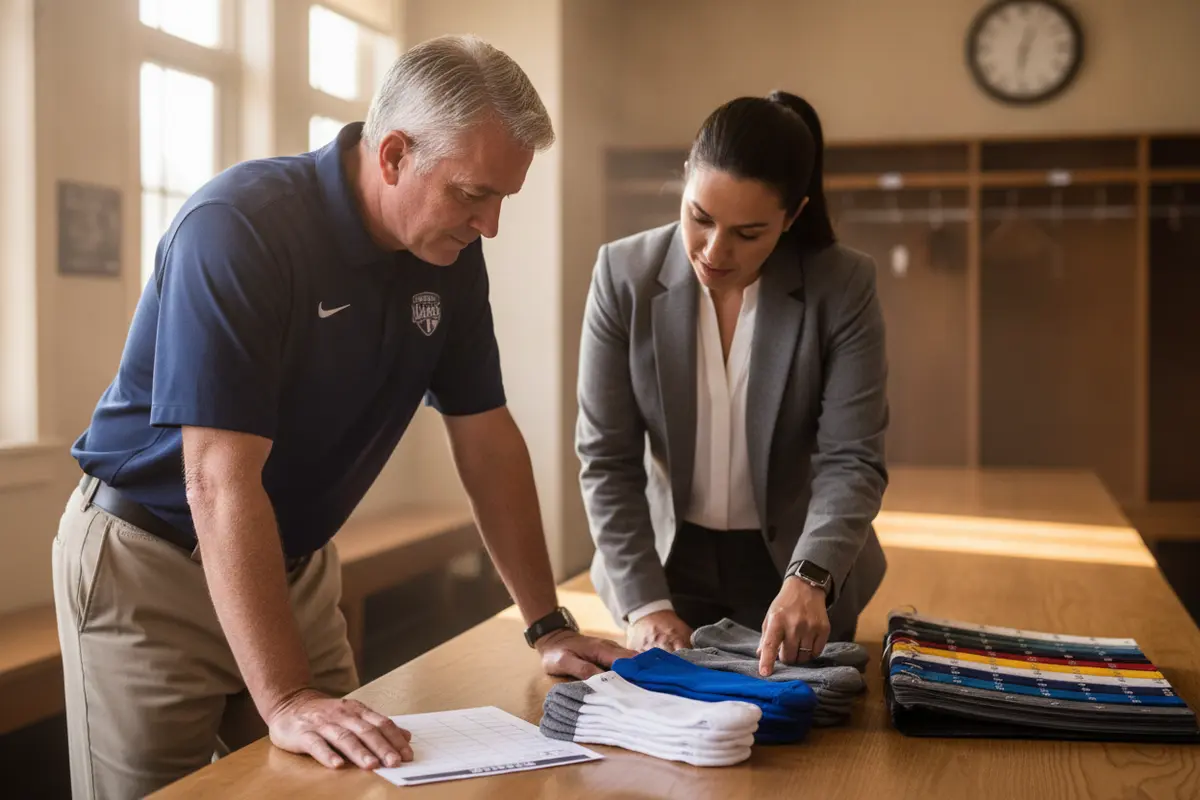
For teams with more than one uniform, make a small coordination chart. List each jersey and pant combination, then note which sock color works with each one. This can reveal whether one choice covers every game-day combination or whether the team needs to consider more than one option. Confirm whether the same sock is intended for home and away appearances before submitting quantities.
Use a design reference that is easy for decision-makers to review. A simple lineup of the jersey, pants, belt, and sock colors can be more useful than a long description. Uniforms Express provides a uniform design resource; ask whether it supports the particular sock details you are considering rather than assuming every product can be represented there. Keep the approved reference with your order notes.
Which sock choices should teams compare?
There is no single sock configuration that fits every roster or uniform. Compare options against your team's actual use, preferred appearance, fit needs, and order constraints. Use the table as a discussion guide, then confirm product-specific availability and specifications with the supplier before making a selection.
Decision area | Option or question to compare | What the team should confirm |
Color approach | One coordinated color or a contrasting accent | How the color looks with every jersey and pant combination |
Visible design | Simple solid look or a more distinctive treatment | Which customization choices are available for the sock style |
Fit and feel | Player preferences and intended game use | Size range, fit guidance, and any relevant product details |
Roster coverage | One order for all teams or separate team selections | Exact quantities, sizes, and delivery grouping |
Replacement planning | Order only current needs or plan for extras if permitted | Available ordering rules and how future reorders can be matched |
Approval process | Approve from a visual reference or sample, if offered | Final color, style, decoration, and order details in writing |
For appearance, start with the simplest design that supports the uniform rather than adding details just because they are possible. A strong team identity can come from consistent color and a clean overall presentation. If you are considering a logo, lettering, or another distinctive treatment on socks, ask the supplier specifically whether that treatment is offered for the product and how it affects the approval process. Do not assume that decoration methods used on jerseys are available on socks.
For fit, gather player feedback without treating one athlete's preference as a universal standard. Sock sizing can relate to shoe size or other product-specific guidance, so use the supplier's current size information. Discuss any fit concerns early, especially if the roster includes a wide range of ages or sizes. The Uniforms Express sizing charts may assist with team apparel planning; confirm whether the relevant chart covers the sock product you are ordering.
Uniforms Express's uniform planning resource offers broader context for thinking through team apparel. For socks, however, make the comparison specific: what is available, how it fits, what the design proof shows, and whether it aligns with the whole kit. Written confirmation is more valuable than relying on assumptions based on another garment.
How should you collect sizes and quantities?
Build the quantity plan from a current roster, not last season's list or an estimate from memory. Collect each player's name, team level, requested size, and whether the player needs one or multiple pairs if the supplier permits that order. Separate current players from likely additions, and identify coaches or staff only if they are intended to receive the same item.
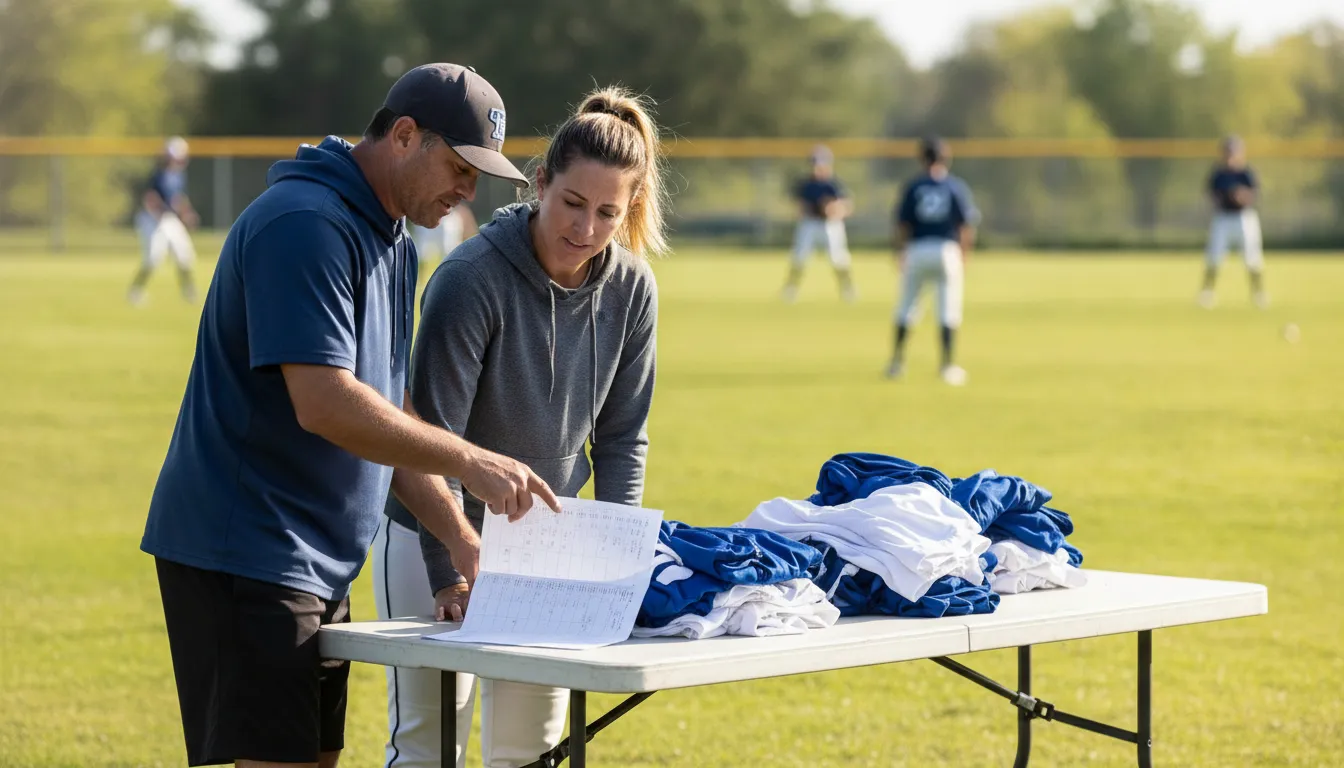
Use one controlled roster sheet. Useful columns include player name, team, sock size, quantity, confirmation status, and notes about unresolved fit questions. Protect the sheet as you would other team information, and limit edits to the people coordinating the order. Ask families or players to confirm their own information by a stated date, then have one person review missing fields before the order is sent.
Do not infer sock size from jersey or pant size. These are different products and may use different sizing guidance. Share the supplier's current sock sizing instructions with the roster and give players a clear way to ask questions. If the size chart does not resolve a fit concern, collect the question and get a specific answer before approving the quantities.
Next, reconcile the roster against the final team list. Check duplicate names, late additions, players assigned to the wrong level, and quantities that do not match the plan. If the program orders multiple uniform looks, make sure the sock count reflects the actual need for each selected option. Confirm how the supplier expects sizes and quantities to be submitted, since order formats and product availability can vary.
Before approval, save a dated copy of the roster used for the order. If a coach later asks why a player was missed or why a quantity was selected, the team can trace the decision to a confirmed roster rather than reconstruct it from messages. A clean record also makes future reorders easier because it separates the last order's facts from today's roster changes.
What should you ask about customization and construction?
Ask focused questions instead of assuming every sock can be customized in the same way as a jersey. Confirm the specific style, available colors, any offered design or decoration methods, sizing details, and how the product is approved. Then ask what the final proof or order confirmation will display, so the team can verify the exact choices before authorizing production.
Uniform manufacturers may offer different options across product categories. The fact that a supplier can provide tackle-twill, sublimation, embroidery, or other decoration on some apparel does not establish that the same method is available for socks. Request a product-specific answer. If a design includes a logo or lettering, provide the current approved artwork and ask what file format or artwork preparation is needed.
Decide how much customization is necessary. A team may prefer color coordination and a straightforward appearance, while another may want a more distinctive visual element. Discuss whether the desired treatment is feasible for the sock, whether it changes the available product choices, and what the supplier needs to show on a proof. Keep the design readable at the scale and location that the supplier confirms, not just on a large screen mockup.
Review the proof as a production document. Check spelling, logo orientation if applicable, color descriptions, selected style, quantities, sizes, and team name. Compare the sock in the proof with the rest of the approved uniform. If the proof omits a detail you need to verify, request clarification in writing before approval. Save the final approved version and the supplier's order confirmation in the same team folder.
Uniforms Express has a baseball uniform package page and separate custom baseball jersey information. These can help organize the wider apparel conversation, but do not assume that a package automatically includes the sock style or customization you want. Ask what is included in the specific order and request a clear list of components.
When should you place the sock order?
Set the target arrival date first, then work backward with the supplier to establish the necessary decision, approval, and ordering dates. Turnaround depends on the product and order details, so request a current estimate rather than relying on a general claim or a past order. Build time for roster collection, design review, corrections, and delivery to the team before the first use.
Start earlier when the order has unresolved choices. A team still deciding between colors, checking sizes, or collecting artwork is not ready to count only production days. Every pending approval can affect the schedule. Ask the supplier to identify which milestones matter, when the team must provide final information, and whether the estimated date assumes that proofs are approved promptly.
Keep a simple timeline with four checkpoints: roster deadline, design and product confirmation, final approval, and requested arrival. Assign an owner to each checkpoint. If the order includes socks alongside jerseys, pants, hats, or other pieces, ask whether items will be produced or shipped together and how that affects the plan. Do not assume all components share the same lead time.
If the season is close, communicate the real deadline immediately and ask what options are feasible for the exact order. Rush turnaround and pricing can vary; do not assume that an expedited option is available or that it carries no additional cost. Uniforms Express can discuss the order and timing through its team inquiry page. Share the roster size, product details, and required arrival date so the response can address the actual request.
One relevant reference point: a Connecticut state procurement catalog listing custom baseball and softball uniform catalogs also lists athletic socks among sports apparel categories. That is an example of socks being considered alongside other team apparel in a purchasing context; it does not specify the product, fit, or lead time for your order. See the state catalog listing, then confirm your own product details directly with the supplier.
How can a team make future reorders easier?
Record the details that a future coach or manager will need: selected product and style, size breakdown, color references, approved artwork, order date, and any supplier confirmation about the design. Include the final proof and an image or sample reference when available. A record is useful only if it distinguishes confirmed information from ideas that were discussed but never ordered.
Save the roster separately from the design specification. The roster will change, but the design may remain the same. When a new player joins, use current size guidance and confirm product availability instead of assuming that the previous size or style is still suitable. Reorders can also be affected by product changes, so ask whether the original option remains available and whether color matching can be confirmed.
Keep a short change log: what changed, who approved it, and when. This is especially valuable when the team adds a new uniform combination or updates its logo. If socks are part of a larger baseball order, cross-reference the team's baseball pants, custom baseball hats, and other approved items. The aim is not to force every product into one order; it is to make the team's intended look easy to reproduce.
For established programs, consider naming a uniform coordinator and giving that person access to the approved files and supplier contact history. A coach should not have to search old email threads to find a size list or a color decision. Uniforms Express shares its company background for teams that want to learn more about the supplier, while the college baseball program information may be relevant to college-level buyers reviewing program needs.
What should you confirm before approving the order?
Pause before giving final approval and compare the order summary against the roster and the team's intended uniform look. Confirm every sock style, size, quantity, color, and any customization detail, along with the requested delivery date. Resolve missing information before approval, and retain the final proof and written confirmation so the team has one reliable record of what was ordered.
- Roster:
Are all intended players included, and are sizes based on current product guidance?
- Quantities:
Do the counts match the final roster and any approved extra-pair plan?
- Design:
Are the colors, style, and any approved decorative details shown correctly?
- Coordination:
Does the sock choice work with each jersey and pant combination the team will wear?
- Order scope:
Is it clear which products are included and which are separate?
- Timing:
Has the supplier confirmed the expected schedule against the team's actual deadline?
- Documentation:
Does the team have the final proof, order summary, and contact record?
Have a second person review the summary when possible. The reviewer can compare sizes and quantities with the roster while the coach checks color and design. This division of attention often catches simple errors that are easy to miss when one person is reviewing the entire order at once. Make corrections before approval, rather than relying on a later message to change an already authorized order.
Frequently asked questions
These practical answers cover the decisions that most often remain open during a team sock order. Product details and availability can vary, so use the questions to guide a conversation with the supplier and get order-specific information before approval.
How do we choose custom team socks for players with different fit preferences?
Collect preferences and size information from the players, then compare them with the supplier's current size guidance for the specific sock. Do not infer sock size from a jersey or pant size. If an athlete has a fit concern that the chart does not answer, ask the supplier before finalizing the roster.
Should we order one sock color for every uniform?
One color can simplify coordination, but it may not be the best fit for every uniform combination. Lay out the team's home and away choices and compare the socks with the actual pants, jerseys, belts, and any other visible components. Confirm whether the team wants one consistent look or separate options for different uniforms.
Can we add a team logo or lettering to custom team socks?
Ask the supplier which customization options are available for the particular sock style. Options used on jerseys or hats should not be assumed to apply to socks. If a treatment is available, provide approved artwork and review the product-specific proof, including color and placement, before authorizing the order.
How much time should we allow for a team sock order?
Ask for a current estimate based on the exact product, quantity, design, and delivery destination. Set the required arrival date first, then work backward to leave time for roster collection, artwork or color review, proof corrections, approval, and delivery. Do not rely on a general turnaround statement for a different product or order.
How should we plan a budget for custom team socks?
Request a current quote for the selected style, quantity, sizes, and any customization. Confirm what is included, whether other uniform components are separate, and whether the quote changes with requested options or timing. Since product choices and terms can vary, compare complete order details rather than evaluating an unclear per-item estimate.
Can socks be included in a complete baseball uniform order?
Ask the supplier to list which items are included in the proposed order or package. A page or discussion about complete uniforms does not by itself confirm that a particular sock style is included. Verify product, sizes, quantities, and any customization in the written order summary before approval.
With fit, color, roster quantities, and timing confirmed in writing, socks can support a cohesive team appearance without becoming a last-minute scramble. Build the decision into the uniform plan early, and keep the approved details available for the next order.
Comments