


Custom Baseball Uniforms for Travel Teams: A Season Planning Guide

A season can start badly before the first pitch: a player has the wrong number, a jersey proof was approved with an old logo, or the shipment arrives after the team needs it. Planning custom baseball uniforms for travel teams means managing a chain of decisions, not just picking colors. A single owner for the roster, clear proof review, and a delivery date confirmed for the actual order can prevent avoidable confusion.
What should a travel team decide before choosing uniforms?
Begin by defining the order and the people responsible for it. Write down which garments are needed, when the team needs them in hand, who approves the design, and who checks each player’s information. A shared plan lets the coach compare choices against the season calendar instead of making disconnected decisions as deadlines approach.
Start with the game-day requirement. Is the order for one jersey and one pair of pants per player, or does the team need alternate jerseys, coordinated hats, warm-ups, or staff apparel too? Divide the list into required items and optional additions. That distinction helps the team protect the core uniform decision if the roster changes or the available time becomes shorter than expected.
Next, identify the decision-maker and roster coordinator. They may be the same person on a small team, but the duties still need to be clear. The decision-maker gathers feedback about color, lettering, and layout, then sends one consolidated response. The roster coordinator collects names, numbers, sizes, and quantities, then checks them against the final team list. If multiple coaches send separate design notes or families submit changes through different channels, conflicting directions are more likely.
Collect the starting materials before requesting a design: team name, approved logo artwork, colors, player names if they will appear, jersey numbers, and the first game date. Confirm the team has permission to use any submitted mark. Also decide whether coaches and support staff need matching pieces and whether those items belong in the same order.
Review the custom baseball uniform and apparel options against this written list. It is a useful product path for identifying what the team wants to consider, but do not assume a particular package or garment includes every requested item. A complete brief makes the conversation more concrete: sport and team level, approximate quantity, garment list, artwork status, desired delivery date, and any open questions.
Finally, agree on a decision calendar. Give families a date to submit sizes, set a deadline for design feedback, and name the person who gives final approval. A team with a multi-squad program may also need one coordinator for each roster and a central person to keep color and logo decisions consistent. These simple roles prevent a late request from silently becoming the new instruction for everyone.
How can you build a design that is easy to recognize?
A clear design gives the team a consistent identity and keeps names and numbers easy to distinguish across the field. Choose a manageable color palette, set a visual priority for the team mark and player number, and review the entire uniform together. Every extra element should serve the look rather than compete with the information players and spectators need to see.
Decide what should stand out first. A team may want its name, city, mascot, or player number to lead the design. Once the priority is clear, give each element a defined location. Check the front and back, sleeves, and any contrasting panels as one system. A logo that looks balanced on a screen may feel too large or too detailed on a garment, so ask to review how it appears at the intended size and placement.
Keep legibility in view. Compare the number against its background, consider whether a name treatment is readable from a distance, and check that contrast remains adequate across the selected colors. If the artwork includes fine lines or several small details, ask the supplier whether those details will reproduce clearly using the proposed decoration method. Do not assume that every file can be used unchanged at every size.
Decoration affects appearance and construction choices. Uniforms Express offers methods including sublimation, screen printing, heat press, embroidery, and tackle twill. Ask how each method works with the chosen artwork, garment, and placement, then evaluate an actual proof rather than choosing by label alone. The company’s tackle twill and sublimation overview can help the team prepare questions, but the right selection depends on the specific design.
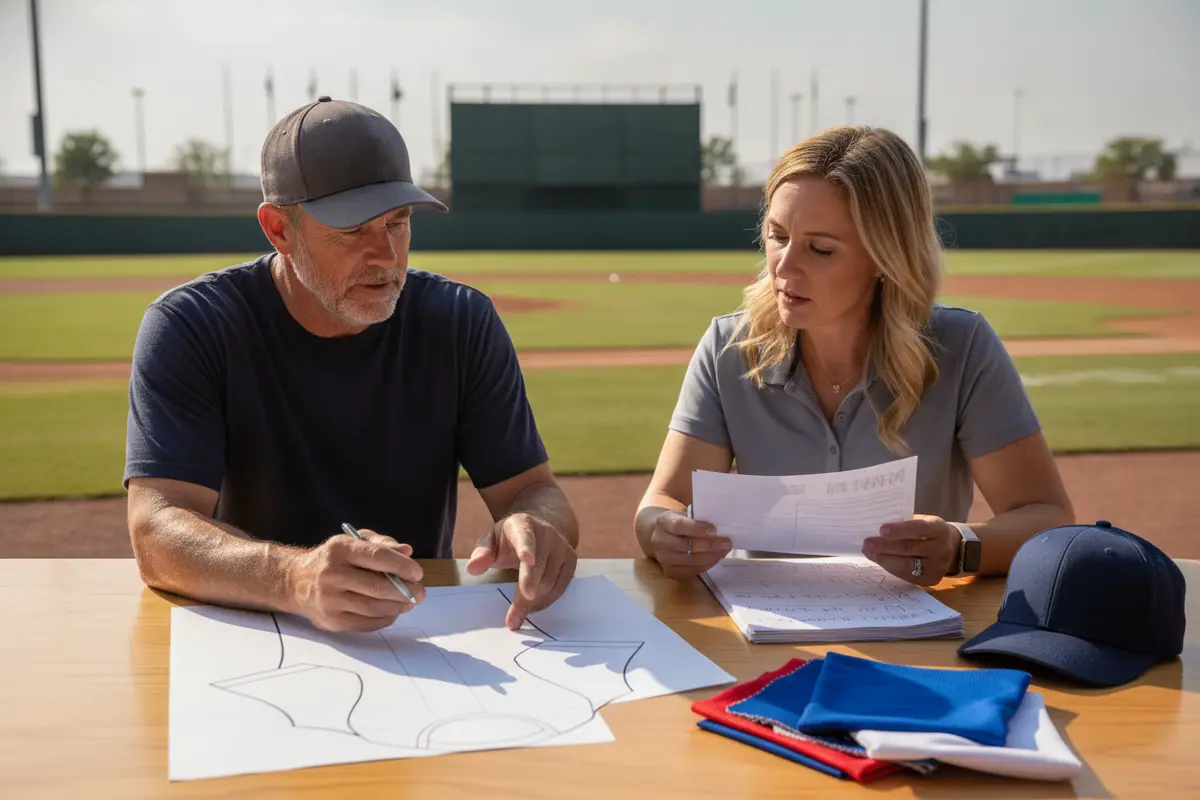
Proof review is a formal checkpoint, not a quick glance at the colors. Assign one person to check team name, logo, color placement, player name format, every number, and each garment view. Have a second person compare the proof against the approved roster. Record corrections in one message and request a revised proof when necessary. Once the responsible person approves the final version, preserve that approved copy so everyone refers to the same design.
Think about coordinated apparel as part of the identity, but keep it distinct from the game-uniform requirement. If the team is considering hats or jackets, compare their colors and logo treatment with the approved jersey. Relevant options include custom baseball hats and baseball jackets for teams. Confirm the design and garment details for each item rather than assuming a separate piece will match automatically.
Which uniform choices should a travel team compare?
Compare choices by what the team needs, how the design will appear, and what information the supplier needs to confirm the order. A table helps separate garment scope from decoration and schedule questions. Use it to capture decisions and unresolved points, then ask for a current, order-specific answer before committing to a design or delivery plan.
Decision | Options to compare | Question to settle |
Game-day scope | Jersey and pants; alternate top; optional apparel | Which pieces must be ready for the first game? |
Decoration | Sublimation, screen print, heat press, embroidery, or tackle twill | Which method suits the artwork, garment, and desired appearance? |
Design layout | Team name, logo, numbers, player names, sleeve details | Can every element be checked clearly on the full proof? |
Roster process | One roster owner; separate coordinators with central review | Who verifies names, numbers, sizes, and final quantity? |
Order plan | Separate items or a coordinated set | What exactly is included in the selected combination? |
Delivery | Standard schedule or a time-sensitive request | What date can be confirmed for this exact order and destination? |
Use the comparison to discuss trade-offs in practical terms. A simpler design may reduce the number of proof details to check, but do not assume that selecting a particular style or decoration automatically makes production faster. Ask what information is needed, when the complete order must be approved, and whether the requested combination is currently feasible. If the roster is incomplete, note what is missing and ask how an update could affect the schedule before submitting the order.
Teams deciding between a jersey-led order and a broader set can review the custom baseball jersey selection and the baseball uniform package options. Compare the actual garment list, personalization, and quantities rather than relying on the label “set” or “package.” For example, a coach can write down the jersey, pants, cap, and optional warm-up separately, then confirm which combination meets the team’s need.
For pants, verify the style and intended use with the supplier and review available choices at the custom baseball pants page. Ask whether the team should make any product decisions before the design proof is finalized. The goal is to resolve dependencies early: if a garment choice changes after artwork approval, confirm whether the proof or production plan also needs revision.
How should coaches collect sizes and verify the roster?
Use one roster file as the team’s source of truth. Record each player’s name, number, selected garment size, and any personalization exactly as it should appear. Set a family deadline, check the entries against the final roster, and ask a second person to review the completed list. Reliable information gives the supplier one consistent instruction set and helps the coach spot gaps before approval.
Give players the sizing information for the specific garment they are ordering. Fit preferences differ, and a size worn in another brand is not a reliable substitute for the supplier’s measurement guidance. Share the relevant team uniform sizing charts early enough for players or families to review them. Explain who should answer questions and when selections must be returned.
Keep the roster structured so that errors are visible. Useful columns include player name, number, jersey size, pants size, optional items, and a status such as confirmed or awaiting response. If different items have different size selections, do not compress them into one generic “size” field. Use a notes column for unresolved requests, but do not treat a note such as “probably medium” as a confirmed selection.
Before submission, work through a validation pass:
Match the number of roster entries to the expected player count and garment quantities.
Check spelling, capitalization, punctuation, and any special characters in names.
Verify each number and identify duplicates or requested number changes.
Confirm every required size using the supplier’s garment-specific guidance.
Separate coaches’ items and optional apparel from player game uniforms.
Identify any player or staff member whose information is still unconfirmed.
Save a dated final copy and have the decision-maker approve it before sending.
Agree on how the team will handle likely changes. A new player, a replacement garment, or a number change can affect the information already supplied. Ask the supplier what process applies and whether an update could alter timing, artwork, or order details. Do not send a replacement instruction through an informal side conversation and assume the whole order record has changed; ask for clear confirmation that the latest direction is on file.
For a program with several age groups or squads, use one template and one naming convention across rosters. Have each coach verify their players, then let a central coordinator check team colors, logo files, and required items across the program. This keeps each team’s player information separate while reducing avoidable inconsistencies in shared design elements.
Before the roster leaves the team, do a final handoff check. Confirm the file has a clear version date, the right team name, and no hidden or duplicate rows. Reconcile the total quantities against the garment list, not just the player count: a player may need more than one piece, and coaches may have separate items. Mark any optional order in a different column so it cannot be mistaken for a required uniform. The person submitting the order should compare the roster to the final proof and keep a copy of both records. If a detail on the proof differs from the roster, stop and resolve it before approval rather than choosing which version seems more likely. This last pass is especially useful when one coordinator collects information from families and another person places the order.
Set a simple change rule for after submission, too. Ask families to send updates only to the roster coordinator, who can check the change against the submitted version and forward a consolidated request to the supplier. The coordinator should then record the supplier’s confirmation and update the team copy. This creates a visible trail for number swaps, new players, and spelling corrections, and prevents the coach’s working document from drifting away from the instructions used for the order.
When should you place the order for the season?
Work backward from the day the team needs uniforms in hand, not only from the first game. The schedule must leave room for roster collection, design decisions, proof review, order confirmation, production, shipping, and an inspection on arrival. Since the exact timing depends on the order, confirm a current estimate for the selected products and complete information.
Start by writing down two dates: the first game and the date the uniforms should be delivered to the person who will inspect them. The second date should come first in the planning calculation. Then ask the supplier when the team needs to submit a complete, approved order to support that requested delivery date. This makes the critical deadline visible to the coach and families.
- Set the in-hand date.
Include time for the team to distribute and check the uniforms before the first game.
- Confirm the order scope.
List garments, quantities, decoration, and whether multiple teams are included.
- Collect roster details.
Give players a clear deadline for names, numbers, and sizes.
- Approve the proof.
Consolidate feedback and return one checked response.
- Confirm the schedule.
Ask for the timeline for the actual combination, quantities, and shipping destination.
- Inspect delivery.
Check quantities and personalization promptly, then report any concern through the supplier’s process.
Build time for decisions that the team controls. A late logo file, unconfirmed sizes, or several rounds of scattered proof comments can delay approval. To reduce that risk, agree on the design direction before the proof arrives, name the final approver, and give that person a date to return consolidated feedback. Keep families informed about the cutoff for roster changes rather than making exceptions without checking the order impact.
For example, if a team’s first game is on a Saturday, the uniform coordinator should first choose an earlier in-hand date that leaves time to distribute and inspect the order. The coordinator can then ask the supplier what date the complete roster, design approval, and order details must be finalized to support that delivery. Those dates become the working backward plan: roster cutoff, proof review, order approval, confirmed production and shipping, then team inspection. The precise spacing is order-specific, so the supplier’s estimate should set the actual milestones. If the family roster deadline falls after the supplier’s needed approval date, the coach has a clear choice to resolve early: move up the internal deadline, ask about handling a later addition separately, or reconsider optional items. This is more useful than simply writing “order early” on a calendar because it ties each team action to a delivery requirement.
Uniforms Express describes some custom orders as potentially game-ready in as little as two weeks. That is a qualified possibility, not a universal delivery promise. Product selection, quantities, decoration, roster readiness, proof approval, and shipping all matter. Ask whether the requested order can meet the team’s date and confirm any rush availability, timeline, and pricing directly for that specific order. Do not build the season plan around the shortest advertised possibility without confirmation.
Use the team uniform planning resources to prepare questions, then discuss the actual order details with the supplier. Keep the confirmed date and any conditions in the same place as the final roster and proof. If the requested date cannot be confirmed, the team can decide whether to adjust optional items, design scope, or its internal deadline before placing the order.
How can teams manage the order and prepare for future seasons?
Keep budget decisions, design records, and reorder information together. Request a quote based on a defined garment list, quantities, and decoration rather than comparing unlike orders. Separate required game pieces from optional apparel, and preserve the approved proof and roster so the team has a reliable record when it reviews the uniform program later.
Because prices vary by product and order details, this guide does not assign a per-player cost. Instead, make a comparison worksheet with one line for each requested garment and a place to note quantities, personalization, and any open question. Ask the supplier what is included in the proposed combination and whether there are order requirements the team should know about. Share a final per-player amount with families only after the order scope and quote are confirmed.
Some teams also look for local fundraising or sponsor support. As one specific example of how this can be framed, a Grove City, Ohio Little League sponsorship form identifies uniform and travel expenses for certain all-star teams among supported needs. That is an example, not a promise that sponsorship is available to every team. Check the rules and timing of any local program before including it in the order plan.
Preserve the records that make a future order easier to discuss: approved artwork, final colors, garment selections, decoration choices, roster format, and the supplier’s order communication. For a later season, verify that the product and design details are still available and check every new player’s information. Do not assume that a previous item, fit, or production schedule remains unchanged.
A design tool can help a group talk through visual choices. Teams can explore the Uniforms Express uniform builder as they consider a direction, then have the decision-maker confirm the final instructions and proof. Treat a preview as a planning aid, not as a substitute for checking the completed proof and roster against the actual order.
Frequently asked questions
How early should a travel team order its uniforms?
Start early enough to collect the roster, settle the design, approve the proof, and allow the confirmed production and shipping schedule to finish before the uniforms are needed in hand. Ask the supplier for timing on the exact order instead of relying on a general estimate, and leave room for review and delivery inspection.
How should players choose uniform sizes?
Use the supplier’s sizing guidance for the specific garment and ask players to follow its measurement instructions. Do not assume that a size in another brand will fit the same. Have one coordinator collect selections in a single roster and flag unconfirmed entries before the order is approved.
Which decoration method is best for a travel baseball uniform?
There is no single best choice for every design. Compare methods such as sublimation, screen printing, heat press, embroidery, and tackle twill based on the artwork, placement, garment, and desired appearance. Ask the supplier to review the specific design and check the full proof before approval.
Can a custom order be ready in two weeks?
Uniforms Express says some custom orders may be game-ready in as little as two weeks, but the schedule is not universal. Product selection, quantity, decoration, roster readiness, proof approval, and shipping can affect timing. Confirm availability, delivery, and any rush pricing for the specific order.
How can a team keep its uniform order within its budget?
Set priorities before choosing optional items, request a quote for a complete and consistent order, and compare the same garments and decoration scope. Keep hats, jackets, and other additions separate from required game pieces so the team can make clear decisions without relying on an unconfirmed per-player figure.
With one approved design, a verified roster, and a delivery date confirmed for the actual order, a travel team can make uniform decisions with fewer surprises and focus on getting ready for the season.
Comments