


Custom Cricket Uniforms: What Coaches Need to Know

A uniform order can become a season-long problem if the fit restricts movement, the colors are hard to reproduce, or the delivery date slips past the first match. Planning custom cricket uniforms starts with more than choosing a shirt design: coaches need to define how the team plays, what the competition requires, who will wear the kit, and what a supplier can actually produce.
What should a coach decide before ordering custom cricket uniforms?
Start by writing down the team’s use case, competition expectations, garment list, roster needs, design priorities, and required arrival date. This short planning brief helps a supplier assess whether it can meet the team’s cricket-specific requirements, prevents important details from being decided informally, and gives everyone a reference point when reviewing samples, artwork, sizing, and delivery information.
First, define who the kit is for and where it will be worn. A school team, adult club, recreational league, and touring side may have different expectations for appearance, durability, replacement garments, and coordination with existing gear. Note whether the order is for match play, practice, travel, or a combination. List every garment the team expects to use, rather than assuming that “uniform” means the same thing to each person. Ask whether the supplier can provide the specific cricket apparel and construction the team requires; do not treat experience with another sport as proof that every cricket item is available.
Next, identify the competition’s written requirements. Uniform color, player identification, sponsor marks, and other details can vary by league or event. The coach or administrator should consult the relevant competition organizer and confirm current requirements before final artwork approval. The International Cricket Council’s official site is a useful starting point for cricket governance information, but a local or school competition may have its own rules. Ask the organizer for the applicable document and confirm which version applies to your team.
Turn those needs into a one-page brief. Include the team name, age or adult group, competition, roster size, garment list, preferred colors, required marks, any existing uniform pieces that must match, and the date the complete order needs to be in hand. Identify one person who can approve the design and one person who can confirm the roster. This avoids conflicting direction from several well-meaning stakeholders. Before contacting suppliers, decide what would make the team pause or decline a proposal. Examples include a garment that does not meet competition requirements, a size range that excludes roster members, an unclear production schedule, or artwork that cannot reproduce the approved colors. Write these deal-breakers separately from preferences. That keeps a discussion focused on practical fit instead of allowing an attractive mockup to overshadow product or delivery questions. If the team has an existing kit, photograph it in natural light and note which features must continue, but use the photo as a reference rather than a precise color standard.
Finally, separate firm requirements from preferences. A competition rule or fixed event date is a requirement. A particular collar, accent, or optional warm-up item may be a preference. Labeling the difference helps suppliers propose workable alternatives without weakening the team’s actual needs. If you are comparing general custom team ordering approaches, Uniforms Express describes its broader team uniform process and product considerations; ask directly whether the specific cricket items in your brief fit its current offering.
Which cricket uniform pieces and fabric details should teams compare?
Compare garments by role and conditions, not by appearance alone. Ask what is available for match and practice use, how each piece is constructed, and whether the fabric and care instructions suit the team’s schedule. A clear item list and written specification make it easier to spot gaps, compare supplier answers, and avoid assuming that a shirt, trouser, or accessory is included when it is not.
Build the list from the players’ actual needs. Depending on the format and team, that might mean a match shirt and trousers, a practice top, socks, a cap, or additional layers for travel and cooler conditions. Do not assume that every supplier makes every item or that its products are designed specifically for cricket. Ask for the product name, available sizes, fabric information, construction details, and any limitations on color or decoration for each requested piece.
Discuss movement and comfort in practical terms. Players need to run, bend, throw, and field, so ask how the garment is intended to fit during those actions and whether the cut differs across sizes or styles. Request an appropriate size guide and ask whether the supplier can explain garment measurements rather than relying only on labels such as small or large. If sample garments are available, use them to evaluate fit and fabric before collecting the full roster’s sizes. A product photograph is useful for design review, but it cannot confirm hand feel, stretch, or the way a garment moves on a player.
Check care instructions before selecting a fabric or finish. The team should know how to wash and dry the pieces, whether colors need special care, and what the supplier recommends for decorated areas. If the players will use the kit frequently, ask about expected wear points and how the garment is constructed there. Avoid treating broad words such as “premium” or “performance” as a specification. Ask for details in writing and compare equivalent garments rather than comparing a detailed description on one proposal with a vague description on another. Teams should also check how the supplier defines a complete set. A quote may describe one upper garment while the coach expects trousers or accessories to be included. List the pieces individually and ask whether they are separate products, how each is sized, and whether they can be ordered together. If one item is unavailable, ask whether a substitute will differ in fabric, color, cut, or decoration. Make the decision based on confirmed product details, not assumptions created by a photograph or a broad product label.
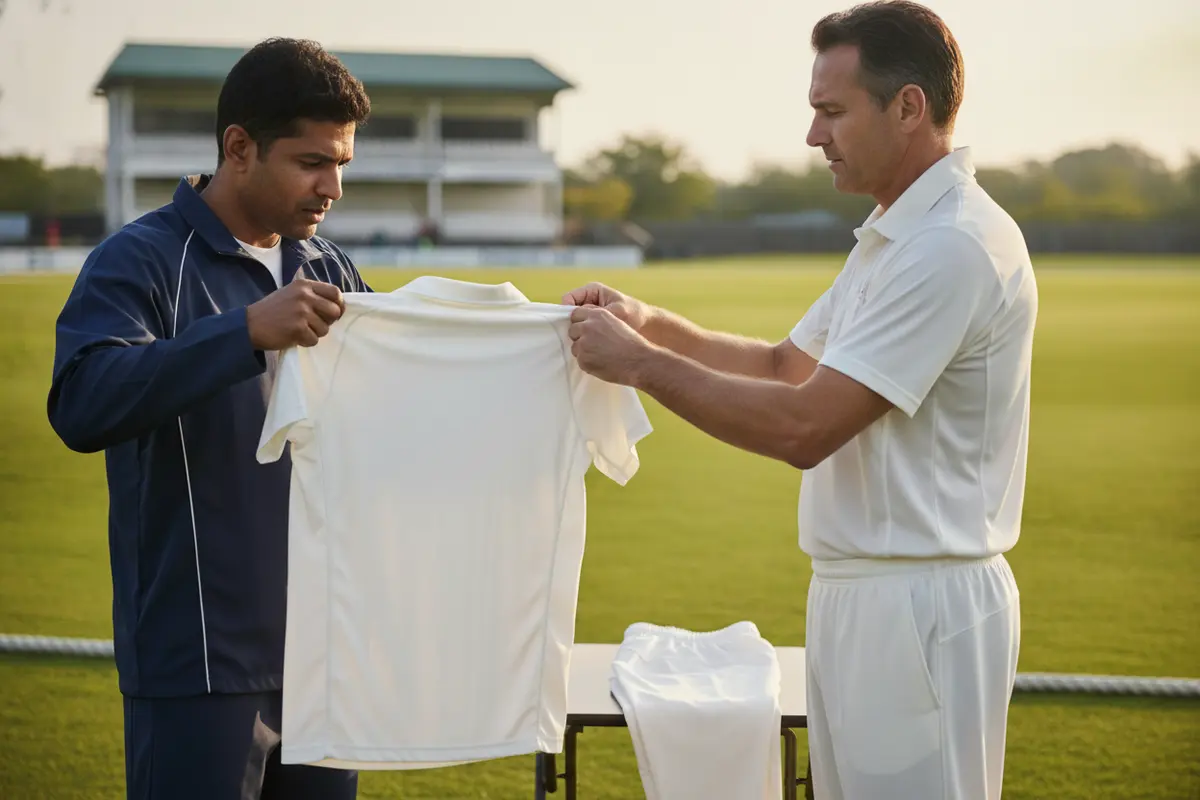
It can help to put the supplier discussion into a simple comparison sheet:
Decision area | What the team should specify | What to confirm with the supplier |
Garments | Match, practice, travel, and optional pieces | Which requested cricket items are currently available |
Fit and size | Player movement needs and size range | Measurement chart, sample access, and fit guidance |
Fabric and care | Use frequency and expected care routine | Material details, construction, and care instructions |
Design | Team colors, marks, and competition constraints | Color options, decoration limits, and proof process |
Order plan | Roster, approval owner, and needed-in-hand date | Production steps, schedule assumptions, and delivery terms |
For a quick reference to apparel measurement information, teams can review the Uniforms Express team uniform sizing charts, then ask whether the relevant chart applies to the exact cricket garment under consideration. Product availability and sizing can differ, so do not transfer measurements from a different item without confirmation.
How can a team choose fit, sizing, and quantities without roster confusion?
Use one approved size-collection method, a named roster owner, and a clear deadline. Collect the exact garment and size for every player, verify names and quantities, and resolve uncertain fits before placing the order. The goal is not merely to submit a total; it is to give the supplier a checked, unambiguous roster that matches the approved garment list.
Begin by confirming the size range and measurement method for each item. A player may wear a different size in a shirt and trouser, and one supplier’s size labels may not match another’s. Share the relevant chart with players and explain how measurements should be taken. If the supplier offers sample garments or fitting guidance, schedule that step early enough to address questions before the order is finalized. For youth teams, have the responsible parent or guardian confirm the player’s information through the team’s established process.
Collect sizes in a single roster file or form controlled by one team administrator. Useful fields include player name or roster identifier, garment, selected size, quantity, spelling of any name or number, and whether the entry has been confirmed. Keep personal information limited to what the order needs and follow the team’s own data-handling practices. Do not combine information from separate chat threads and assume it is complete; that is how duplicate entries, missed players, and mismatched sizes appear.
Before approval, run a count against the team list. Confirm the number of players, the quantity of each garment, the sizes, and any extras or replacement pieces. Ask the supplier how it handles late roster changes, substitutions, and additional units. Do not assume a change is possible after production begins. If an athlete’s size is uncertain, ask what options are available and what decision deadline applies. Document any accepted exception in the same order record.
Make the approval chain explicit. One person should verify roster accuracy, and the coach or designated administrator should approve the final design and order summary. Share the final version with the person who will receive the shipment so that arrival and package checks are covered. Teams ordering several garment types should review each line separately; a correct shirt count does not guarantee the trouser list is correct. Use a cutoff date for collecting sizes and send one reminder through the team’s usual communication channel. Mark each entry as confirmed, pending, or needing follow-up so the roster owner can see gaps before submitting it. When a player is unavailable for fitting, record how the size was chosen and who confirmed it. After the supplier returns an order summary, compare it against the team’s approved roster rather than simply accepting the supplier’s total. This second check catches transcription errors that can occur even when the original roster is accurate.
Uniforms Express has a general online uniform builder for exploring team design options. Confirm whether it supports the exact cricket products in your plan before relying on it for final specifications. For teams comparing a different sport as a reference for customization, the custom baseball jersey page shows an example of a product-specific ordering path, but it should not be treated as confirmation of cricket availability or fit.
Which design and decoration details should coaches approve?
Approve a complete written design, not just a color idea or an early mockup. The final review should cover the garment style, colors, marks, player identifiers, decoration method where applicable, placement, spelling, and any competition restrictions. Ask the supplier to show how the approved artwork will appear on the specific garment, then keep that approved proof with the roster and order summary.
Start with a restrained design brief. Record the team’s primary and secondary colors, the preferred visual style, and any existing items that the new pieces must coordinate with. Provide clean artwork for the team crest or sponsor marks if available, and identify who owns the right to authorize its use. Avoid sending several contradictory versions without naming the current one. A dated file name and a single source of truth make revisions easier to track.
Ask what decoration methods are available for the specific product and what each can reproduce. Uniforms Express lists methods across its custom team apparel work, including sublimation, screen printing, heat press, embroidery, and tackle twill. Availability and suitability depend on the garment and design, so ask the supplier to recommend a method and explain any limitations. The company’s guide to tackle twill and sublimation can help buyers frame questions about how decoration approaches differ; confirm the actual options for the cricket items being considered.
Review the proof at full size and inspect details that are easy to overlook: color order, logo proportions, number placement, name spelling, alignment, contrast, and whether every requested mark is present. Check the front and back, plus any sleeves or other decorated areas. If a competition sets restrictions, compare the proof against the current written rule rather than relying on memory. Ask whether colors shown on screen are a visual approximation and how the supplier confirms color choices for production.
Record the approved version and the approver. If changes are requested, ask for a revised proof and review it again; do not assume a verbal edit has been incorporated. Make no production commitment until the team has resolved outstanding questions about artwork, garment selection, sizing, and schedule. That disciplined sign-off protects both the team and the supplier from preventable misunderstandings. Consider the design at the scale players and spectators will see it. A small mark that looks clear on a computer screen may be difficult to read at a distance, while excessive detail may not reproduce well on every garment. Ask the supplier to identify any artwork that needs a different size, simplified treatment, or alternate placement. Confirm that the team has permission to use supplied logos and that the latest proof—not an earlier draft—is the one being approved. Keep feedback consolidated: one reviewer can gather comments, resolve conflicting preferences, and return a single list of requested changes.

How should coaches plan the order timeline and delivery?
Work backward from the first date the complete kit must be ready for use, leaving time for design review, roster checks, supplier confirmation, production, shipping, and a final inspection. Ask for the schedule in writing and clarify what event starts the clock, which approvals or information are still required, and how the supplier will communicate if a milestone changes.
First, set a real needed-in-hand date. A match date is not necessarily the order’s safe arrival date: the team may need time to sort packages, distribute garments, check sizes, and correct a problem. Add a practical buffer for those tasks and for the possibility that the roster or proof needs another review. Then tell the supplier the date and ask whether the entire requested order can be completed and delivered in time. Do not treat a general turnaround statement as a commitment to your specific order.
Request a schedule with milestones. It should distinguish the time needed to approve artwork, submit a complete roster, confirm the order, make the garments, and deliver them. Ask what could delay the schedule, what the supplier needs from the team to keep it moving, and whether partial shipments are possible if a team has a firm event. Get any rush option, timing, and associated conditions confirmed for the exact order; availability and charges may vary. Never assume a rush schedule or fee policy without written confirmation.
Assign an owner for each team task. The designer or coach can approve the proof; a roster coordinator can confirm sizes and names; an administrator can handle purchase authorization and delivery details. Agree on how questions will be answered and who can approve a change. Make sure the supplier has accurate delivery information and a contact who can receive the shipment. If several locations are involved, confirm whether the order will be consolidated or divided and what that means for the schedule. Ask how the supplier defines the estimated completion date and the delivery date; they are not necessarily the same milestone. Clarify whether a quoted schedule assumes that artwork, roster, and required approvals arrive together and are complete. The team can then identify its own dependencies and avoid holding up production while waiting for a missing number list or late design decision. Put the agreed milestones and the team’s responsible contacts into one shared order record. If a date changes, note the revised date and the reason so everyone is working from the same current plan.
When the shipment arrives, compare the contents against the final order record before distribution. Check garment types, quantities, sizes, names, numbers, and visible decoration. Photograph and document any issue promptly, then contact the supplier using the agreed process. Retain the approved proof and order confirmation so the team can describe the issue precisely. For future seasons, save the final product details, colors, and roster workflow as a reference, while rechecking current availability and requirements before reordering.
If the process raises questions about available products or order coordination, Uniforms Express offers a booking option for a conversation. Ask specifically about cricket items, applicable turnaround, and what information the team must provide before any schedule can be confirmed.
How can a team compare suppliers and manage the uniform budget?
Compare complete proposals on the same scope, not on a single garment or headline claim. Each proposal should identify the requested items, materials or product details, decoration, quantity, sizing assumptions, delivery terms, and any exclusions. Only then can a coach understand what is included, what remains uncertain, and which supplier’s plan best fits the team’s requirements and constraints.
Send each supplier the same written brief and ask for responses in the same format. Compare the garment list line by line, including optional pieces, player identifiers, and any requested extras. Clarify whether artwork setup, proof revisions, shipping, or other order components are included or handled separately. Uniforms Express does not publish stable article pricing here, and team quotes can depend on the products and order details; request a current written quote instead of relying on a number seen elsewhere.
Look beyond the initial amount when planning the team’s total commitment. Consider what happens if a player joins late, a garment needs replacement, a size must be changed, or the team reorders next season. Ask about the supplier’s policies and any minimum quantities or change deadlines that apply. These questions do not imply that every change will be available; they expose the conditions early enough for the team to make an informed decision.
Evaluate reliability using evidence that applies to the specific order. Ask how the supplier confirms an order, communicates schedule updates, handles an identified defect, and supports repeat orders. Ask what delivery timing can be committed to after the team has submitted complete information and approved the proof. Compare actual written terms rather than broad promises. The team should also decide how much uncertainty it can accept before selecting an option. Include communication in the comparison: ask who will answer order questions, how the team should report a discrepancy, and what information is needed to investigate it. A responsive process matters most when a deadline or roster issue arises, so test the process with concrete questions before choosing a supplier. Record the answers alongside product and schedule details. If a supplier cannot confirm a point yet, mark it as unresolved and ask when it can be answered rather than silently treating it as settled.
Keep a simple decision matrix. Weight what matters most—product suitability, fit, design flexibility, schedule confidence, service process, and overall cost—then record the evidence behind each rating. A low total is not useful if a needed garment is unavailable or the delivery plan cannot meet the event date. Likewise, a polished mockup does not settle questions about materials, sizing, or production. If you need a general point of contact to discuss a team order, Uniforms Express’s custom baseball uniform ordering page is a relevant team-uniform pathway; be clear that your inquiry is about cricket and confirm product fit before proceeding.
For a broader view of the company’s background and approach, read the Uniforms Express story. That information can provide context, but it does not replace a current product confirmation, quote, or written delivery commitment for a cricket order. Buyers can also review the Uniforms Express uniform challenge and ask which stated terms apply to their particular request.
Frequently asked questions
Before placing an order, confirm that the supplier can provide the exact cricket garments and decoration your team needs, and get size, schedule, and order terms in writing. These quick answers cover common planning questions, but competition rules and product availability should always be checked for the specific team and order.
How do we choose the right cricket uniform style?
Start with the format, competition rules, weather and use conditions, and the garments players need for match, practice, or travel. Compare the available cut, fabric, care instructions, and decoration options for the exact product. Ask the supplier to confirm cricket suitability and availability rather than assuming that a general team uniform can meet every sport-specific requirement.
How should we choose sizes for the whole team?
Use the supplier’s size chart for the exact garment, collect each player’s size through one controlled roster, and confirm the count before approval. Ask whether sample garments or fitting guidance are available. Keep separate shirt and trouser sizes where needed, and resolve uncertain fits before production. Do not assume labels match across suppliers or product styles.
Which decoration method should we choose?
Choose based on the garment, artwork, desired appearance, care needs, and the methods actually offered for that product. Ask the supplier to explain the available choices and show a proof on the selected item. Check placement, color, scale, name and number details, and any competition restrictions. A method used for another sport may not be available or suitable for the cricket item.
How early should we order custom cricket uniforms?
Begin early enough to complete design approval, size collection, order confirmation, production, shipping, and a team-level check before the first use. Ask the supplier for a written schedule tied to your exact order and needed-in-hand date. Confirm what information and approvals are required, and do not rely on a general turnaround estimate or an unconfirmed rush option.
How should a team set and compare its uniform budget?
Set the scope first: garment list, quantities, decoration, shipping, and any extra or replacement pieces. Ask suppliers for current written quotes covering the same scope, and compare exclusions, change policies, and delivery terms as well as the total. Prices and options can change, so confirm current details directly rather than using old examples as a quote.
A clear brief, a verified roster, and a written supplier confirmation give coaches a stronger basis for ordering custom cricket uniforms. Confirm product availability and competition requirements before approving the final design, then keep the proof, order details, and delivery plan together for the team.
Comments