


Custom League Uniforms: A Practical Guide for Team Buyers

A missing size, a duplicate number, or a late design change can turn a uniform order into a season-opening problem. Planning custom team uniforms as a coordinated program—not a collection of individual requests—helps coaches and league administrators protect the team identity while keeping roster details, approvals, and delivery expectations clear.
Begin with the decisions that shape the whole order: who is responsible, which teams and garments are included, what rules apply, and when the finished uniforms must be ready to distribute. Then set a process for design review, size collection, and final approval. This guide focuses on those decisions so a coach, athletic director, or team manager can prepare a complete request and compare options on equal terms.
What should league buyers decide before requesting custom team uniforms?
Before asking for product options, define the scope, the decision-makers, and the date the uniforms must be in players’ hands. A concise order brief gives a supplier a consistent basis for recommendations and helps the league compare equivalent proposals. It should separate confirmed information from estimates, so an open registration count is not mistaken for a final quantity.
A league purchase may cover one squad or several teams across age groups, divisions, or sports. List each team separately, then identify which design elements should be shared. Decide whether coaches’ apparel, practice gear, replacement pieces, or accessories belong in this order. An item that is not named in the brief should not be assumed to be part of a complete set.
Write down the boundaries of the order
- Teams and quantities:
Record teams, current player counts, coaches’ needs, and any spare pieces under consideration. Mark estimates clearly and note when registration closes.
- Garments:
Specify jerseys, pants, socks, belts, hats, warm-ups, or other items. Mark each as required, optional, or undecided.
- Use:
State whether the order is for regular-season games, tournaments, practice, or multiple uses. A garment used frequently in practice may face different demands from one reserved for games.
- Deadline:
Give the date the order must be received and sorted, not only the first game date. Distribution and corrections need time too.
- Approvals:
Name who signs off on the artwork, roster, size totals, and final order. Choose one coordinator to combine feedback.
- Constraints:
Note governing-body rules, school colors, sponsor requirements, purchase procedures, and any delivery-location limits that are already known.
For example, a league with four age divisions might estimate 48 players today but still have registration open for two weeks. Its brief can show the current count, the date the count will be final, and whether a later addition can be placed separately. That is more useful than sending one number without context. Ask the supplier how a changing count affects quantity, artwork, timing, and any minimum order requirements.
For baseball programs, review the available custom baseball uniform options while defining the complete order. If the league is coordinating multiple sports, the uniform planning overview can help frame general questions about custom orders.
How can a league coordinate design and team identity?
A strong uniform design should belong to the program while remaining practical to produce, wear, and reorder. Establish the approved colors, logo files, number treatment, and placement rules before reviewing mockups. Invite coach input within those boundaries, then have one person consolidate comments into a single revision list instead of sending conflicting directions.
Decide which details should link teams together and which may vary. A league might use the same mark and placement across every division but allow team-specific accent colors or names. If a sponsor mark is part of the design, confirm that its artwork and placement are authorized before proof approval. An agreed design system makes a multi-team order look intentional without requiring every team to look identical.
Prepare a usable design brief and artwork
Gather the best logo file available, approved color references, team names, and useful photographs of previous uniforms. State what must remain fixed and what can change. A photo can communicate an overall look, but it cannot replace clean artwork or written instructions about placement, colors, and size. If the logo exists in several versions, identify which file is approved for production.
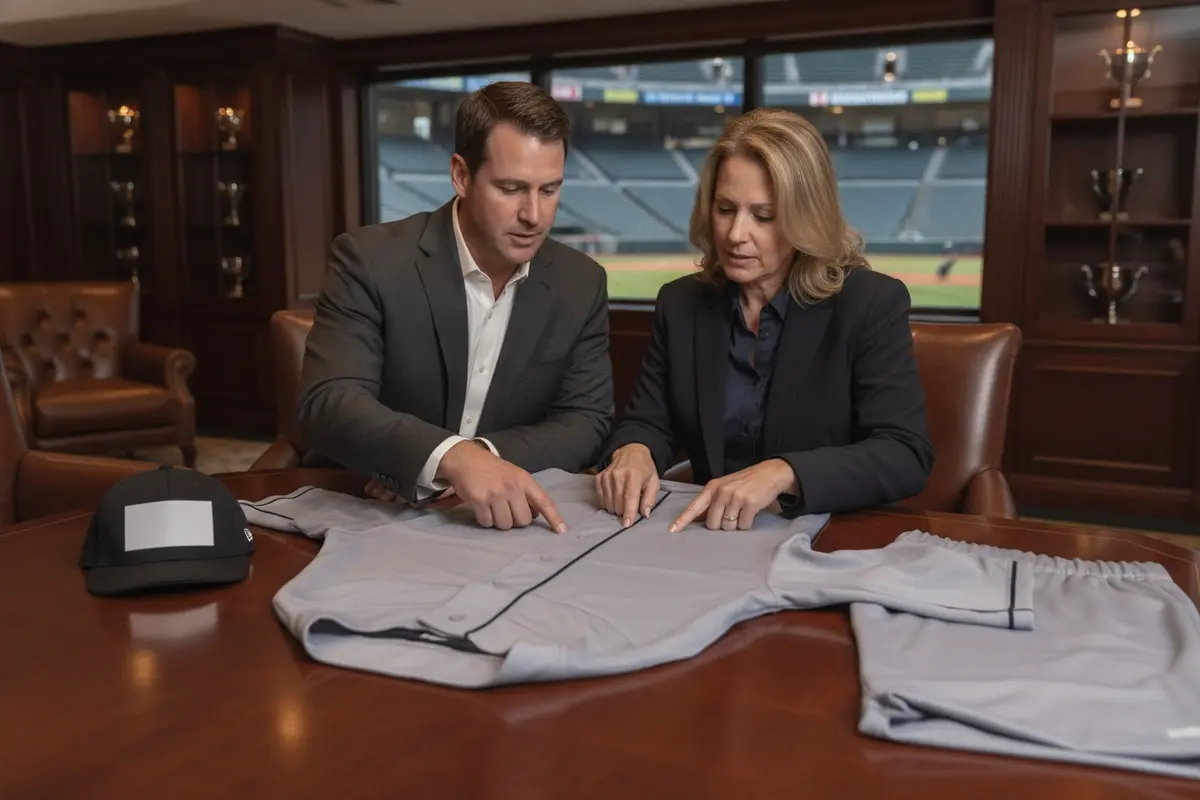
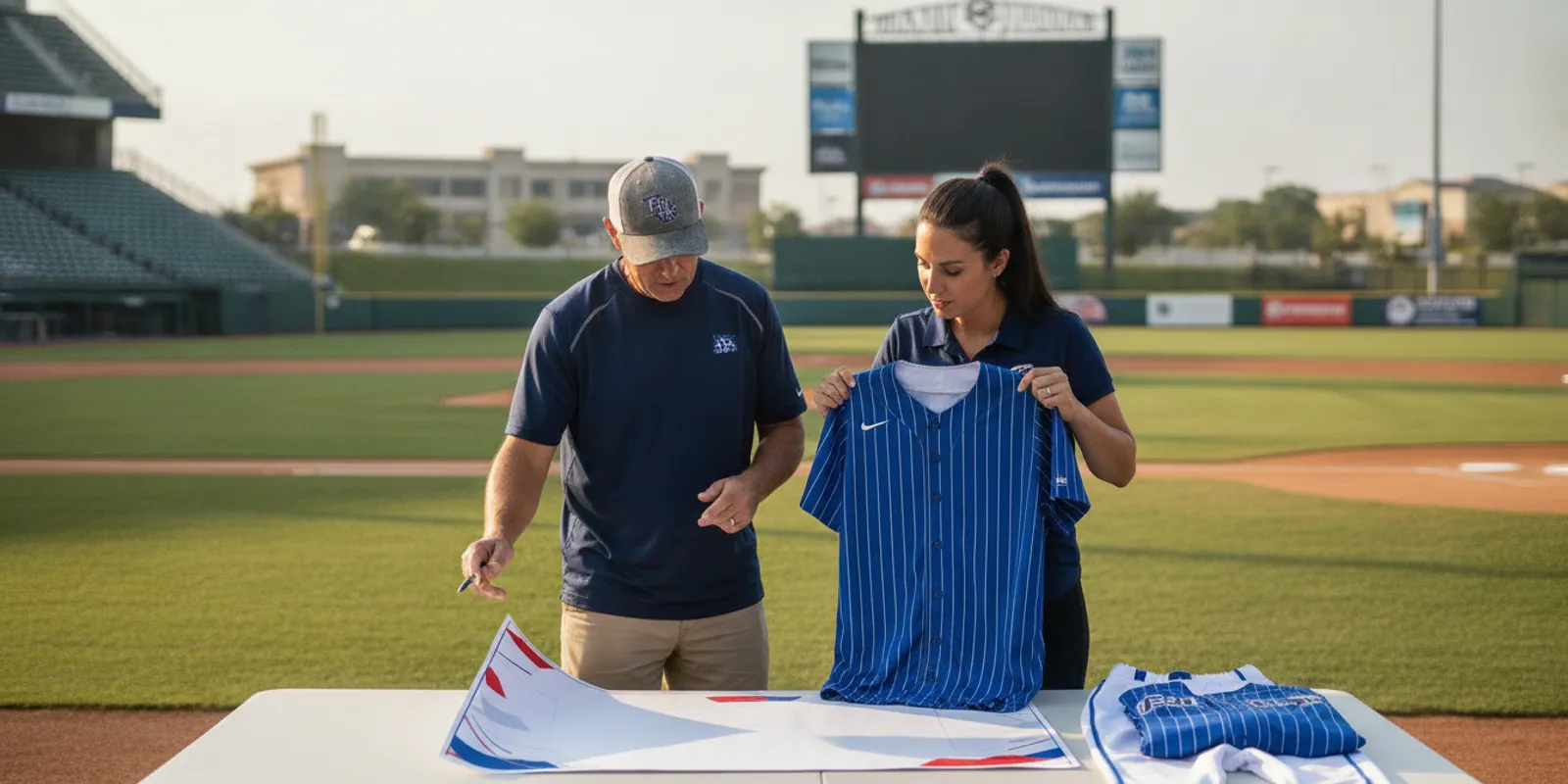
When the proof arrives, inspect it as an order document—not just as a picture. Check front, back, and sleeve views where applicable. Verify logo locations, colors, number size, name treatment, and the relationship between marks and seams. Confirm the full garment is shown and that no important feature is cropped. If the proof represents multiple garments or teams, check that each version is clearly labeled.
Decoration methods also affect the finished appearance. Sublimation integrates printed design into fabric; tackle twill uses fabric layers for a dimensional effect; screen printing, heat press, and embroidery each suit different design elements and garments. Ask which method is proposed for each component, why it fits, and how the artwork will look on the actual garment. For background on two lettering approaches, see the guide to tackle twill and sublimated lettering. This is a comparison resource, not a substitute for approving the specific proof for your order.
Keep a decision log with the proof version, approval date, and approver. If a change arrives later, ask whether it affects design, order details, or the delivery schedule before authorizing it. Replace superseded files clearly—for example, label a revised roster with its date and state which version it replaces. One authoritative version is safer than an email chain with several attachments that appear current.
Which uniform options should buyers compare?
Compare products against the team’s real use, not appearance alone. Review the garments included, fabric and construction details the supplier can confirm, decoration methods, coordinated pieces, and size information. Separate product questions from ordering-process questions. That makes proposals easier to compare and prevents a low-looking total from obscuring differences in scope or assumptions.
A useful comparison asks the same questions of each option: What is included for every player? Which design elements and decoration are specified? How are sizes collected? What milestones depend on the buyer? What happens if roster information changes? Request written clarification where the answer influences your decision. This is especially useful when several administrators review the order at different times.
Decision area | Options to compare | What the buyer should confirm |
Uniform set | Jersey alone or coordinated garments and accessories | Exact items and quantities included for every player |
Program design | Shared league identity or team-specific details | Approved colors, logo placement, numbers, and names |
Decoration | Sublimation, twill, screen print, heat press, or embroidery where applicable | Method for each garment and intended design element |
Fit and roster | Available garment sizes and collection method | Current chart, completed roster, and correction process |
Schedule | Proof, approval, production, and delivery milestones | Expected in-hand date and conditions that could affect it |
Administration | One team or multiple teams and divisions | Quantity, any minimums, payment steps, and change process |
Numbers need a specific review. A league or tournament may govern number duplication, placement, or format, but those requirements differ by organization and sport. As one example, Oak Ridge’s published men’s basketball rules call for non-duplicated one- or two-digit jersey numbers. That is a rule for that league, not a universal standard. Check your own governing body’s current rules before approving the roster or design; the Oak Ridge rules document illustrates why buyers should verify the local requirements.
For baseball, the baseball jersey selection and baseball pants options can help identify components for discussion. Keep the comparison grounded in your intended set and ask what each product choice means for the complete order.
How should coaches collect sizes and verify the roster?
Accurate sizing and personalization depend on a repeatable roster process. Use the current size chart for the exact garment, give players clear instructions, and collect information in one controlled sheet. Before approval, compare every name, number, size, and team assignment with the current roster. Do not assume that a size selected for a jersey automatically applies to pants or another garment.
Set a size deadline and explain how late responses will be handled. If the program can arrange sample garments, choose a person to manage them, record who tried which sample, and set a return date. A try-on is useful only if the selected size is recorded accurately and connected to the right player. Without samples, use the supplier’s sizing directions and give each player or guardian a chance to confirm the choice before final submission.
Use an auditable roster sheet
Create a tab or clearly marked section for each team and division.
Use consistent columns for player name, number, garment size, personalization, and response status.
Mark additions, removals, and pending choices rather than silently overwriting an approved value.
Ask a second person to compare the final sheet with registration or coach records.
Save a dated, read-only copy of the approved roster and send that version through the agreed channel.
Review duplicate numbers, spelling, punctuation, and special characters. Have the coach confirm the list for that team and then compare it with the proof or order summary. If a player changes teams or receives a new number, update every relevant record together; otherwise the proof and roster can diverge. Keep personal information limited to what is needed for the order and share it only with people responsible for the process.
For sizing questions, consult the appropriate uniform size chart for each garment rather than treating one chart as universal. A team ordering jerseys, pants, and accessories should keep separate size fields where the products require them. A simple validation pass—counting the entries by size and comparing the total with the roster—can catch a blank or duplicate row before approval.
When should a league start the order and what belongs on the calendar?
Work backward from the date the complete order must be ready for distribution. Include roster collection, artwork preparation, proof review, approval, order confirmation, production, delivery, and sorting. Ask the supplier for a schedule tied to your products and details; a general turnaround description is not a promise that every style, quantity, or late change will follow the same timeline.
Custom garments depend on decisions being complete enough to proceed. Missing artwork, a delayed proof response, or an unconfirmed roster can hold up the next step. Ask which milestones depend on information from the league and what the supplier needs at each one. Get the expected schedule and assumptions in writing so that everyone understands the same dates.
Build milestones with a named owner
- Set the in-hand date.
Include time for sorting, distribution, and resolving an issue before competition begins.
- Confirm product scope.
Identify garments, quantities, decoration, and requirements that could narrow the options.
- Collect roster data.
Set an internal deadline for names, sizes, and numbers, then define how late changes are reported.
- Prepare artwork.
Gather approved marks and color references; name one person to consolidate feedback.
- Review and approve.
Check the proof and roster together, resolve questions, and retain the approved versions.
- Confirm the order.
Verify quantities, delivery location, milestones, and outstanding actions before production proceeds.
- Plan receipt.
Assign a contact to receive, count, and sort the delivery by team and player.
Uniforms Express describes custom baseball jerseys as available in as little as two weeks in company materials, but the schedule for a specific order depends on its products and confirmed details. Ask about your requirements and available timing rather than assuming every garment, quantity, or late-season request shares the same turnaround. Start with the baseball uniform ordering page for product-specific questions and consultation.
Plan the receiving step as carefully as the approval step. Verify the destination, who can accept delivery, and how many packages are expected. Ask one contact to track progress and relay updates to coaches. Name an alternate approver who can make a decision if the primary contact is unavailable; an unanswered approval request can disrupt a carefully planned calendar.
How can buyers manage budget, quantities, and future reorders?
Budget planning starts with a complete scope rather than a single-item estimate. Compare equivalent garments, quantities, decoration, shipping, and any optional components. Ask what is included and what is separate. Product pricing and promotions can change, so request current details for the actual order and use the same assumptions for each proposal.
Separate required items from choices that can be added later. A decision sheet might show a required game jersey and pants, then list optional warm-ups or extra practice pieces on separate lines. That helps a board see the consequences of an add-on without accidentally treating it as part of the minimum set. Do not remove a necessary component merely to make two proposals appear comparable.
Confirm how the organization will pay and whether each team has a separate allocation. If the school or league requires a purchase order, documentation, or a particular approval sequence, raise it before the final order. Clarify any minimum quantities, payment timing, and change or cancellation terms directly with the supplier. Do not infer a policy from a past order or informal recollection.
Plan for roster movement without assuming every late change can be absorbed after production starts. Estimate likely additions from current registration, then ask how late additions and replacement pieces are handled. Preserve the final design, selected products, size data, and order details so a future request can begin from a reliable record. Confirm availability, current specifications, and timing again for a reorder; a previous selection does not guarantee that every detail remains unchanged.
For a league ordering multiple divisions, maintain a program-wide total and team-level breakdown. For example, the master sheet might summarize the total number of jerseys while each team section lists its own names, numbers, and sizes. Reconcile the team subtotals against the program total before sending the order. Then ask whether the order can be grouped and delivered in the way the league needs. A clear structure makes a consolidated order easier to audit without losing the details that each coach must approve.
What should a team verify before submitting its order?
Conduct one final side-by-side review of the approved design, roster, quantities, delivery details, and written order summary. The person authorized to approve the purchase should review the exact version that will be submitted. Close open questions before approval instead of relying on assumptions that could be interpreted differently by the team and supplier.
Team names, player names, numbers, sizes, and personalization match the approved roster.
Totals reconcile by team, garment, and size.
Artwork, colors, logo placement, and decoration match the approved proof.
Required garments and accessories are included; optional items are identified separately.
The delivery address, receiving contact, and desired in-hand date are correct.
Schedule assumptions, payment steps, and change terms have been reviewed.
The final approval and order summary are saved in a shared, accessible location.
Use a sign-off record that identifies the date, approver, proof version, and roster version. This small step helps resolve confusion if a coach later finds an old file or remembers a different number. If something changes after submission, tell the supplier promptly, describe exactly what changed, and ask what options remain. Do not send a replacement attachment without naming the version it supersedes.
For a final scope check, compare the planned package with the available baseball uniform packages and the related baseball accessories. Those product pages can help prompt questions about what the team needs; verify the contents and current details for your own order.
Frequently asked questions
How do we choose a uniform style for a league?
Start with the sport, level of play, expected use, and required garments. Establish the league’s identity rules, then compare available styles against fit, intended use, construction details, and coordination across the set. Review the supplier’s proof and confirm the listed products before approving the order.
How should we handle sizing for a mixed-age team?
Use the current chart for each specific garment and collect choices in a roster sheet. Give players or guardians clear directions and a deadline. Arrange sample try-ons if practical, and record each selection against the correct player. Do not assume the same size applies to different garments.
Which decoration method should we choose?
Ask the supplier to recommend a method for the artwork and garment, then review the result on the proof. Sublimation, tackle twill, screen printing, heat press, and embroidery create different appearances and suit different applications. Confirm how the names, numbers, and marks will look on each item before approval.
How much time should we allow for custom team uniforms?
Work backward from the date the complete order must be distributed and ask for a schedule based on the actual products, quantities, and approved information. Leave time for roster collection, proof review, corrections, production, delivery, and sorting. A general turnaround statement may not apply to every order or late change.
How should we compare uniform budgets?
Define the complete garment list and quantity first, then compare proposals using the same assumptions for decoration, shipping, and optional items. Ask for current order-specific details and clarify payment, minimums, and change policies. Keep optional pieces distinct so decision-makers can see what is essential and what could be added separately.
A well-managed league order combines a clear identity with accurate roster data, deliberate approvals, and a schedule confirmed for the products being ordered. Give each decision an owner, keep the approved details together, and your teams can approach the season with a consistent, professional look.
Comments