


Custom Flag Football Jerseys for Youth Leagues: A Coach’s Checklist

A uniform order that arrives with the wrong sizes, unreadable numbers, or a design that conflicts with league rules can turn a simple team purchase into a season-opening problem. Planning custom flag football jerseys early gives coaches time to settle the details, gather accurate sizes, and approve a complete proof before production begins.
This checklist is for youth league coaches, athletic directors, and team managers coordinating a team order. Use it to make the decisions in the right order, reduce avoidable revisions, and prepare a clear request for a supplier. Start with league requirements, then work through the look, garment details, roster, decoration, proof, timeline, and final handoff.
What should a coach confirm before designing custom flag football jerseys?
Before choosing colors or sending artwork, confirm what the league requires and what your team actually needs. Flag football rules and league operations can differ, so collect the applicable requirements from your own league or tournament organizer. Then identify the roster, intended use, garment options, and key dates. A clear brief prevents design decisions from outrunning practical requirements.
1. Check the league’s uniform rules
Ask the league administrator for its current uniform or equipment rules. Confirm whether jerseys need contrasting colors, visible numbers, a particular number placement, a team-color standard, or other identifying details. Do not assume that another league’s checklist applies. Rules may be set by a local league, school, tournament, or governing organization, and the buyer is responsible for checking the requirements that apply to this event.
Also ask whether the league has guidance about logos, sponsor marks, player names, or color combinations. If teams are expected to distinguish themselves clearly, discuss how jersey colors will look against the opponent’s colors. Request the rules in writing when possible and save them with the order notes. That gives the coach and supplier one agreed reference when reviewing a proof.
2. Define who will wear the jerseys and when
Settle the roster scope before requesting a quote or proof. Record the number of players, the age range, whether coaches need matching apparel, and whether the order includes only jerseys or a larger uniform set. If you are equipping multiple teams, clarify which colors, numbers, and artwork belong to each squad. Naming the teams consistently makes it easier to catch mix-ups later.
Think about the full season, not just the first game. Will players use the jersey at practices, games, tournaments, or more than one event? Will you need a few additional sizes for late roster changes, or must the initial order account for all known players? These decisions affect quantities and the information the supplier needs. Avoid guessing at extras before you understand the league’s roster policy and your budget approval process.
3. Set an order owner and approval path
Choose one person to coordinate sizes, collect artwork, answer supplier questions, and return the final approval. If the school or league requires an athletic director, board, or purchasing contact to sign off, include that person early. A design can be ready while administrative approval is not, so map both paths at the start.
For local events, requirements and organization can vary. A Botetourt County recreation notice, for example, describes local flag-football tournament opportunities and notes that interested coaches or parent groups may create them. Use your own league’s current guidance for decisions about eligibility, uniform rules, and deadlines; the local notice is an example of why buyers should verify arrangements with the organizer.
How do you create a jersey design that works for players and coaches?
A strong team jersey is recognizable from the field, comfortable for the intended activity, and practical to reproduce consistently across the roster. Choose a restrained color system, agree on a number style, and decide which design elements are essential before adding extras. Most importantly, review a complete visual proof at realistic size so the team evaluates the actual layout rather than an idea in someone’s head.
Choose the colors and identity first
Begin with the team’s established colors, school identity, or league palette. Pick a primary color, a supporting color, and a contrasting treatment for numbers or other important identifiers. Keep the combination easy to distinguish at game distance. A design may look sharp on a phone but lose contrast under field lighting or when viewed against another team’s uniform.
If multiple teams share a program, decide whether each group will use the same design with different colors or a consistent color with a small variation. A shared system can make the program look coordinated, while a clear team distinction helps managers and spectators identify groups. Write down approved color names or provide reference artwork; informal descriptions such as “dark blue” can mean different things to different people.
Keep the layout readable and intentional
Decide where the team name, mascot, player number, and any approved sponsor mark should appear. Not every jersey needs every element. Prioritize what the league requires and what players must be able to identify. Keep the number large and clear enough for the team’s intended use, and avoid placing decorative details where they compete with it.
Choose the lettering and number treatment with the jersey fabric and decoration method in mind. Uniforms Express offers decoration methods that include tackle twill, sublimation, screen printing, heat press, and embroidery. The best approach depends on the artwork, garment, and intended finish; ask the supplier to recommend a suitable option rather than assuming every method behaves the same. The comparison page on tackle twill and sublimation can help frame one common decoration decision, though the right choice for a flag football jersey should be confirmed for that specific design.
Keep artwork files organized. Send the approved team logo at the best quality available, identify the exact colors, and list all words and numbers in plain text as well as in the artwork. Avoid screenshots when a clean original file is available. If the team is still developing a logo, make that an explicit open item rather than sending a temporary version that might accidentally become the production file.
It also helps to separate a must-have from a nice-to-have. A required team mark or clear number treatment should be resolved before optional trim, extra lettering, or secondary graphics. Every added element needs review for placement, legibility, and production suitability. A simpler design is often easier for a youth program to keep consistent across teams and future orders. Ask the supplier which elements are feasible on the selected garment, and do not assume that a sample image shows every customization available for your order.
Match jersey choices to real team use
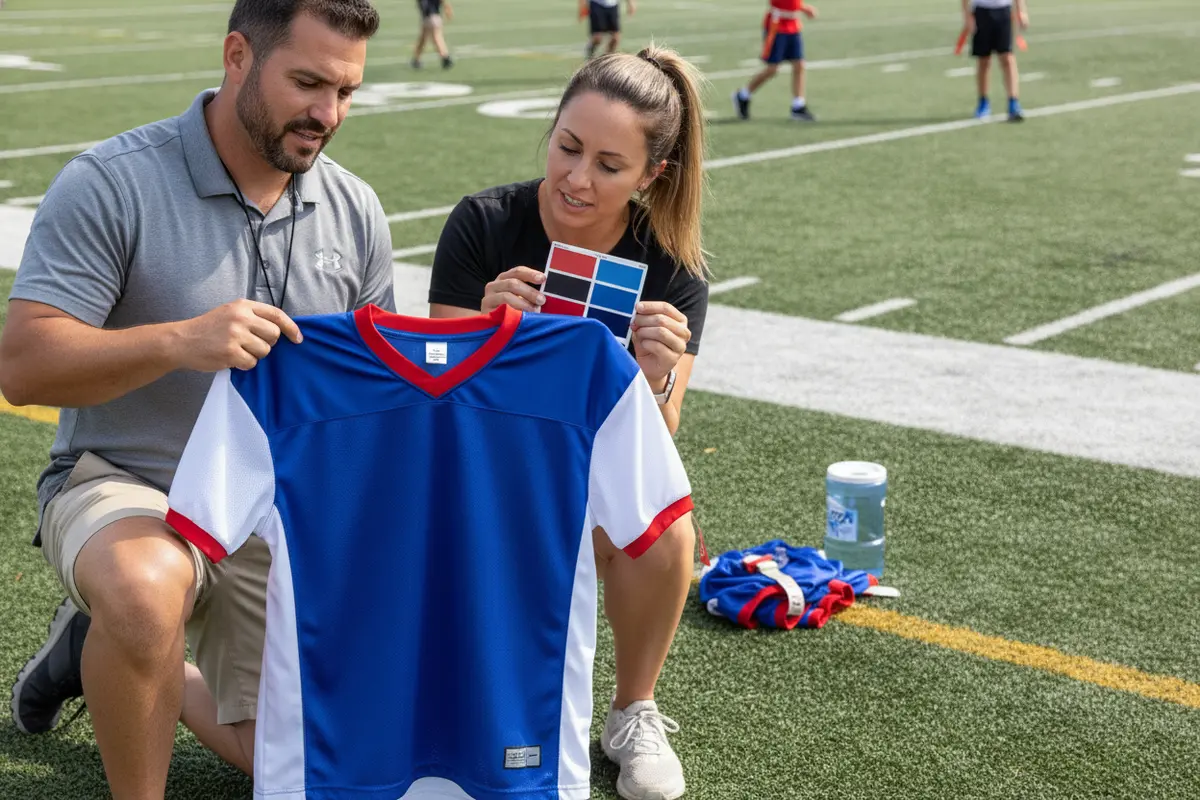
Discuss how the team will wear and care for its jerseys. Consider the season, practice schedule, expected frequency of use, and whether players will wear another layer beneath them. Ask the supplier about available garment styles, fabric, fit, care instructions, and decoration compatibility. Those details are better confirmed for the actual product than inferred from a photo or from a different team’s order.
Uniforms Express manufactures custom sports apparel and offers multiple decoration methods, but the available product and configuration should be confirmed for the requested flag football order. You can review the relevant football uniforms and apparel page, or compare the selection with the football uniform options before sending the request. If you are considering jerseys only, use the custom football jersey page as another starting point and confirm that the style fits your league’s needs.
Which decisions should go into a team jersey brief?
A useful brief puts the choices a supplier needs in one place: team and league context, quantity, garment preference, sizes, colors, artwork, decoration, and deadline. It does not need to be elaborate. It does need to separate confirmed decisions from questions still awaiting approval. Use the table below to assign each decision, compare what matters, and prevent essential details from being lost in email.
Decision area | What to record | Why it matters |
League requirements | Color, numbering, logo, and any relevant uniform rules | Ensures the design is checked against the right standard before approval |
Roster and quantity | Team names, player count, coach items, and any approved spare plan | Sets the order scope and helps reconcile all size entries |
Garment | Requested style, fit questions, fabric or care questions | Connects the design to a real product the team can wear and maintain |
Decoration | Logo, numbers, names if needed, placement, and method questions | Clarifies how artwork will appear and what the supplier should assess |
Approvals | Decision-maker, proof reviewer, and authorized final approver | Prevents unapproved changes from being treated as production-ready |
Timing | First game, delivery target, proof deadline, and internal approval dates | Gives the supplier a realistic schedule to review against current capacity |
Write down what is confirmed and what is not
For each item in the brief, label it “approved,” “requested,” or “to confirm.” For example, the school colors may be approved while the final logo file is still being located. A jersey style may be requested but not yet matched to the supplier’s available options. This simple distinction avoids turning an early concept into an assumed final specification.
Include any procurement requirements. Schools and leagues may need a formal quote, purchase order, invoice details, or an authorized contact. Confirm which documents are required and who submits them. Uniforms Express lists a catalog request option for teams that want to review product information, and its uniform builder can be a useful place to explore design possibilities. Treat the final supplier proof and order confirmation as the source to verify the exact order details.
How can coaches collect sizes and prevent roster mistakes?
Collect sizes with one consistent process and maintain a single roster document as the order’s reference. Do not rely on memory, a string of text messages, or a mixture of youth and adult size labels. Ask the supplier which sizing chart applies to the specific garment, give players a clear response deadline, and verify every entry before submitting the final quantity.
Use the correct sizing chart and garment
Sizes are not interchangeable across every product or cut. First identify the jersey style, then use the corresponding chart rather than a chart saved from an older order. Share the supplier’s team uniform sizing charts with families or managers, and explain which chart and size system to use. If the garment offers a fit choice, ask the supplier what measurements or try-on process can help the team decide.
Collect player name, selected size, and any approved name or number in separate fields. Use a consistent format for names and record numbers as numerals. Have a second person compare the list with the official roster. Then check that every player appears once, the total matches the order quantity, and any coach or extra items are clearly identified as separate entries.
For a league with several teams, keep each team’s list separate and use the exact team label that appears in the design brief. Check for repeated numbers within the same team if the league restricts them, and do not assume that a number is available just because a player wore it last season. If a player requests a change, update the master roster first and mark the older version obsolete. This reduces the chance that artwork, a spreadsheet, and a late message each contain a different answer.
When families submit sizes, explain whether the team is collecting a preferred size or a confirmed size based on the product chart. If there is uncertainty, note it and seek supplier guidance before finalizing. Avoid quietly converting between youth and adult sizing. Make the final list readable to someone who did not collect it, with clear column headings and a total for each team and garment type.
Set a roster deadline and a change process
Give families a clear deadline and explain what information is needed. Send a reminder before the cutoff, then freeze the roster for proof review. Late changes should go through the designated coordinator, not directly to several people at the supplier. If a player joins after the order is submitted, ask what options are available instead of assuming an individual replacement can be made on the same schedule.
Before approving, print or view the roster in a format that makes errors easy to spot. Check spelling, number duplication, size labels, team assignment, and quantity. Ask the supplier how changes are handled after proof approval and after production begins. Do not approve a proof until the people responsible for the roster have confirmed it.
When should you order custom flag football jerseys?
Order planning should work backward from the date the team needs the apparel, not forward from the day the coach gets around to starting. The time needed depends on the chosen product, customization, order details, approvals, and current production schedule. Request a current estimate from the supplier, then reserve time for collecting sizes, reviewing proofs, and resolving any revisions before the first game.
Build a timeline with decision dates
Start with the first date the team must have the jerseys. Work backward and list the latest practical date for delivery, the expected production window confirmed by the supplier, proof review, internal approval, roster collection, and initial request. Add a buffer for a missing logo file, late size response, or a requested design adjustment. A timeline is only useful if each stage has a person responsible for moving it forward.
Uniforms Express describes custom jerseys as available in as little as two weeks in its company information, but that should not be treated as a universal promise for every flag football design or order. Confirm the current estimated turnaround, what the estimate includes, and whether it begins after all artwork, sizes, approvals, and payment requirements are complete. Ask about rush availability and any related terms for the actual order. Do not assume rush production or a particular delivery date until it is confirmed for your specifications.
Leave room for the proof and approval cycle
Proof review is a production checkpoint, not a formality. Assign a primary reviewer and a final approver, and send all feedback together. Group corrections by location: colors, logo, text, number list, size assortment, and placement. That is clearer than returning separate messages with potentially conflicting edits.
Keep the order moving by resolving open questions quickly. If an approver is unavailable, identify a substitute before the deadline. If a required change affects the design or roster, ask whether it changes the schedule. The supplier’s updated timeline should reflect the approved design and final order details, not an earlier draft. A clear schedule makes it easier to spot a risk early and decide what action the team can take.
When requesting a turnaround estimate, give the supplier the actual game date, delivery destination, order quantity, requested customization, and status of the artwork and roster. Mention any school approval or purchase-order steps that could affect when an order is ready to proceed. A general estimate without those details may not reflect the team’s real situation. Ask which date the timeline is measured from and whether proof revisions or incomplete information can shift it. Keep the response with the order notes so the coach and administrator are working from the same expectation.
How should you review the final proof before approving production?
Review the proof as if it were the specification for the finished order. Compare it with the league rules, approved artwork, roster, and written brief. Check both the overall appearance and the small details that can create costly confusion: spelling, number placement, color contrast, garment style, and item counts. Ask the supplier to resolve discrepancies before the authorized approver gives final sign-off.
- Team identity:
Confirm that the correct team name, colors, and approved artwork appear.
- Legibility:
Check that numbers and required identifiers are easy to distinguish in the layout.
- Roster:
Match each player’s name, number, size, and team against the approved list.
- Garment:
Verify the requested style and any agreed fit or product details.
- Decoration:
Confirm method and placement as shown in the approved proof.
- Quantity:
Reconcile player items, coach items, and any separately approved extras.
- Schedule:
Confirm the supplier’s current delivery estimate and any remaining requirements.
Ask for clarification when an item is unclear; do not infer that a small-looking difference is unimportant. Keep the approved proof and final roster together with the quote or order confirmation. If the organization needs a purchase order or other documentation, check that it matches the same quantity, specifications, and authorized total before completing its process.
Make approval explicit. The designated decision-maker should confirm that the proof is approved for production, rather than sending comments that could be mistaken for authorization. If changes are requested, wait for the revised proof and check the changed areas again along with any details that might have shifted. Save the final version with a date or clear filename, and ensure every person sharing feedback is reviewing that same version.
What should a coach do after placing the order?
Once the order is submitted, keep the approved version easy to find and make one person responsible for updates. Confirm the supplier has the final artwork, roster, approval, and any required purchasing information. Use a single communication thread when possible. If a correction or question comes up, identify the exact team, item, and approved version so the supplier can respond to the right order details.
When the jerseys arrive, compare the shipment with the confirmation and roster. Check the team and quantity, sizes, names or numbers if included, colors, and visible decoration. Report a discrepancy promptly through the supplier’s support process and include clear photos and the relevant order information. Avoid handing out pieces until the team has completed the count and noted any issue that needs follow-up.
For future seasons, save the final proof, size roster, and notes on what worked. That record helps the next coordinator start with accurate information instead of reconstructing the order from old messages. If the team needs related apparel, Uniforms Express also offers football jerseys and football pants; check each item’s suitability for flag football, league rules, and the intended team use with the supplier before ordering.
Frequently Asked Questions
These answers cover the practical questions that commonly surface while a youth team order is taking shape: what to choose first, how to gather sizes, whether names and numbers are feasible, how to plan timing, and what belongs in the budget. Confirm details for your actual league and product before approving an order.
What should I decide first when ordering custom flag football jerseys?
Start with your league’s current uniform requirements, roster size, first-game date, and approval process. Then identify the preferred garment, colors, artwork, and decoration needs. Confirm product availability and current timing with the supplier before treating a design or delivery estimate as final.
How do I choose the right jersey size for each player?
Use the sizing chart for the specific jersey style being ordered. Collect each player’s size in a single roster file, follow the chart’s guidance, and ask the supplier about fit questions before the order is finalized. Check every entry and total against the roster before proof approval.
Can we add player names and numbers to the jerseys?
Names and numbers may be included when the selected product and decoration setup support them, but confirm the options and placement with the supplier. Check league rules first, provide an accurate roster, and make sure all names and numbers appear correctly on the final proof before approving production.
How long does it take to receive custom flag football jerseys?
Timing depends on the product, customization, order completeness, approvals, and current production schedule. Request a current estimate for your exact order. Uniforms Express notes that custom jerseys may be available in as little as two weeks, but confirm the applicable timeline and any rush terms rather than assuming every order follows that schedule.
How should a youth league plan its jersey budget?
Build the budget from a confirmed product quote and the approved quantity. Include only items the team intends to order, such as jerseys, additional apparel, or separately approved extras. Ask the supplier to clarify what is included, any decoration choices that affect the quote, and the payment or purchasing documents your league requires. Do not base a final budget on an old price or an unconfirmed design.
What if our team has not finalized its logo or colors?
Mark those decisions as open in the brief and ask who has authority to approve them. Request the cleanest available artwork and agree on a color reference before proof review. Do not approve production with temporary graphics or informal color notes that the team may later want to change.
With league rules, roster details, design choices, and approvals organized, your team can make a more confident jersey decision and give the supplier a clear path to prepare the order. Confirm the current product options and timeline before committing so the finished apparel fits the team’s needs and season schedule.
Comments