


Custom Football Pants for Teams: Fit, Inseam, and Quantity for Complete Uniforms

A pant order that looks right on a design proof can still create a sideline problem if the inseam, rise, or size mix does not work for the roster. Coaches planning custom football pants for teams should check fit and quantities alongside color and decoration, then leave enough time for approval and production before the first game.
How do you plan custom football pants for teams?
Before selecting a design, establish who will wear the pants, how they should coordinate with the team's jerseys, and what the order must accomplish for the season. These early decisions help the coach, athletic director, and supplier work from one clear brief instead of correcting avoidable mismatches after the order is underway.
Start with the use case. Are these pants for the full roster, a new team, a replacement group, or a small number of additions to an existing set? A full set gives you more freedom to revise colors and decoration together. A replacement order usually needs to match what players already own, so gather the current garment or reliable photos and confirm the details before requesting a proof.
Next, record the team's visual requirements in one place. Include the main and accent colors, stripe placement, team name or other requested decoration, and the jersey style the pants need to complement. If the team uses several uniform combinations, identify which jersey or combination is the priority. Do not rely on descriptions such as "dark blue" alone when an exact match matters; provide an approved reference and ask how color matching will be confirmed across garments.
Then settle the roster and purchasing process. Identify the person who can approve the design, who will verify sizes, and whether a school or program needs a purchase order or other administrative step. Set a deadline for collecting player information and a separate deadline for proof approval. Those dates matter because a design that is still being revised cannot move forward like a finalized order.
It also helps to distinguish must-haves from preferences. A required team color or league rule is different from a preferred stripe width or optional personalization. Marking that difference helps the designer propose a practical solution without losing what makes the team's look recognizable. Use the official football pants product page as the reference for available styles and construction, then ask the Uniforms Express team to confirm which option fits the program's design and protection needs.
Finally, review the product path before submitting the brief. Explore custom football pants and uniform pants, then consider how the selected pant works with the team's football uniform options. A coordinated order is easier to evaluate when the jersey and pants are reviewed as parts of one uniform rather than as isolated purchases.
How do you choose a fit and inseam that work for the roster?
A reliable fit decision starts with the size chart and the team's own fit expectations, not a guess based on a player's age, position, or current casual clothing size. Collect measurements consistently, check them against the available chart, and confirm the intended length and room for movement with the supplier. For a roster with varied builds, a careful size review is more useful than ordering every pair in a single estimated size range.
Fit affects comfort, mobility, and how the complete uniform looks in team photos and during play. The waist should stay secure during normal movement, while the leg should provide the coverage and silhouette the program expects. A close-fitting pant and a more relaxed fit can look different even when labeled with the same size, so review the product-specific information instead of assuming sizing is interchangeable across styles.
Use one repeatable measurement process
Choose one adult to coordinate measurements and give every player the same instructions. Use the sizing guidance supplied for the product and write down each player's selected size, name, and any approved personalization in a single roster file. If the supplier's chart calls for a particular measurement, follow that method for everyone rather than mixing self-reported clothing sizes with measurements taken in different ways.
Where a player is between sizes, or the fit preference is uncertain, do not quietly make an assumption. Flag the entry and ask the supplier how to resolve it. A sample or fit check may be useful when available, but confirm whether it can be arranged and how it affects timing; do not assume every order includes one.
Discuss inseam and coverage specifically
Standard length" can mean different things to different people. Ask how the available pant style is intended to sit and whether the inseam or length selection is fixed, selectable, or determined by the size. Have the coach describe the desired look in practical terms, such as the intended leg coverage and how the pant should meet the socks or other uniform components. Confirm any applicable team or league requirements directly rather than relying on another program's preferences.
Think about the whole uniform while reviewing the fit. A pant that seems appropriate on its own may look different alongside a particular jersey cut, socks, belt, or other gear. Check a representative player's full combination if possible, and use the same uniform configuration in reference photos. Uniforms Express offers a team uniform sizing guide that can help organize the review; follow the instructions for the specific item being ordered.
For a team ordering both jerseys and pants, review the baseball pant sizing and product information only if the program also needs baseball apparel; for football, use the football-specific pant page and its available fit details. Avoid copying measurements or assumptions from a different sport's garment.
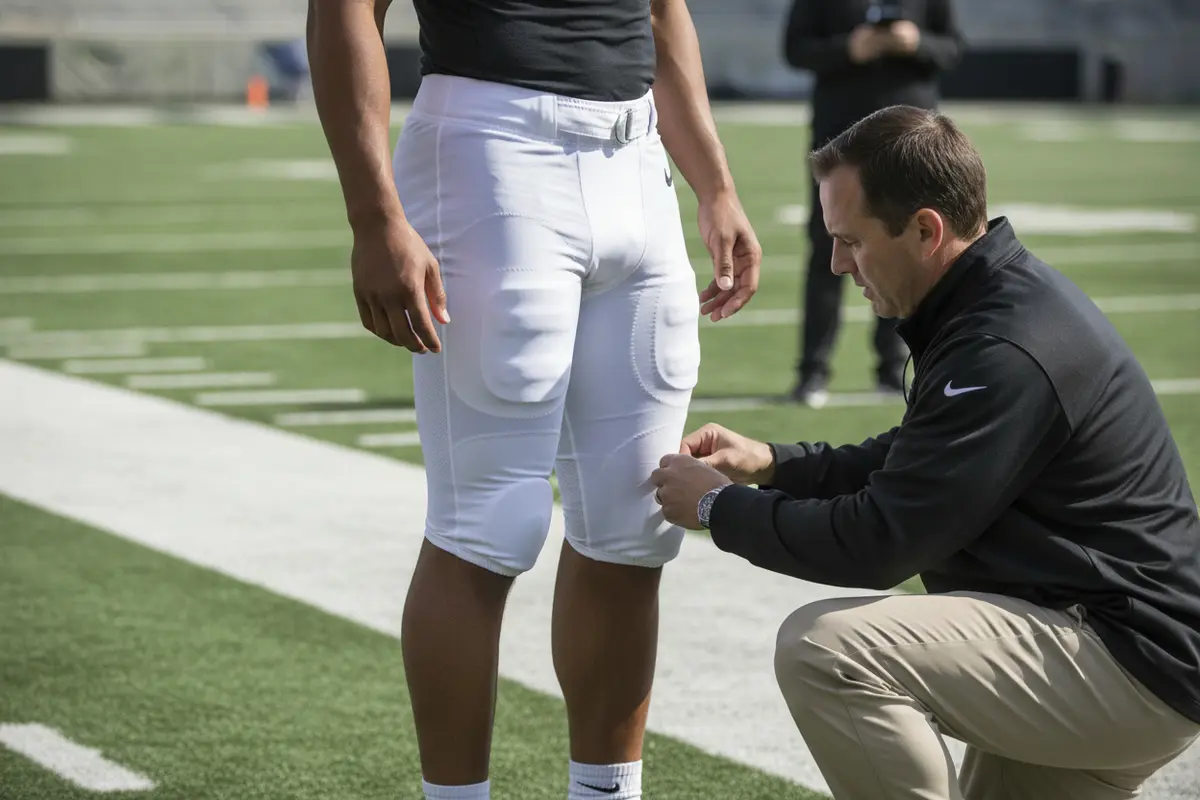
Keep the final size decisions visible in the roster and have a second person check the entries before approval. A simple second review can catch transposed sizes, duplicate names, and missing players while there is still time to ask questions. If the roster changes later, update the master copy and clearly identify the latest version so the supplier is not working from two conflicting lists.
Which design and decoration choices make a coordinated uniform?
Choose pants as one part of the team's visual system: the colors, stripes, and decoration should work with the jersey and any other garments in the order. Decide which elements are essential, then review a proof for the exact placement and color relationships. Uniforms Express offers in-house decoration methods including tackle twill, sublimation, screen print, heat press, and embroidery; availability and suitability depend on the item and design.
Begin with color. List the base color and every accent in plain language, then provide an approved reference when a close match is important. Ask the supplier how the proposed colors will appear on the selected garment and whether the same color treatment can be coordinated with jerseys. Screens and printed proofs can represent color differently from a finished garment, so treat the approved reference and supplier's proof process as the decision point rather than expecting an image on a phone to settle a close color question.
Next, decide what belongs on the pants. Some teams want a clean, minimal look that lets the jersey carry most of the visual identity. Others want a stripe or additional team detail to make the uniform read as a complete set. Keep placement and scale intentional: identify the feature, its location, and what it should align with on the jersey or other uniform piece. Submit approved artwork in the format requested by the supplier and avoid assuming that a low-resolution screenshot is production-ready.
Decoration method is not just a visual decision. Uniforms Express identifies tackle-twill as heat-sealed and sewn, sublimation as a permanent option for unlimited color and design combinations, screen printing as a multi-color choice for larger runs, heat press as a names-and-numbers option, and embroidery as a detailed logo finish. For football pants, ask which method is approved for the exact pant, artwork, and placement rather than assuming that every jersey treatment transfers directly to the pant.
Construction should guide the design conversation as well. The football pants collection lists several product-specific differences: Warhawk and Bomber use a 4-way stretch spandex body, a belt slot and loop, thigh and knee pad pockets, and a premium elastic waistband with silicone gripper; Bomber adds a straight side panel. Raptor uses a sharpened side panel, Eliminator uses piping with a triangle insert, and the Champro Integrated pant uses an 82% polyester and 18% spandex body, matte finish, full-length covered belt, and sewn-in ventilated pads. Review the football pants product details for the selected style, and ask the supplier to confirm that the proof reflects the actual side panel, piping, belt, and pad-pocket configuration.
Uniforms Express explains decoration options in its uniform education guide, and coaches can also review their concept with the online uniform builder. Keep the final method, product style, and placement together in the approval record so the team is not approving a graphic without confirming the garment it will be applied to.
Use this proof checklist before signing off:
Confirm the named football pant style and the construction details that matter to the order, such as side panel, piping, belt treatment, and pad pockets.
Check the base color, accent colors, stripe or insert placement, and coordination with the selected jersey.
Verify every team name, logo, number, spelling, artwork file, and requested decoration method.
Review every proof view shown, including any side or rear view, and confirm the approved size and placement of each detail.
Save the approved proof with its version date and send corrections in one consolidated message before production begins.
Do not approve based on a verbal assumption that is not reflected in the written proof. The final record should identify the product, decoration, placement, and complete uniform combination. College programs should also check their governing body's current requirements before approval; the NCAA Football Playing Rules hub includes official football rules resources and a uniform diagram.
To compare decoration choices, separate the questions of look, garment suitability, and artwork complexity:
Decision | What to compare | What to confirm before approval |
Color and stripes | Base color, accent colors, placement, and coordination with jersey | Approved color reference and how the proof represents the final design |
Decoration method | Available method, surface appearance, and fit with the design | That the method is available for the selected pant and artwork |
Team details | Placement and size of any requested name, number, or emblem | Spelling, artwork quality, location, and consistent treatment across pieces |
Uniform combination | How pants look with the selected jersey and other components | One approved view of the intended complete combination |
This comparison is not a substitute for a product-specific recommendation. It gives the decision-maker a clear set of questions to take into the design review and reduces the chance that a preferred detail is assumed to be available without confirmation.
Roster quantity and order verification
Calculate the quantity from the current roster, not the original season plan. Include every player who needs a pair, approved replacements or extras, and any additional sizes the program has specifically decided to keep on hand. Then compare that count with the list of names and sizes before submitting the order. A clean roster is the best defense against both missing garments and duplicate entries.
Use a master spreadsheet with one row per player. Typical columns include player name or roster identifier, selected size, any approved personalization, and a status such as "confirmed," "needs follow-up," or "approved." Limit access to the people coordinating the order so that late edits do not produce several competing versions. If the program has a required order minimum for the selected product, confirm it with the supplier; do not assume every style has identical quantity rules.
Separately count the number of each size and compare that total with the number of players. For example, if the team roster contains 34 players, the size totals should also sum to 34 unless the order intentionally includes an extra pair or a replacement. Record that additional quantity as a separate line and explain its purpose. This reconciliation catches common errors such as a player omitted from the spreadsheet or a duplicated entry hidden in a long list.
Before sending the roster, use this two-person verification process:
Freeze the roster date and assign one person to own the master file.
Confirm that every player appears once, with a selected size and any approved personalization.
Count each size and reconcile the total against the player list and the intended quantity.
List replacements, extras, and open size questions separately so they are not confused with player assignments.
Have a second staff member review the file, then send only the approved version to the supplier.
After proof approval, compare the order summary against the same master file and send one consolidated correction if anything changed.
Do not rely on a text message to one person if the official roster or proof still shows an older version. Keep the approved file and its date with the order record.
For a combined package, decide whether the pants are part of a full team set or a separate order. Uniforms Express lists custom football jerseys and other team apparel; review the matching items together so that quantity, color, and delivery planning are aligned. If a school's purchasing procedure applies, allow time for that approval as well. A team order can involve a coach, athletic director, purchasing contact, and supplier, so assign one person to consolidate questions and approve the final information.
Use the uniform catalog request if you need product information to compare options. For a product-specific question or an order discussion, contact Uniforms Express directly rather than submitting a roster with unresolved fit or design decisions.
Plan timing around the season deadline
Work backward from the date players need to wear the pants, and treat design approval, roster completion, and production as distinct stages. Ask the supplier for the current expected timeline for the chosen product and order details, including any rush possibility and applicable conditions. A past turnaround or a general statement is not a guarantee for every order, so confirm timing for your actual design and quantity before setting expectations with the team.
Work backward from the first game or required delivery date:
Set the required delivery date and identify whether pants and jerseys must arrive together.
Choose the pant style and confirm its construction, decoration options, and available sizing.
Set deadlines for artwork, roster completion, school purchasing, and proof approval.
Leave time for corrections, questions, and a second review of the final order.
Ask Uniforms Express to confirm the production or rush schedule for the exact product, quantity, and design in writing.
Assign one person to monitor the roster received, proof issued, proof approved, order accepted, and delivery expectation.
Complete artwork, accurate sizes, and one authorized decision-maker reduce avoidable pauses during order review. If the team changes the order after approval, ask how the change affects the written timeline.
When time is tight, tell the supplier the real deadline at the outset. Ask what options may be possible for the selected pants, what information is needed immediately, and whether a rush schedule or pricing applies. Rush turnaround depends on the specific order and must be confirmed; never assume an expedited option is available or that it comes without additional charges. If the requested deadline cannot be supported, discuss an alternative plan before committing to a design or announcing a delivery date to players.
Keep one person responsible for monitoring milestones: final roster received, design proof issued, proof approved, order accepted, and delivery expectation confirmed. Save the latest written confirmation with the roster. If the team makes a change after approval, ask how it affects the timeline and get the revised expectation in writing. A late addition, artwork change, or unresolved size can affect the order differently from the original plan.
For an order that combines several garments, confirm whether the items will be handled together or on different schedules. If matching pants and jerseys are needed for the same game, explain that at the start and verify the plan for the complete set. Uniforms Express emphasizes game-ready custom uniform options in as little as two weeks in its business information, but actual timing must be confirmed for the particular style, order, and production circumstances. Use the Uniform Challenge information as a starting point for learning about the company's offer, not as a substitute for a written timeline for your order.
Frequently asked questions
These practical answers address common team-order decisions: choosing a fit, checking inseam, selecting decoration, preparing the size list, and managing a deadline. Product details and order timing can vary, so use the answers as a planning checklist and confirm item-specific options with Uniforms Express before approving the design or promising a date to players.
How do I choose the right football pant fit for my team?
Use the sizing information for the exact pant style and have all players follow the same measurement instructions. Compare the results with the product-specific chart, flag uncertain or between-size cases, and ask the supplier how to resolve them. Do not assume that age, position, or casual clothing size alone determines the right fit.
How should a coach decide on inseam or pant length?
Describe the desired coverage and how the pants should coordinate with the team's socks and jersey. Ask whether length is fixed, selectable, or tied to the selected size for the product. Confirm any program or league requirement directly, then review the intended full uniform combination before approving the proof.
Which decoration method is best for custom football pants?
There is no single method that fits every artwork and garment. Uniforms Express offers methods such as tackle twill, sublimation, screen print, heat press, and embroidery, but availability depends on the selected item and design. Ask which options are appropriate for the pants, compare the visual effect, and approve the method and placement on the proof.
When should we finalize the size list and design?
Finalize both as early as practical and before the supplier's production schedule requires them. Work backward from the first game, set internal deadlines for size collection and proof approval, and confirm the current timeline for the specific order. If you need a rush option, discuss availability, turnaround, and any pricing conditions directly rather than assuming a blanket expedited service.
How many extra pairs should a team order?
There is no universal extra quantity that suits every roster. Base the order on the current player count and the program's replacement plan, then list any extras separately so they are not mistaken for player assignments. Check the chosen product's minimum quantity or other ordering conditions with the supplier before placing the order.
Can pants be ordered to match jerseys we already own?
It may be possible to coordinate a new pant order with an existing jersey, but provide the supplier with the exact product information and a clear, approved color reference. Ask how closely the colors and design can be matched, and request a proof before approval. For a new set, review the jersey and pants together to confirm the complete combination.
Get the pant order ready before the season
A dependable team order starts with decisions coaches can verify: the intended fit and length, a coordinated design, one accurate roster, and a timeline confirmed for the exact product. Review the available football pants, gather the team's sizes, and resolve open questions before approving the proof. That preparation gives the program a clearer path from a design concept to a uniform players can wear with confidence.
Comments