


Custom Football Uniforms For Youth Teams: A Season Planning Guide

A uniform order that arrives with missing sizes, mismatched names, or an unreadable number can put a team in a scramble just before kickoff. Planning custom football uniforms for youth teams starts with more than choosing colors: coaches need a dependable roster, a design that works across sizes, and enough time to review every detail before production.
What should a youth team decide before ordering custom football uniforms?
Start by naming one person to coordinate the order, setting the first game date, and confirming the team's league requirements. Then build a single roster with player names, numbers, and sizes, and decide which pieces the team needs. These decisions create a shared reference for design approval, sizing, and delivery planning.
A football uniform order has a lot of moving parts. If coaches, parents, and administrators each send updates separately, it is easy to lose track of the latest number, spelling, or size. Assign one order lead to gather information and submit the approved version. That person can maintain a dated master roster and record who has confirmed each entry.
Before discussing artwork, clarify the scope of the order:
Which items are required for every player: jersey, pants, or both?
Are there optional pieces, such as a second jersey color or team apparel?
Will coaches or staff need matching gear?
Does the league require particular colors, number placement, or other uniform details?
Does the team expect roster changes before the season starts?
Requirements can vary by league, age group, and competition. Ask the league or governing organization for its current uniform rules before finalizing a design. For high school football, the National Federation of State High School Associations is a useful starting point for finding information about high school sport rules; confirm the applicable rulebook with your association. Do not assume a design acceptable in one competition is automatically acceptable in another.
Next, establish the timeline from the date the team must have uniforms in hand, not just the first game. Allow time for collecting sizes, resolving late roster changes, reviewing the proof, and distributing pieces. Ask the supplier what production and delivery timing applies to the specific order, and get the schedule confirmed before approval. Turnaround depends on the product and order details, so do not base the plan on a general promise or a previous season's experience.
Keep the planning decisions in one place. A short order brief should identify the order lead, roster deadline, required items, league requirements, delivery deadline, and who can approve the final proof. Share it with the coach, administrator, and any person responsible for payment or distribution. This is a simple safeguard against conflicting instructions later.
How can coaches build a reliable roster and choose the right fit?
Use one roster as the source of truth. Record each player's name, jersey number, and size in separate fields, then have a second person check the list before it is submitted. Confirm fit using the supplier's size information and actual player measurements where possible. Clear records reduce preventable errors and make changes easier to track.
Start with the people who will wear the uniforms. Collect each player's preferred name spelling and requested number, then check for duplicate numbers and any league restrictions. Avoid building the order from memory, group chats, or a stack of unconfirmed forms. If the team has an existing roster system, copy information into the order sheet and ask players or families to verify their own entries.
Separate data that is easy to confuse. A useful roster might include columns for player first and last name, jersey number, jersey size, pant size, and confirmation status. Add a note for a special request only when it is relevant to manufacturing or distribution. Keep the master file with a single coordinator, and mark each revision with a date so everyone knows which version is current.
For fit, do not treat age or a player's height as a substitute for the actual size chart. Uniform cuts and sizing can differ by garment and supplier. Ask players to compare measurements against the correct chart for each item, and follow the supplier's measuring directions. If the team is between sizes or has questions about intended layering, ask the supplier before submitting the order rather than guessing.
Plan a method for players who cannot attend a fitting or respond by the deadline. The coordinator can contact the family directly, document the decision, and set a final cutoff for changes. Do not silently estimate a missing size. If a provisional size must be used, record that it is not confirmed and resolve it before approving the order.
For returning players, check old sizes instead of assuming they still fit. Players grow, and a new garment may fit differently from last season's uniform. Prior sizes can be a reference, but the current size chart and current measurements should guide the new selection. Confirm that jersey and pant sizes are not accidentally copied into the wrong fields.
Finally, review the total quantity against the roster and the required pieces. Count each item separately. If the team needs home and away jerseys, for example, confirm whether every player needs one of each and whether coaches or reserve players are included. Compare the final list with the roster before it goes to the supplier. The Uniforms Express sizing charts can help the coordinator find sizing information, while questions about a particular garment should be addressed before the order is submitted.
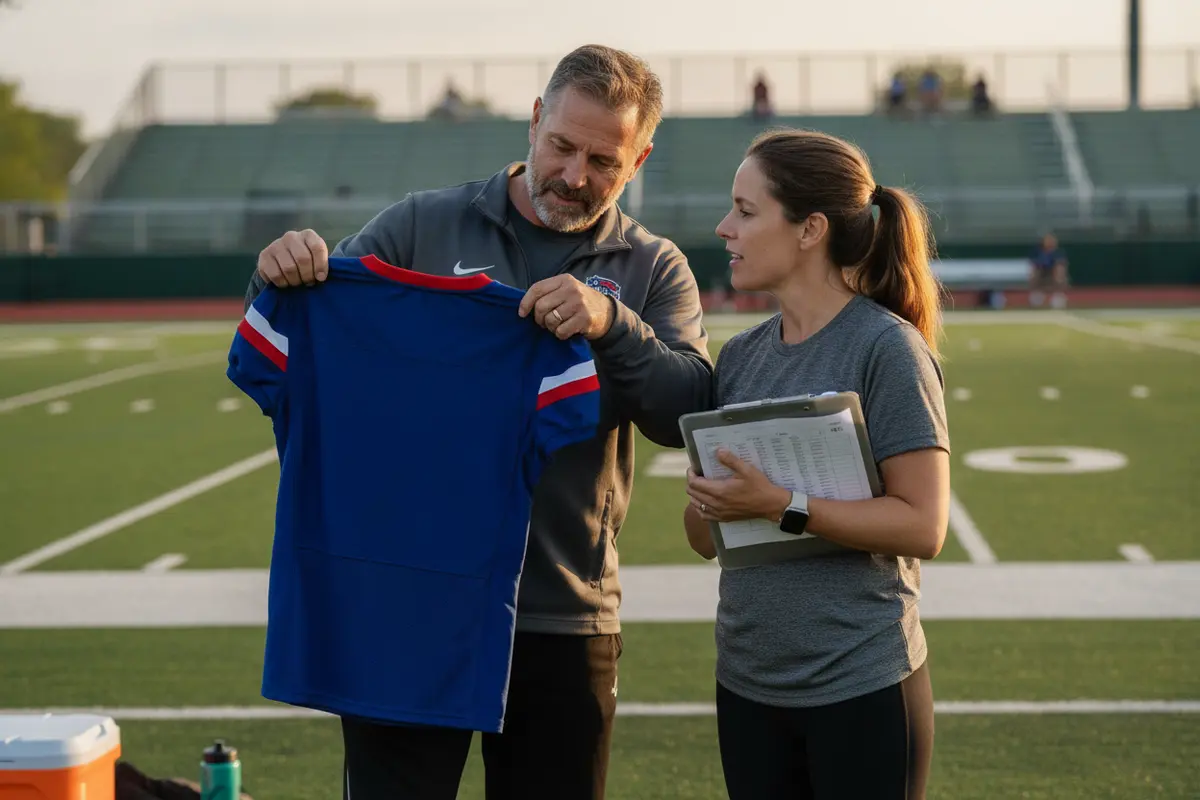
Which design and decoration choices make a team uniform work?
A successful design is recognizable at game distance, consistent across the roster, and practical to reproduce on every garment. Start with the team's colors, name, and number system, then check contrast and legibility on both light and dark backgrounds. Choose decoration to suit the artwork and garment, and review the final proof at full size before approving it.
Begin with the team's identity rather than adding every possible visual element. A clear hierarchy helps: the team name or mascot establishes identity, the player number needs to be easy to read, and any additional marks should support rather than compete with those essentials. Compare the design on a full jersey mockup, not only as a small logo or isolated artwork file.
Color choices need to work in different settings. A color that looks distinct on a computer screen may blend with another color under field lighting or against a different background. Check the main body, sleeves, trim, lettering, and number together. If the team uses both light and dark jerseys, review each version separately so contrast remains strong on each garment.
Decoration choices also affect the visual result. Common methods for custom team apparel include sublimation, screen printing, embroidery, heat application, and tackle twill. The best fit depends on the artwork, garment, placement, and desired appearance. A detailed, multicolor graphic has different needs from a simple name or number. Ask the supplier which method suits the specific design and garment, and consider reviewing a sample or close-up rendering when available.
Think about consistency across the complete order. Decide whether names, numbers, and logos belong on the same locations for every player. Keep artwork proportions consistent across sizes, while checking that small garments do not look crowded and larger garments do not make the design seem undersized. If the team is ordering matching pants or additional apparel, coordinate colors and decoration so the pieces look intentional together. Uniforms Express offers custom football jerseys and football uniform options for teams comparing their order components.
Before approving artwork, compare each detail against the order brief:
Are the team name and player names spelled correctly?
Does every number match the current roster?
Are the colors, outlines, and contrast clear on the actual garment color?
Are logos and other artwork authorized for team use and placed as intended?
Are decoration locations consistent across all pieces?
Does the proof represent the requested garment and not just a similar sample?
Do not rely on a proof that is too small to inspect. Zoom in on lettering and numbers, and ask for clarification if the image obscures stitching, trim, or placement. Save the approved proof alongside the final roster. If an adjustment is made after approval, make sure the revised version is reviewed and that the old version is clearly marked as superseded.
How should a team compare uniform options and order details?
Compare options using the same checklist instead of judging a product image alone. Review garment type, available sizing, design method, included pieces, proof process, and the supplier's stated timeline together. A written comparison makes differences visible and helps coaches select a uniform that fits the team's needs without overlooking an important order condition.
Decision area | What to compare | Question to resolve before approval |
Uniform pieces | Jersey, pants, alternate tops, or other requested items | Does the order include every required piece for each player? |
Fit and sizing | Size chart, measurement directions, and garment fit | Has each player's size been checked against the relevant chart? |
Decoration | Artwork method, number and name placement, colors | Does the proof show the exact design and placement requested? |
Order process | Roster format, proof reviews, and change handling | Who submits changes and signs off on the final version? |
Schedule | Production and delivery timing for this specific order | Does the confirmed schedule leave time for team distribution? |
Budget planning | Included items, optional extras, and any order-specific charges | Are all decision-makers comparing the same complete order? |
When comparing quotes or proposals, line up equivalent orders. One option may include a jersey only while another includes multiple pieces, so a headline figure cannot tell the whole story. Because pricing can change with garment selection, quantities, and decoration, ask for an itemized description of the exact package rather than relying on broad price assumptions. Uniforms Express does not list pricing here; teams can review team uniform product information as an example of product navigation or contact the company about the football order they need.
Ask how the proof and correction process works. Find out which details will appear in the proof, how the team should report corrections, and whether a revised proof will be issued after changes. Confirm who is responsible for final approval. A clear review process matters because a proof becomes the shared reference for names, numbers, colors, and decoration placement.
Get the timing in writing for the exact garment and order. Ask when the production clock begins, what approvals or information are needed first, and what delivery estimate applies. If the team has a fixed season date, share it early and ask whether the requested timing is workable. Uniforms Express describes game-ready options that may be available in as little as two weeks, but timing depends on the specific order and must be confirmed; do not treat that as a universal schedule.
Use the comparison to identify open questions, not just to pick a winner. If two options differ in fabric, sizing, decoration, or included items, decide whether that difference matters to the team. Save the final comparison with the approved roster and proof. That record can help the coordinator answer questions from families and avoid reopening settled choices as the order moves forward.
What should coaches check on the proof and order confirmation?
Review the proof and confirmation against the same master roster, line by line. Check spelling, numbers, sizes, garment colors, artwork, and piece counts before authorizing production. Have a second reviewer independently verify names and numbers, then record who approved the final version and when. Treat every revision as a new version that needs review.
Start with identity details. Read every name aloud or compare it directly with the submitted roster. Check punctuation, spacing, capitalization, and any special spelling. Then compare each jersey number with the latest list, looking for duplicates or number changes that were approved after the first draft. It is helpful for one person to read the roster while another follows the proof.
Next, verify sizes and quantities. Count the garments by type and size, and confirm that the total matches the team roster plus any approved extras. If an item is missing or an extra is present, pause and resolve it before sign-off. Check player-specific combinations carefully: a correct jersey size does not prove that the pants size is also correct.
Inspect the visual details at readable scale. Confirm colors, trim, lettering, number outlines, logos, and decoration locations. Compare the proof with the approved design brief, not with an old mockup or an informal message. Make sure each alternate uniform version is reviewed separately. A change to one colorway may not automatically carry over correctly to another.
The order confirmation should make the final scope and next steps understandable. Check the listed products, quantities, sizes, and any stated timing. Confirm that the proof version referenced is the approved one. Ask for a written explanation if a line item or timeline is unclear. Keep a copy of the confirmation, roster, and proof where the coach and order coordinator can find them.
Use a simple approval checklist:
Match the proof to the current roster, not an earlier draft.
Verify every name, number, garment, size, and quantity.
Review each color and decoration version at a readable scale.
Resolve exceptions and changes with the supplier in writing.
Save the final proof and confirmation, then identify the approver.
Once approved, set a change-control rule for the team: no one sends separate design or roster updates directly without telling the coordinator. If a necessary correction arises, the coordinator should ask the supplier what changes are still possible and whether they affect the schedule. This creates a clear record and prevents two different versions from circulating.
How can a team plan delivery, distribution, and next steps?
Work backward from the first required use date and schedule each task: roster collection, size verification, design approval, order confirmation, delivery, and distribution. Build in time to inspect the shipment and resolve questions before game day. Confirm the specific delivery estimate with the supplier, then give families a realistic pickup plan instead of promising an unverified date.
After placing the order, keep the coordinator as the central contact. Track the confirmed delivery estimate and any outstanding information the supplier needs. If the team changes a number or size, notify the coordinator promptly so the change can be checked against the order status. Do not assume a late change has been accepted until the supplier confirms it.
Prepare distribution before the boxes arrive. Make a copy of the final roster with player names and the exact pieces assigned to each player. Plan a pickup table or equipment handoff, and have a process for a player who is absent. At delivery, count packages and compare the items received against the confirmation and roster before distributing everything. This makes it easier to identify a discrepancy while the order records are close at hand.
Inspect the uniforms as a team order rather than handing out one garment at a time without a record. Confirm that names and numbers correspond to the correct players, and that all required items are present. Note any issue clearly, take a photo if useful, and contact the supplier with the order information. Keep affected items together until the next step is understood.
Set expectations with families about how and when uniforms will be distributed, what to do if a size seems wrong, and who should receive questions. Clear communication prevents several people from submitting conflicting requests. For a repeat season, save the approved design, garment details, and roster process as a reference, while checking current sizes and requirements again rather than copying last year's information automatically.
Teams that are still comparing options can explore uniform package examples and the Uniforms Express uniform challenge as additional product-planning resources. For a football order, use the actual football product details and discuss your team-specific scope, fit needs, and schedule with the company. If your organization is ordering other team gear as well, the Uniforms Express team uniform guide offers another starting point for planning.
How can the order lead keep the process on schedule?
Break the order into milestones and give each task an owner and due date. Track roster completion, size confirmation, art approval, order confirmation, delivery, and distribution separately. A short status check at each milestone can uncover missing information early, while there is still time to ask a question and make a careful decision.
Set the roster deadline before the date you expect to approve the artwork. Tell families what information is needed, how to report a size question, and when changes stop being accepted for the initial submission. A clear cutoff does not eliminate every late change, but it helps the coordinator distinguish confirmed information from pending requests. Keep an exception list instead of altering the master roster without a record.
Use a simple tracker with a task, owner, due date, and status. For example, the coach may own league-rule confirmation, the coordinator may own the roster, and an administrator may approve the final order scope. One person can hold more than one role on a small team. The point is to make it clear who must act next, not to create extra paperwork.
When sharing files, label versions by date and status. A draft roster, a proof under review, and an approved proof should not have confusingly similar names. Store the final files where the coach and coordinator can access them, but direct corrections through one person. This reduces the chance that a supplier receives an old roster or that a family member assumes a draft is final.
If timing becomes tight, identify the information still missing and ask the supplier which decisions are essential to proceed. Do not skip the proof check just to move faster. Ask whether a proposed product or design adjustment changes the delivery estimate, then make the decision based on confirmed details. Avoid telling players a uniform will arrive by a specific date until the supplier has confirmed the schedule for that order.
After delivery, close the loop. Record what arrived, note any item that needs follow-up, and tell families how to report an issue. Keep the final order records for the next season, but treat them as a starting point rather than a ready-made replacement order. Rosters, sizes, league rules, and product selections can change, so verify each one again.
Frequently asked questions
These answers cover common decisions that can delay or complicate a youth football uniform order. Confirm garment-specific details and current timing with the supplier, and check league requirements with the organization that governs your competition before finalizing a design.
How should a team choose football jersey sizes?
Use the supplier's size chart for the exact jersey and follow its measuring directions. Ask each player or family to verify the requested size, and do not assume a player's age or last season's size is sufficient. Confirm sizing questions before the final roster is submitted.
Which decoration method should a youth team choose?
Choose based on the artwork, garment, placement, and the appearance the team wants. Methods such as sublimation, screen printing, embroidery, heat application, and tackle twill serve different design needs. Ask the supplier which method suits the specific jersey and review how the approved artwork will appear on that garment.
How early should coaches order custom football uniforms?
Start with the date the team needs the uniforms, then work backward to allow time for roster collection, fit checks, proof review, approval, production, delivery, and distribution. Ask the supplier to confirm timing for the exact order. Do not assume that an advertised or previously experienced turnaround applies to every product.
How can a team keep its uniform order within its budget?
Define the required pieces first, then compare complete orders with the same garments, quantities, and decoration. Separate essentials from optional extras, and ask for an itemized description of the specific order. Prices can vary with product and customization, so request current details from the supplier rather than relying on an old quote.
Can a team change names, numbers, or sizes after approving the proof?
It may depend on the order's production status and the supplier's process. Send any necessary correction through the order coordinator as soon as possible, and ask the supplier to confirm in writing whether the change can be made and whether it affects timing. Do not treat a requested change as accepted until it is confirmed.
What details should the coach check before approving a proof?
Verify every name, number, garment color, size, item count, logo, and decoration placement against the current roster and design brief. Have a second person review names and numbers independently. Save the approved proof and make sure any revision is checked again before the order is authorized.
With one verified roster, a practical design, and a deliberate proof review, coaches can make uniform ordering easier to manage and give the team a coordinated look for the season. Confirm the details that matter to your league and order with the supplier before production begins.
Comments