


Custom Pinstripe Baseball Jerseys: Team Design Guide

Pinstripes can make a team look established before the first pitch, but a weak stripe contrast, crowded front, or late roster change can undermine the entire order. Coaches and team managers need to make design decisions that look right from the stands, work with player personalization, and leave enough time for proofing and production.
Custom pinstripe baseball jerseys combine a classic vertical pattern with team-specific choices for base color, stripe contrast, jersey cut, trim, names, numbers, and decoration. The strongest team designs settle the visual hierarchy first, then confirm sizing, artwork, roster details, and the delivery schedule before production.
This guide is for athletic directors, coaches, and team administrators choosing a pinstripe look for a school, travel, recreation, or adult program. It focuses on the design decisions that shape the jersey itself, not a general uniform-package comparison or a generic names-and-numbers checklist.
What should teams decide before choosing custom pinstripe baseball jerseys?
Before selecting a jersey model, define the team's visual priorities, competition level, use case, and approval process. Decide whether the uniform should feel traditional or modern, how visible the pinstripes should be at game distance, and which details must remain consistent across future reorders. Those decisions narrow the product options and prevent last-minute artwork changes.
Start with the team identity
A pinstripe pattern already communicates structure and baseball tradition. Your job is to decide how much of the design should carry that message and where the team should add its own personality. A white or light base with dark vertical stripes creates a familiar, high-contrast look. A gray, navy, black, or other team-color base can make the jersey feel more contemporary, but it requires a closer review of readability and contrast.
Write down the non-negotiables before anyone begins adjusting colors. These may include a school or club color, an existing logo, a preferred collar, a full button front, a two-button front, or a requirement that home and away jerseys share the same visual system. If the program already owns pants, hats, jackets, or socks, photograph or bring those items into the discussion so the new jersey does not introduce a mismatched shade.
Choose a design hierarchy
Every jersey needs a clear order of attention. A practical hierarchy is:
- Primary:
the team name or front logo.
- Secondary:
the front number, sleeve detail, or piping.
- Supporting:
the back name, back number, collar, and trim.
Pinstripes should support that hierarchy rather than compete with it. If the stripes are bold, keep lettering and trim simpler. If the stripes are subtle, a stronger team name or sleeve accent can carry more of the visual weight. This approach also helps when the team needs a design that works for both adult and youth sizes, where the available surface area changes.
Plan for the full uniform
A jersey is rarely purchased in isolation. Confirm how the pinstripe top will work with pants, belts, socks, caps, and outerwear. Uniforms Express offers custom baseball pants in open-bottom and knicker styles, and a matching pant treatment can make the whole uniform feel intentional. If the team plays in cold weather or travels between fields, review baseball jackets and outerwear at the same time rather than trying to match colors after the jersey is approved.
How do stripe width, spacing, and color contrast change the look?
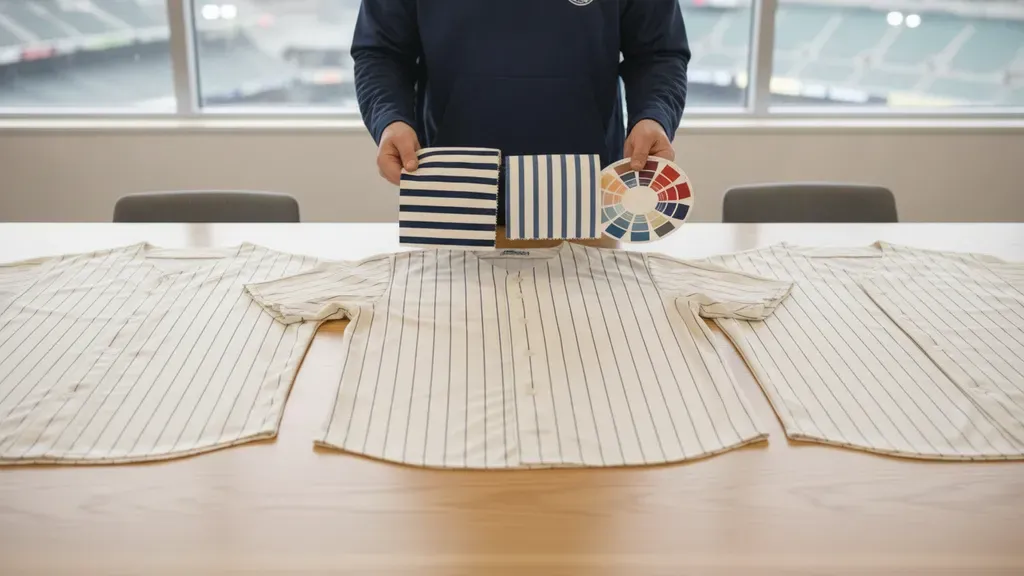
Stripe width, spacing, and contrast determine whether a pinstripe jersey reads as refined, traditional, bold, or modern. Narrow stripes with even spacing create a restrained heritage look, while wider or higher-contrast stripes draw more attention from a distance. Review these choices on the full jersey, not only on a small digital swatch.
Stripe scale and spacing
Thin, closely controlled stripes usually create the most traditional appearance. They give the jersey a clean vertical rhythm and leave the team name or logo as the main focal point. A more pronounced stripe can work for a team that wants a stronger visual statement, but it can also make the front feel busy when combined with large lettering, piping, sleeve panels, and multiple accent colors.
Ask to see how the stripe pattern will align across the body, sleeves, button area, and side panels. A pattern that looks balanced on the front may feel crowded at the placket or difficult to read beneath the back number. The goal is not to chase a specific historical uniform. It is to select a stripe scale that stays consistent with the team's identity and remains legible across the entire roster.
Base color and stripe color
Contrast affects both appearance and usability. A dark stripe on a light base is easy to see and gives the jersey a crisp, traditional profile. A dark base with a lighter stripe can look more contemporary, but the team should check how the pattern interacts with white lettering, outlined numbers, and any sponsor or school mark permitted by its league.
Limit the number of competing colors. A useful starting point is one base color, one stripe color, and one accent color for lettering, piping, or trim. If the team needs a fourth color, assign it a narrow role. For example, use it only as an outline or sleeve accent. This makes future replacements and additions easier to match and keeps the uniforms cohesive when players join after the original order.
Home, away, and alternate versions
If your program needs multiple jerseys, decide whether the versions should share the same stripe pattern or simply belong to the same color family. Consistent stripes with a changed base color can create a clear home and away system. An alternate jersey can use a different cut or accent, but it should preserve at least one recognizable element, such as the team-name font, piping color, sleeve treatment, or number style.
Do not approve a single close-up image and assume the complete set will match. Request views of the front, back, sleeves, and any alternate version. A proof should show enough of the garment to evaluate the stripe scale, not just the lettering.
Which jersey cut and decoration choices work with a pinstripe design?
The jersey cut determines where the stripes, buttons, neckline, and front graphics meet. Decoration determines how the team name, numbers, and logo look and feel on the garment. Uniforms Express lists full button-up, v-neck, 2-button, vest, and raglan options, with Tackle-Twill sewn-on and fully sublimated decoration available on its baseball jersey collection.
Match the cut to the team's use
- Full button-up:
a classic option that gives the pinstripe pattern a traditional baseball frame and a clear front opening.
- V-neck:
a clean alternative for programs that want a less formal front and more open neckline.
- 2-button:
a versatile middle ground that retains a baseball detail without the full button-up appearance.
- Vest:
a sleeveless approach that can make the stripe pattern and underlayer part of the overall look.
- Raglan sleeve:
a sport-focused option with a diagonal shoulder seam and a different color-blocking opportunity.
The best cut depends on the team's expectations for tradition, movement, layering, and roster consistency. A high school program may prioritize a recognizable full button-up silhouette, while a travel team may prefer the visual flexibility of a 2-button or raglan design. Ask how the selected cut affects stripe placement before approving the final artwork.
Choose the decoration method around the design
Tackle-Twill gives lettering and numbers a dimensional, sewn-on appearance associated with traditional team uniforms. It can be a strong choice when the team wants the name and numbers to stand apart from the vertical pattern. Confirm the number of decoration colors and the outline treatment so the lettering remains readable without overpowering the stripes.
Fully sublimated decoration integrates the design into the jersey artwork and gives the team more flexibility for complex color layouts. It can keep the garment visually streamlined because the pattern, team name, numbers, and accents are planned together. Uniforms Express lists both Tackle-Twill and fully sublimated options for its baseball jersey styles, so the decision should follow the desired look, design complexity, and program preferences rather than a generic rule that one method is always better.
A hybrid approach may also be appropriate when the main pattern is handled one way and a key accent, logo, or lettering detail uses another. Ask the account manager to explain what is available for the exact jersey style selected and how the method affects the final proof.
How should team buyers approve names, numbers, and artwork?
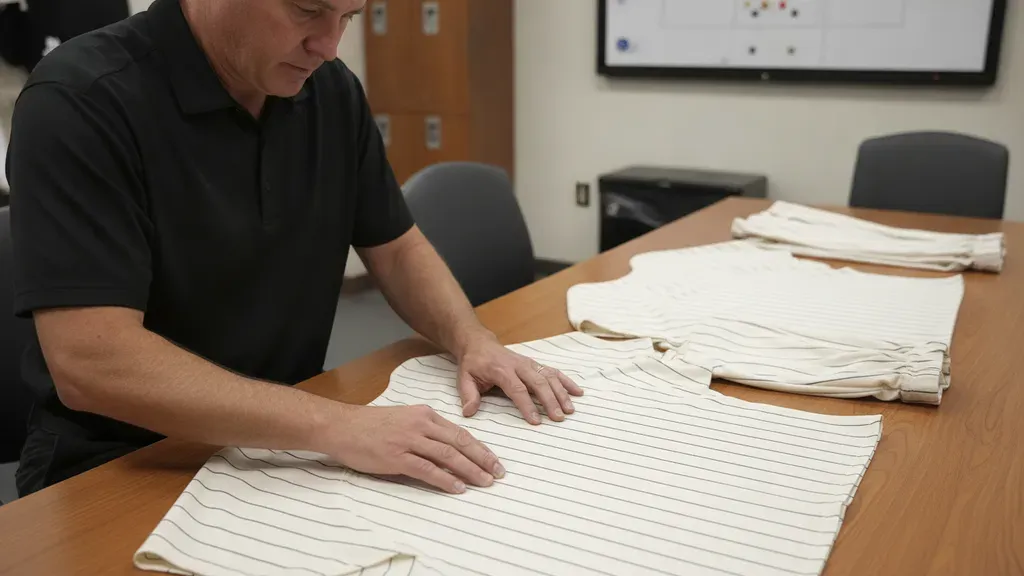
Use one controlled approval process for the design and roster. The person who checks the artwork should not have to rebuild the design from memory. Collect the team name, logo files, player names, numbers, sizes, and special requests in one current roster, then compare that information against the proof before authorizing production.
Review the design proof in a fixed order
- Confirm the garment:
Verify the jersey style, sleeve treatment, neckline, base color, and pinstripe direction.
- Check the visual system:
Review stripe width, spacing, contrast, piping, trim, and the relationship between the pattern and the team name.
- Check personalization:
Confirm every player name, front number, back number, font, outline, and placement.
- Check the logo:
Make sure the correct artwork version is used and that its size and position are approved.
- Compare the roster:
Read each name and number against the latest coach-approved list, including duplicate numbers and late additions.
- Record one approval:
Send one consolidated set of corrections rather than a series of conflicting messages from multiple reviewers.
Look at the proof on a large screen and, when possible, ask for a real color or fabric reference. Digital displays vary, and a subtle stripe can look stronger or weaker depending on the screen. If the team has strict school colors or a previous uniform to match, provide that information before the artwork is finalized.
Protect the back number from the pattern
The back number needs enough contrast against the stripes to be read by coaches, officials, and spectators. This is especially important when the stripe color and number color are close in value. An outline, backing panel, or different decoration treatment may improve legibility, but it must be evaluated on the actual back layout. Do not judge the front team name and back number by the same standard because the stripe interaction can differ.
Use a change cutoff
Set a team deadline for corrections before production begins. After approval, late roster changes may affect the timeline and can create mismatched additions. Maintain the approved proof, the final roster, and the person authorized to request changes. That record also makes future reorders easier because the team can refer back to its established stripe, font, color, and placement decisions.
What is the best ordering process for a pinstripe team jersey?
A reliable order moves from design direction to product selection, proof approval, roster confirmation, production, and delivery. Starting early gives the team room to compare options and correct errors. When the season or tournament deadline is close, tell the supplier the required in-hand date at the beginning, then ask which rush options are available for the selected products and quantity.
- Set the deadline:
Identify the first game, team fitting, tournament, or photography date and work backward from the required in-hand date.
- Gather inputs:
Prepare team colors, logos, preferred cuts, decoration preferences, size information, and the initial roster.
- Compare styles:
Review the pinstripe jersey options, then check pants, jackets, and accessories for a coordinated uniform.
- Request the quote:
Share the quantity and timeline so the account team can recommend an appropriate path.
- Approve the proof:
Check stripe scale, color contrast, decoration, roster details, and the complete front and back views.
- Protect the schedule:
Keep one decision-maker responsible for final corrections and ask for written confirmation of the production and shipping plan.
Uniforms Express states that game-ready custom uniforms may be available in as quickly as two weeks, while rush timing and pricing depend on the products, order details, and production capacity. Treat that as a conversation to have early, not a blanket promise for every pinstripe order. A team with a fixed first-game deadline should request a product-specific timeline before approving the order.
Frequently Asked Questions
Team buyers usually need quick answers about stripe customization, jersey cuts, decoration, readability, timing, and reorders. Use these questions as a final review before requesting a quote, and confirm product-specific availability, rush timing, and artwork details with the Uniforms Express account team before production begins.
Can teams customize the stripe color and contrast?
Yes, teams can discuss the base color, stripe color, spacing, trim, and related artwork for the selected jersey style. Start with the team's established colors, then request a full front and back proof so you can judge how the pattern affects lettering and numbers.
Which jersey cut is best for a pinstripe baseball design?
There is no single best cut for every program. Full button-up and vest styles emphasize a traditional baseball look, while v-neck, 2-button, and raglan styles create different neckline, movement, and color-blocking options. Choose the cut that fits the team's use and visual identity, then check stripe placement on that exact model.
Should a team choose Tackle-Twill or sublimated decoration?
Choose Tackle-Twill when the team wants dimensional sewn-on lettering and numbers. Choose fully sublimated decoration when the design calls for an integrated, streamlined artwork treatment or more complex color planning. Uniforms Express offers both options on its baseball jersey collection, subject to the selected style and order specifications.
How can coaches keep names and numbers readable on pinstripes?
Use clear contrast, an appropriate font weight, and an outline or backing treatment when needed. Review the front and back separately because a number that reads well over one section of the pattern may blend into another. Always compare the proof with the current roster before approval.
When should a team order custom pinstripe baseball jerseys?
Begin as soon as the season or event date is known, especially if the roster, sizing, artwork, and approval process involve several people. Teams with a short deadline should share the required in-hand date at the first conversation and confirm whether a rush path is available for the selected products.
Can the same pinstripe design be used for future additions?
Often, a documented approved proof makes future additions easier to coordinate, but availability, product style, decoration, and production details still need to be confirmed for each order. Keep the final artwork, color decisions, roster record, and supplier contact information together for reorders.
Comments