


Ordering Custom Rugby Uniforms: A Practical Team Guide

When a season date is fixed, a uniform problem can become a team problem: mismatched sizes, unclear numbering, or a late proof can leave players waiting for kit. Planning custom rugby uniforms starts with the requirements that affect every player and every match, not just the color scheme.
What should a team settle before ordering custom rugby uniforms?
Before comparing designs, agree on the job the kit must do. Record the competition and age group, the number of players, the pieces each player needs, and the date the uniforms must be in hand. Confirm any kit rules with the league or competition organizer, then give the supplier one written brief. A complete brief prevents design decisions from hiding practical gaps.
A rugby order may cover match jerseys and shorts, with socks or warm-up apparel handled separately. Do not assume every player needs the same package. A senior squad, development squad, and coaching group may have different items, while substitutes or late roster additions can affect quantities. List each group and each garment before you request a design or quote.
Start with a competition-ready kit list
Ask the competition administrator which garments, colors, and identifying details are required or restricted. Rules can differ by competition, and organizers may specify how teams distinguish home and away kits. Verify current requirements directly rather than relying on last season’s memory. World Rugby is a useful starting point for the sport’s laws and resources, but the relevant local competition remains the authority for its own kit requirements.
Write the result as a checklist. Separate must-haves from preferences. For example, the list might specify a match jersey and shorts for each player, a primary color combination, a contrasting option if required, and a consistent number treatment. Add practical constraints such as whether the team wants the same design across multiple squads or needs a separate colorway for a second side.
Then assign one decision-maker to collect and approve information. A coach, administrator, or equipment lead should own the roster, sizes, artwork, and final sign-off. When feedback comes from several people, route it through that person and return one consolidated set of corrections. This keeps the design process clear and reduces the chance of approving two conflicting versions.
Set the quantity and order structure
Build a working roster with a row for every player and a column for each item. Include the player’s name or roster identifier, garment size, and any approved personalization. Count coaches and staff separately if they need apparel. Mark uncertain roster places instead of quietly guessing; the final count should distinguish confirmed players from possible additions.
Clarify whether the order is one team or several squads, whether each group has a different color or sponsor treatment, and whether replacement garments are part of the request. If the team anticipates a midseason addition, ask how a later single-item order would match the original fabric, color, decoration, and numbering. Do not assume a future reorder will be identical without confirming the process.
Uniforms Express provides online tools and team-uniform information that can help frame the planning conversation. Review the team uniform planning resources and use the uniform builder to explore design direction. A design preview is a starting point, not a replacement for written order details or a final proof.
Which jersey, fabric, and construction details matter for rugby?
Choose the garment around the way the team plays and the competition’s requirements. A rugby jersey needs to feel appropriate for regular contact and movement, while the full kit should be comfortable across the expected conditions. Compare the supplier’s specific fabric and construction options rather than relying on a general label such as “performance.” Confirm what is included in each option and what can be customized.
Ask for concrete information about fabric composition, weight or hand feel where available, stretch, care instructions, seam construction, and how the decoration is applied. The right choice depends on how the team trains, how often uniforms are washed, climate, budget, and the competition rules. No single fabric or decoration method is automatically best for every club.
Compare jersey and short specifications
For the jersey, consider the cut, sleeve length, collar or neckline, side panels, and how the garment sits when a player moves. For shorts, ask about waistband construction, rise, leg length, and whether the team expects players to wear any particular underlayer. If players will use the kit in both training and competition, define which pieces are game-day items and which are training apparel.
Construction details are worth reviewing, but ask the supplier to describe what the proposed product actually includes. A sample, product specification, or clear written description may help the team compare alternatives. Avoid assuming a feature is present because it appears on a mockup; ask whether it is standard, optional, or unavailable for the selected garment.
Color choice affects more than appearance. Decide whether the team needs one home design or multiple looks, how colors will distinguish the squads, and whether the numbers and crest will remain readable against the fabric. Keep a record of the selected color references and placement, especially when several garments or teams must coordinate.
Match decoration to the artwork and use
Common decoration approaches include sublimation, screen printing, heat application, embroidery, and stitched tackle-twill elements. Each has different visual effects and suitability depending on garment, artwork, and placement. Ask the supplier which techniques are available for the specific jersey or shorts, how they affect the design, and whether a particular method is appropriate for the team’s intended use and care routine.
Do not choose a method based only on a small image in a design tool. Ask how fine lines, gradients, multiple colors, sponsor marks, names, and numbers will appear on the finished garment. For example, a complex full-color design may call for a different process than a simple one-color mark. The supplier should confirm the achievable result for the selected product, not just the theoretical possibilities of a decoration technique.
Use this comparison to organize the discussion. It is not a universal ranking: the available options and final result depend on the garment, artwork, and supplier.
Decision | What to compare | Questions to ask |
Jersey and shorts | Cut, fabric, construction, color options | Which product specifications apply to the exact items in this order? |
Decoration | Sublimation, printing, heat application, embroidery, or stitched elements | Which method suits the artwork and selected fabric? |
Personalization | Numbers, names, crest, sponsor marks, placement | What information and artwork files are needed, and how will each item be checked? |
Order quantities | Confirmed roster, extras, separate squads | How are late additions or replacements handled? |
Timing | Proof, approval, production, shipping, distribution | What dates are achievable for this specific order, and what could change them? |
How can you collect sizes without creating a roster headache?
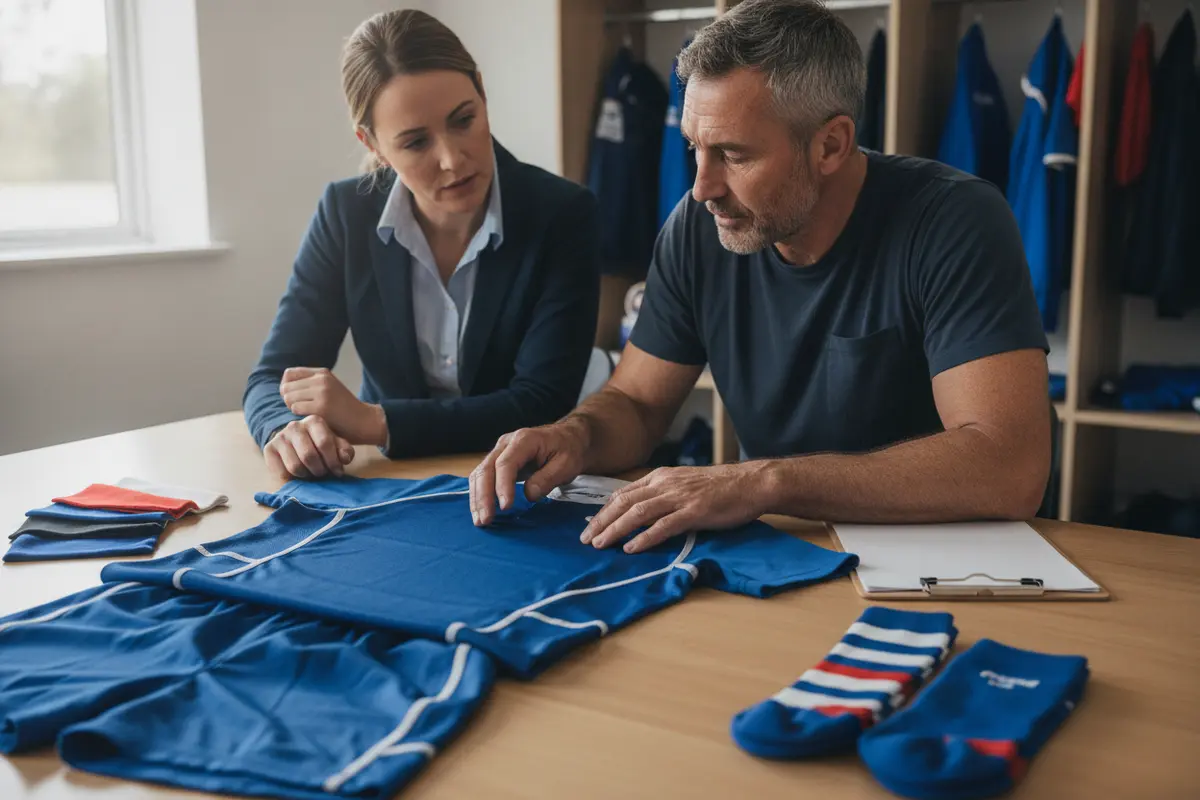
Use one sizing method and a single record that the team coordinator controls. Give players the same instructions, collect every required item size, and resolve missing or uncertain entries before approving production. A consistent process is more useful than a rushed estimate. Check the garment-specific chart and instructions, since sizing can differ across product styles.
Start by downloading the supplier’s current chart for the exact item under consideration. Do not transfer measurements from a different brand or a different garment type without checking. If the supplier provides measuring guidance or a sample process, follow it and tell players whether the chart refers to body measurements or garment measurements. Keep the method consistent for the full roster.
Make a size collection plan players can follow
- Confirm the exact product.
Identify the jersey and shorts styles before collecting sizes. A switch in cut or model may change fit.
- Share one set of instructions.
Send the relevant chart and specify how to measure or choose a size. Direct players to ask questions before the deadline.
- Record choices in one place.
Use a roster spreadsheet or form with a row per player, separate fields for each garment, and an owner for corrections.
- Check unusual entries.
Follow up on blank fields, duplicate names, outlier sizes, and entries that do not match the player’s stated preference.
- Freeze the roster before sign-off.
Mark the version and date so that changes after approval are visible and can be reviewed.
A team should not treat a size chart as a fit guarantee. Players vary in preferred room, layering, and how they want a garment to sit. If the supplier can provide a sample or fitting approach, ask whether it is available for the products and schedule in question. A local fitting or sample is especially useful when many players are ordering the same item, but confirm availability rather than assuming it.
For programs with young players, have a parent or guardian participate in the size decision where appropriate, and follow the team’s normal safeguarding and data-handling practices. Keep roster details limited to the people who need them. The final supplier file should contain only the information required to make and label the order.
Before sending the roster, check that every name or identifier maps to the correct size and personalization. Decide whether the jersey needs a name, number, or both, and confirm spellings and number assignments with the person responsible for the team list. One misplaced digit can be harder to correct after production begins than an error caught in the proof stage.
Uniforms Express has a team uniform sizing chart resource that can help you find sizing information. Confirm that the chart corresponds to the exact rugby garment and order option you are considering, and ask for guidance if the product is not shown.
What should a team approve on the design proof?
Treat the proof as the final checkpoint for both appearance and order data. Check every side and every garment shown, verify names and numbers against the approved roster, and confirm colors, logo placement, and decoration details. A proof that looks attractive but contains a wrong number or an unapproved change is not ready to release.
Ask the supplier what the proof represents. It may show a design concept, a production layout, or a visual approximation of the finished garment. Clarify whether the colors on screen are exact or illustrative, whether the proof includes every requested item, and how corrections should be returned. Get answers before signing off.
Use a deliberate proof-review checklist
- Team identity:
Is the team name correct, spelled consistently, and placed where expected?
- Color:
Do the primary and secondary colors match the written brief and the agreed references?
- Crest and marks:
Are the correct approved files used, with the right size and placement?
- Names and numbers:
Does each player’s information match the roster, including duplicate or reserved numbers?
- Garments:
Does the proof show all ordered items and the correct front, back, and relevant detail views?
- Decoration:
Are the intended methods and placements clear, including sponsor marks if applicable?
- Squad variations:
Are colorways, team labels, and item differences correct across all groups?
Send corrections as one numbered list tied to the proof version. Avoid vague feedback such as “make the crest smaller.” Say which garment, view, and location needs a change, and describe the desired result. Ask for a revised proof and check it again. Keep the approved version in the team’s records so that the production reference is clear.
Do not add a sponsor, change a number, or update a color in a side message after approval without asking how the change affects the order. A late revision can require another review or affect the schedule. Confirm whether a requested correction is included in the current proof cycle and whether it changes any other part of the order.
How should you plan the timeline and delivery?
Work backward from the first date the players need the uniforms, then reserve time for roster collection, artwork preparation, proof review, corrections, production, and shipping. Ask the supplier to confirm the achievable schedule for this particular order. Turnaround depends on the selected items, order details, approval timing, and other conditions, so do not treat a general estimate as a promise for every team.
Build a calendar with named owners and dates. A schedule is only useful when the team knows who is responsible for each step and when a delay needs to be raised. Include time for collecting missing sizes and resolving artwork—not just the production period.
Work backward from the date of first use
- Set the in-hand date.
Choose a date that leaves time to sort and distribute uniforms before the first match or team event.
- Ask for a realistic schedule.
Give the supplier the full quantity, garment choices, decoration needs, destination, and deadline, then request an order-specific timing estimate.
- Set internal deadlines.
Establish dates for the final roster, artwork files, proof feedback, and approval. Name a person responsible for each one.
- Allow for a review cycle.
Leave time to correct a spelling, number, color, or placement issue. Do not schedule approval for the last available day.
- Confirm shipping and receipt.
Ask how delivery will be handled, where it will arrive, and who will check the shipment against the order.
Ask what events can shift the schedule. Incomplete artwork, a changing roster, late proof approval, or an unavailable product option may affect the expected timing. Find out which decisions must be final before production can begin, and what the supplier needs from the team to keep the order moving.
If the first date is close, state the deadline at the start of the conversation. Ask whether the requested products and decoration are feasible on that timeline and whether expedited options are available. Rush turnaround and any added charges depend on the order and must be confirmed directly; never assume a particular schedule or fee applies to all orders.
After delivery, assign someone to check the shipment promptly. Compare the quantities and item types with the approved order, then confirm that names, numbers, and sizes correspond to the final roster. Photograph or record a discrepancy and contact the supplier with the order information. An orderly receipt check makes it easier to identify and resolve a mismatch before the season gets busy.
For a next step, use the Uniforms Express contact page to share your team’s sport, quantity, garment needs, artwork status, and deadline. You can also review the team uniform catalog request option while preparing your questions. Ask for an order-specific consultation and timing rather than relying on a general turnaround claim.
How can you compare suppliers and manage the team budget?
Compare suppliers using the same written requirements and ask each one to identify what is included. Looking only at a headline offer can hide differences in garment types, decoration, personalization, delivery, and proof support. Since prices and available options vary, request a current quote for the team’s actual roster and desired kit rather than relying on an old estimate or a generic per-item figure.
Use a like-for-like comparison: same quantities, same garments, same decoration, same personalization, and a clear delivery destination. Ask whether the quote includes artwork setup, individual names or numbers, shipping, and any optional pieces. If an item is excluded, note it so that the team does not mistake a lower initial total for the same order scope.
Build a budget that reflects the full order
Separate core match kit from optional additions. Jerseys and shorts may be the required base, while socks, training tops, or warm-up apparel might be funded separately. Decide which pieces are essential for the team and which can wait. This makes it easier to adjust the order if the available budget changes without losing track of the minimum kit each player needs.
Plan for the actual roster, not just a single sample uniform. The total order may be affected by squad count, garment options, sizes, personalization, and delivery. Ask whether quantity thresholds or package arrangements apply, and have the supplier explain any differences. Do not assume that an offer for another sport, product, or quantity transfers to a rugby order.
Keep a record of the quote date and assumptions. If the roster changes, ask for an updated total before approving the new quantities. Also agree how the team will handle late additions, replacements, or a future reorder. Understanding those scenarios early helps the coach explain the budget and avoid making an informal promise to players or families.
A practical decision record can be a single page with the approved kit list, size totals, decoration decisions, supplier quote, deadline, and the person who authorized the purchase. Share the relevant parts with whoever handles team finances, but keep player information and payment details restricted to appropriate team personnel. The record provides a clear reference if questions arise later.
There are a few final handoff details that are easy to overlook when a team focuses only on design. Decide who will receive the shipment, how the cartons will be checked, and how kit will be distributed to players. If uniforms are sent to a school, club office, or individual address, confirm the correct destination and contact person in advance. Keep a copy of the approved order with the person receiving the delivery.
For a multi-squad program, label the roster and delivery plan clearly so each group receives the right items. Decide whether coaches will distribute the full kit in one session or whether players will collect pieces at different times. Record any item that arrives with a discrepancy and follow up using the order details. A simple handoff process helps the team spot a missing size or incorrect number before the next event.
Finally, save the color references, approved artwork, garment specifications, and final roster version for the next order. If you make changes later, identify what changed and ask whether it affects matching or availability. That record does not guarantee a future product will be identical, but it gives the supplier a useful reference and helps the team explain its preferences without rebuilding the order from memory.
Frequently asked questions
Quick answers can help a coach resolve common ordering questions, but the right choice still depends on the team’s competition, product options, and schedule. Confirm requirements with the organizer and ask the supplier to verify details for the exact garments and quantities before approving the order.
How do we choose the right rugby jersey for our team?
Start with the competition’s current requirements, then compare the specific jersey’s cut, fabric, construction, available colors, and decoration options. Tell the supplier how the team will use the garment and ask for details about the exact product. If possible, review a sample or supplier guidance before finalizing the choice.
What is the best way to size a full rugby squad?
Use the current size chart for the exact product, provide consistent instructions, and collect each player’s jersey and shorts sizes separately. Have one coordinator check missing or unusual entries and confirm the roster before approval. If fit is uncertain, ask whether a sample or fitting process is available.
Which decoration method should we use for team names and numbers?
It depends on the artwork, garment, placement, and the supplier’s available methods. Ask how the proposed technique handles the team crest, sponsor marks, names, and numbers, and request a proof that shows all of them. Confirm the final method in writing instead of inferring it from a mockup.
How long does it take to receive custom rugby uniforms?
There is no single schedule that applies to every order. Timing depends on the selected products, quantity, decoration, proof approvals, and delivery details. Provide the supplier with the date you need the kit in hand and ask for a confirmed schedule for that specific order, including any rush option and related terms.
How should a club set a budget for rugby uniforms?
List required items first, then separate optional apparel and possible extras. Request a current quote based on the actual quantities, sizes, personalization, decoration, and shipping needs. Compare suppliers using the same order scope, and ask what is excluded or may change if the roster or design changes.
Can we add players or replace uniforms after the main order?
Ask the supplier how later additions and replacements are handled before approving the original order. Confirm whether the same product, color, decoration, and number style can be matched and whether minimums or schedule considerations apply. Keep the approved artwork, roster version, and order reference so future requests have a clear starting point.
Good planning makes the uniform order easier to approve and easier to use: define the kit, verify sizing and artwork, and get order-specific timing in writing. With those decisions organized, a coach or team administrator can discuss custom rugby uniforms with a supplier from a clear, practical brief.
Comments