


Custom Softball Uniforms: Design Tips and Ordering Guide

Updated: 6 days ago
For a coach, a uniform order is more than a color decision. It has to match your team identity, fit the athletes comfortably, and arrive before the first game, not after the schedule has already started. Delivery speed and reliability are the leading pain points coaches report when ordering athletic uniforms, so your design plan should begin with the season deadline.
The best custom softball uniforms balance player-ready fit, breathable performance fabrics, durable decoration, and a clearly confirmed delivery date. Start with the roster and deadline, then choose a jersey style, color system, decoration method, and matching apparel that your team can approve before production.
Working with a direct manufacturer can also simplify quality control because the production process stays under one roof. Uniforms Express offers custom jerseys in as little as two weeks, compared with a typical industry standard of four to twelve weeks, while providing guaranteed delivery dates. The right starting point is comparing the jersey styles that shape both appearance and movement.
Softball Uniform Styles: Button-Up, V-Neck, and Raglan Jersey Options
Button-up jerseys deliver a traditional baseball look, V-necks give teams a clean athletic profile, and raglan sleeves add shoulder mobility and a distinct identity. For fastpitch, prioritize a close women's or girls' fit that stays secure through quick movement. Slowpitch teams often prefer a roomier cut. Choose the style around player comfort, movement, and your season deadline.
Start with the way your team plays and moves, not just the way a jersey looks on a catalog model. A good softball jersey should sit cleanly at the shoulders, leave room for a full swing, and stay in place when players slide, throw, or reach overhead. Ask for a size chart and compare it with a jersey your players already wear before you finalize the roster order.
Button-up jerseys: the traditional choice
Button-up jerseys are the familiar choice for teams that want a classic baseball-inspired uniform. They work well for programs that value a structured, traditional appearance and may pair naturally with matching pants, belts, and caps. Coaches should check the button spacing and torso length, especially for younger players who may need room to grow without creating excess fabric around the shoulders.
V-necks: a clean athletic profile
V-neck jerseys offer a streamlined look and an easy entry point for players. They can feel less restrictive around the neckline than a fully closed collar, which is useful during long practices and warm games. A women's cut can shape the torso more naturally, while a girls' cut should account for age, layering, and the range of body types on a youth roster. Do not assume one unisex size curve will fit every team.
Raglan sleeves: built for shoulder movement
Raglan sleeves run diagonally from the collar toward the underarm rather than using a traditional shoulder seam. That construction gives the jersey a recognizable look and can make the shoulder area feel less restrictive during batting and throwing. Raglan is a strong option when you want visual contrast between the body and sleeves. But confirm the sleeve length and underarm fit so players can move without extra bulk.
Fastpitch teams typically benefit from a more athletic fit that stays close to the body during rapid defensive movement and base running. Slowpitch teams may choose a relaxed cut for comfort and easier layering. For women's and girls' teams, offer measurements by player instead of guessing from age or a single sample. Bust, waist, hip, sleeve, and torso measurements can reveal whether a style needs a women's shape, a girls' proportion, or a unisex alternative.
Ordering from a direct manufacturer also affects the practical side of the decision. Owning the production process supports tighter quality control and can provide better pricing than a layered supply chain. It can also matter when your deadline is close: custom jerseys may be available in as little as 2 weeks, compared with a 4-12 week industry standard. Confirm the guaranteed delivery date in writing before approving the design. Review the full range of softball team uniforms and select the cut your players can perform in, not merely the one that photographs best.
How Do You Decorate Custom Softball Uniforms?
The best decoration method depends on the garment fabric, artwork, and how your team will use the uniform. Sublimation gives lightweight jerseys all-over color, while Tackle-Twill, screen printing, heat press, and embroidery create different looks and textures. Choose for durability and readability first, then use a combination when the design calls for it.
Start by deciding whether the artwork should become part of the fabric or sit on top of it. For most design your softball jerseys projects, that choice affects the look, feel, and long-term maintenance more than the logo itself.
Sublimation for full-color softball designs
Sublimation is well suited to lightweight performance fabrics and designs with gradients, pinstripes, patterns, or multiple colors. The artwork is integrated into the jersey material rather than applied as a separate layer, which helps preserve a smooth, flexible feel. It is a practical choice when every player needs a detailed design with names, numbers, and team graphics.
Because the design can cover the garment broadly, sublimation also gives coaches more control over visual consistency. Review the artwork at actual jersey size before approving it. Fine details that look clear on a screen may need stronger contrast or simpler shapes to remain readable from the field.
When Tackle-Twill, screen print, or heat press makes sense
Tackle-Twill creates a sewn-on, dimensional appearance that works especially well for bold lettering, traditional team names, and straightforward numbers. It gives a uniform a classic baseball and softball identity, but the added layers and stitching should be considered when choosing a lightweight jersey.
Screen printing is useful for simpler graphics and limited-color artwork. Heat press decoration is flexible for names, numbers, and smaller runs or details that need to be applied after the base garment is selected. The right choice depends on the artwork and garment, not on a one-size-fits-all rule. For a closer breakdown, compare Tackle-Twill vs sublimation vs screen print.
Decoration method | Best for | Look and feel | Durability notes |
Sublimation | Full-color designs, gradients, and all-over patterns on lightweight jerseys. | Artwork becomes part of the fabric; smooth and flexible. | Will not peel or crack; color can fade with heavy UV exposure over time. |
Tackle-Twill | Bold team names, traditional lettering, and classic numbers. | Sewn-on, dimensional, raised edges. | Very durable; layers add slight weight to lightweight fabric. |
Screen print | Simple graphics, limited-color logos, and large runs. | Flat ink layer on the fabric surface. | Durable on most fabrics; can crack with repeated washing if overstretched. |
Heat press | Names, numbers, and small-run details. | Applied film or vinyl layer. | Good when applied correctly; inspect edges for lifting over a season. |
Embroidery | Small logos on jackets, caps, and bags. | Raised, textured threadwork. | Long-lasting on heavier apparel; avoid large, dense artwork on lightweight jerseys. |
Use embroidery for selected details
Embroidery adds a raised, textured finish that can work well for small logos on jackets, caps, bags, or heavier apparel. It is usually better for compact marks than for large, highly detailed jersey artwork. Ask for a proof so you can confirm that lettering remains legible and that the decoration will not make a lightweight area feel unnecessarily heavy.
When should you combine decoration methods?
Combining methods can give different pieces of the uniform distinct jobs. For example, a team may use sublimation for an all-over jersey base, Tackle-Twill for a bold chest identity, and embroidery on a jacket or cap. Keep the colors, fonts, and number treatment consistent across every method so the finished set still looks like one uniform.
Uniforms Express provides proprietary design configurators to help coaches plan custom softball uniforms before production. Use the interactive uniform builder to compare a clean base design with more layered decoration, then confirm the final method against the fabric and season demands.
What Fabric and Fit Matter Most for Softball Jerseys?
For a softball jersey, prioritize lightweight breathability, a secure but unrestricted fit, and construction that can handle a full season of practices and games. Moisture-wicking materials can help sweat evaporate, while the right women's cut and sleeve design keep players comfortable through repeated swings, slides, and throws.
Fabric choice should start with how your team plays and how often the jerseys will be worn. Lightweight, breathable sports fabrics are designed to support sweat evaporation and comfort during exercise in heat, according to research on sports clothing and thermoregulation. For softball, that usually means a jersey that allows airflow through the torso and does not feel heavy when damp.
Look for breathable performance, not just a fabric label
Moisture-wicking fabric is useful because it moves perspiration away from the skin, where airflow can help it evaporate. That matters during doubleheaders, hot tournament weekends, and long innings in the sun. Still, do not assume one fiber automatically outperforms every other option. The same review found that relatively few studies have identified significant comfort or performance differences between natural and synthetic fabrics. The weave, weight, surface treatment, and garment construction all matter.
Ask for a clear description of the jersey material and test the feel before committing to a full order when possible. A fabric that feels comfortable standing in a store may behave differently during repeated high-intensity play. Research also cautions that previous wearer trials often failed to reproduce the upper limits of real training and competition demands. In practical terms, evaluate jerseys against your actual season: heat, game frequency, sliding, laundering, and how long players will wear them.
Choose a women's cut that supports movement
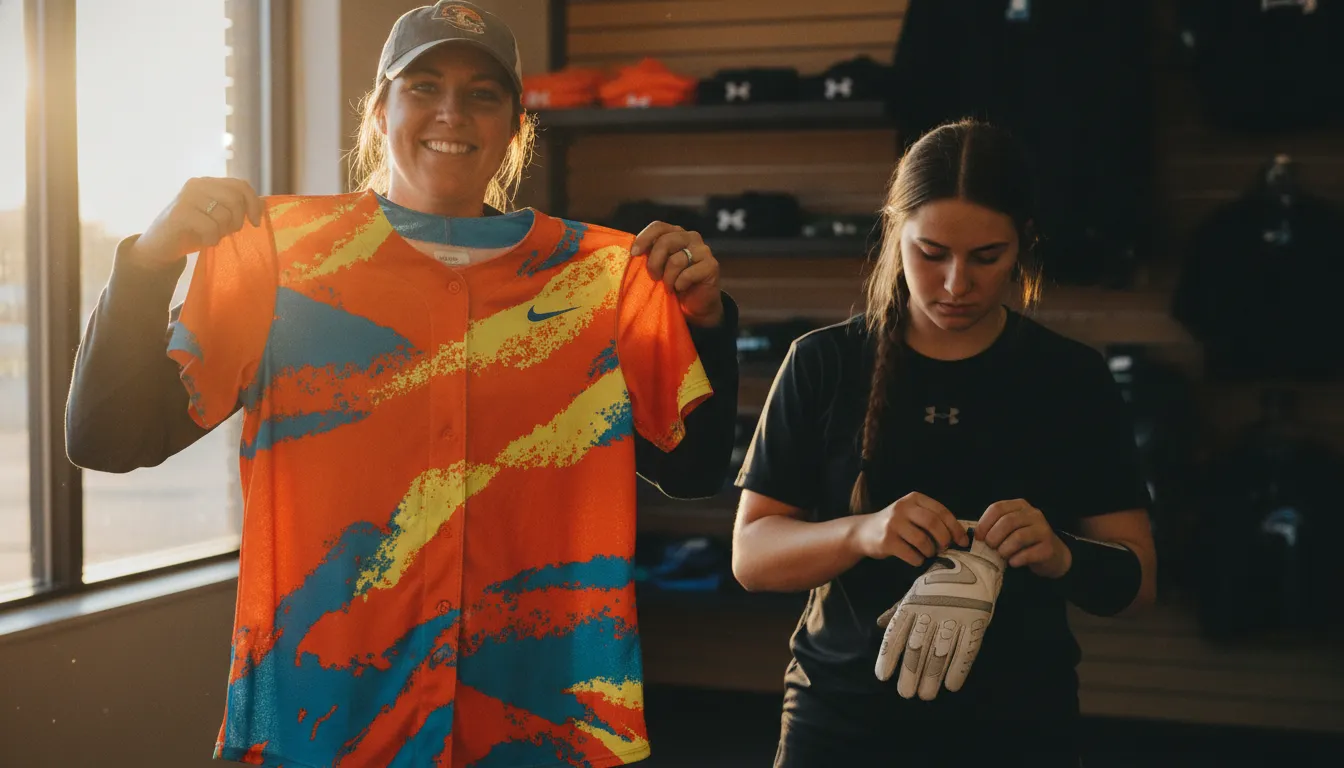
Women's softball jerseys should follow the athlete's shape without pulling across the chest, binding at the shoulders, or riding up when she raises her arms. Compare the size chart with actual player measurements, especially chest, waist, and hip measurements. A slightly shaped torso can look cleaner than a straight unisex cut, but it still needs room for a full swing and an undershirt.
Raglan sleeves can provide useful shoulder mobility, while a traditional button-up or V-neck may fit the team's preferred look. Check sleeve openings and jersey length with players who wear protective gear or tuck their jerseys into pants. For softball team apparel and accessories, coordinate the jersey fit with pants, undershirts, and outer layers so the complete uniform moves as one system.
Build for the whole season
Durability is more than a thick material. Look for stable seams, secure hems, resilient decoration, and care instructions your team can follow. Ask how the jersey is expected to hold up through regular washing, tournament travel, and contact with dirt. A direct manufacturer can explain how the garment is constructed and control quality across production, which gives coaches a clearer path to resolving issues before the season starts.
The Uniforms Express Ordering Process for Softball Teams
Ordering custom softball uniforms becomes straightforward when you work backward from the first game. Confirm your roster and deadline, settle the look and decoration, approve a quote, and allow production time before delivery. Uniforms Express keeps the process organized from the first design conversation through a guaranteed delivery date.
- Lock the roster and season deadline.
Start with the details that control the order: player names, sizes, jersey numbers, the number of pieces required, and the date the team must be game-ready. Most custom orders typically require a minimum of 12 pieces, so confirm your expected order size early. If your roster may change, ask how additions or replacements should be handled before approving production.
- Choose the uniform style and decoration.
Decide whether your team needs jerseys only or a complete uniform package, then select the cut, colors, trim, names, numbers, and logo treatment. Common decoration methods include sublimation, Tackle-Twill, screen print, heat press, and embroidery. Your choice should support the fabric, design complexity, and level of durability your season demands. A direct manufacturer can also help keep the design practical for production.
Build the design with expert help.
Use the free design service or
design your custom softball uniforms online
with the interactive uniform builder. This gives coaches a clear way to explore colors, layouts, and team details before requesting approval. Share your artwork, school colors, or inspiration, and review every spelling, number, and placement detail before moving forward.
- Request and approve the quote.
Once the design and quantities are clear, request a quote with the correct roster information and delivery deadline. Review the product list, decoration details, sizes, shipping information, and approval proof together. Do not approve the order until the final design matches what your team expects and the delivery date fits your schedule.
- Let production begin.
After approval, the order moves into production. Uniforms Express is a direct manufacturer that controls the production process, which supports consistent quality control and clear scheduling. Custom jerseys may be available in as little as 2 weeks, compared with the 4-to-12-week industry standard, but your confirmed delivery date should remain the controlling deadline.
- Receive and check the shipment.
When the uniforms arrive, open the boxes promptly. Match the quantities against the roster, check names and numbers, and inspect the decoration before the first game. Reporting a discrepancy quickly gives the team the best opportunity to resolve it before the season begins.
How to Design a Softball Uniform Your Team Will Be Proud to Wear
Start with the identity your team wants to project, then make every design choice support it. A coordinated color scheme, practical accessories, readable names and numbers, and well-matched decoration create a uniform that looks professional without feeling overworked. The best design is easy to recognize from the dugout and comfortable to wear all season.
Build the color scheme around your program
Use your school, league, or club colors as the foundation rather than chasing a short-lived trend. Choose one primary color, one supporting color, and an accent for trim or lettering. This gives the jersey enough contrast for names and numbers while keeping the overall look consistent across the roster. If your program has an established logo or color standard, treat it as the starting point for the uniform, not an afterthought.
Think beyond the jersey. Pants, visors, socks, belts, and undershirts should reinforce the same palette. Matching accessories make the team look organized when players warm up, travel, or take the field. For a coordinated wardrobe, review custom softball uniforms and apparel before locking in the final colors.
Make names and numbers readable
Place numbers where they can be identified quickly from the stands and the coaching box. The back is typically the primary location, while a smaller number on the front or sleeve can help with player recognition. Keep the name and number sizes proportional, and use strong contrast between the lettering and jersey fabric. Check that the chosen typeface remains legible when outlined or layered over stripes, gradients, or other design elements.
Ask for a roster proof before production. Confirm every spelling, number, placement, and size, including coaches' apparel if it is part of the order. A clean proof review prevents a small design detail from becoming a season-long distraction.
Choose decoration that supports the design
Decoration should match the fabric, the visual effect you want, and the amount of wear the uniform will receive. Common options include sublimation, Tackle-Twill, screen print, heat press, and embroidery. Sublimation works well for integrated colors and patterns, while Tackle-Twill creates a traditional, dimensional team look. Screen print and heat press can suit simpler graphics, and embroidery is useful for selected details rather than crowded jersey fronts. The right balance keeps the uniform distinctive, durable, and easy to read.
Use a design configurator to test color combinations, lettering, and placement before requesting final approval. Uniforms Express provides a uniform builder tool to help coaches develop a clear concept, then refine it with the production team. Review the decoration choices as a complete system so the finished uniform communicates one team identity instead of several competing ideas.
Frequently Asked Questions
How much do custom softball uniforms cost?
The total depends on the uniform style, decoration method, apparel pieces, and order size. Request a team quote after confirming your roster and design so the manufacturer can recommend the right combination without guessing at your needs.
What is the fastest turnaround time for custom softball uniforms?
Some custom jerseys can be delivered in as little as 2 weeks, while the broader industry standard is 4 to 12 weeks. Confirm your game or tournament deadline before approving the order, and request a guaranteed delivery date in writing. Source: Uniforms Express.
Can I design softball uniforms online?
Yes. A proprietary design configurator lets coaches explore colors, styles, and customization options before submitting the design for review. Use the online uniform design tool to create a starting concept, then verify names, numbers, sizes, and placement before production.
What decoration method is best for a softball uniform?
That depends on the fabric, artwork, and desired finish. Common options include sublimation, Tackle-Twill, screen print, heat press, and embroidery. Ask the manufacturer to match the method to your design, especially when artwork includes gradients, layered lettering, or fine details. Source: Uniforms Express.
Are there minimum order requirements?
Most custom orders typically require at least 12 pieces. Share the expected roster size early, including coaches or replacement garments if applicable, so the quote and production plan reflect the full team. Source: Uniforms Express.
Ready to Design Your Custom Softball Uniforms?
A clear design plan helps your team choose the right look, decoration, and fit before production begins. Get a free custom softball uniform design consultation and fast quote tailored to your season timeline. Get started with the uniform builder, or call the uniform team at 888-661-7044. Share your roster details, design ideas, and delivery deadline so the Uniforms Express team can confirm a delivery date your schedule can count on.


Comments