


How Teams Choose Custom Wrestling Uniforms

A uniform problem discovered just before the first meet can turn a straightforward team order into a scramble over sizing, artwork, and delivery. Planning custom wrestling uniforms early gives coaches time to confirm competition requirements, collect a dependable roster, and check the design before the order moves forward.
\n
What should a team decide before choosing custom wrestling uniforms?
Before comparing styles, define what the team needs, when athletes need it, and who will approve the order. Separate competition apparel from practice or travel items, identify rules that apply to the program, and list the design elements that cannot change. These decisions help make supplier conversations focused and make later approvals easier to verify.
Start with the actual use. Is the purchase for a competition singlet, practice gear, warmups, or a coordinated mix? Write down each item separately, including approximate quantities and which team levels need it. Avoid assuming a single garment must cover every use. A competition piece may have requirements that are not relevant to a warmup shirt, while practice apparel may be selected around comfort and repeat wear.
Next, identify the relevant competition organization and confirm its current uniform requirements. Rules can depend on the event, age group, school association, or governing body. Check the current materials from the organization responsible for your competition rather than relying on an older uniform, an online discussion, or an assumption from another program. For USA Wrestling event resources, start at the USA Wrestling official website; school programs should also confirm the applicable state or league rules with their athletic department. The organization’s current rules, not a supplier’s design suggestion, determine what is acceptable for an event.
Make a short brief for the design. Separate required elements—such as approved colors, team name, or a specific logo—from optional preferences such as an accent panel or extra personalization. Note who has authority to approve school marks and who can authorize spending. When a school, club, and booster group are all involved, settle the decision path before artwork begins.
Finally, work backward from the first date the athletes must have the items. Build a calendar with internal deadlines for roster collection, design review, approval, order confirmation, production, shipping, and distribution. Ask the supplier which milestones apply to the exact product under discussion. Uniforms Express offers team-planning material in its uniform planning resource, but product availability and specific order details should be confirmed directly.
List each garment and its intended use.
Confirm the rule source for your competition and season.
Separate fixed branding from optional design choices.
Name one order lead, one approver, and a backup reviewer.
Set an in-hand date and internal deadlines with room for review.
Which garment and construction details should buyers compare?
Compare candidate garments against the program’s use, required coverage, fit preference, care routine, and approved event rules. Ask for product-specific details instead of assuming that every singlet has the same cut, material, or decoration options. A clear comparison should distinguish confirmed specifications from questions that still need an answer before the team chooses.
For a competition singlet, consider how the garment is intended to fit, how much stretch it provides, where the seams sit, and whether the cut offers the coverage the team expects. Ask what material is used and how the product’s care instructions address washing and drying. These are questions to verify for the specific item, not qualities to infer from a photograph or a general description.
Look closely at the construction points that matter during repeated movement and washing. Ask whether seams or other stress areas have any reinforcement, and what care steps help maintain the garment. If the supplier cannot confirm a feature, do not record it as a specification in the team brief. Keep a written note of the answer so that the approved option and final order description match.
Fit needs a team-wide plan, not a single sample decision. Request the product’s size chart and measurement guidance. A sample can help the team understand the cut, but one athlete’s experience does not establish the correct size for everyone. If sample garments are available, use them to explain fit and measuring, then collect each athlete’s information consistently. Make sure an uncertain or between-size entry is resolved with product-specific guidance instead of guesswork.
Separate competition garments from other apparel in the order. Practice tops, warmups, or travel items may need a different fit and care discussion from a singlet. A coordinated color palette can connect these pieces without requiring them to use identical construction or decoration. Uniforms Express provides team uniform sizing charts; use the chart for the item being considered and ask the company to clarify any fit question it does not answer.
Decision area | Option or question | What to compare | Before approval |
Primary use | Competition garment | Required coverage, cut, fit, and event rules | Confirm rule compliance for the specific event |
Additional use | Practice or travel apparel | Comfort, repeat wear, coordination, and care | List it as a separate item with its own quantities |
Fit process | Size chart and measurement collection | Product-specific chart and consistent measuring | Resolve uncertain entries before submitting |
Decoration | Logo, name, or team identity | Method suitability, visibility, and placement | Review a proof for each distinct garment |
Schedule | Requested in-hand date | Approval, production, and shipping milestones | Get timing confirmed for the actual order |
The table is a working checklist, not a substitute for product specifications. For each option, record the supplier’s answer, the person who confirmed it, and any condition attached to it. That record prevents a general comment about one product from being mistakenly applied to a different garment.
How can coaches collect reliable sizes and organize the roster?
A reliable roster gives the buyer a single source of truth for quantities, sizes, teams, and any approved personalization. Choose one person to maintain the master list, provide the same product-specific sizing instructions to everyone, and set a deadline that leaves time to resolve questions. Check the final totals against the planned order before approval.
Use a consistent form or spreadsheet with one row per athlete and separate fields for team level, garment, size, and personalization if the selected product supports it. Do not combine a name and sizing instruction in a single free-text cell. A clean format makes it easier to spot missing information and reduces the chance that an instruction gets overlooked when the order details are transferred.
Send the size chart and any measurement directions with the request. Explain who should take measurements, which garment the chart applies to, and when the athlete or family must respond. Do not infer a size from age, height alone, or a different brand’s garment. If a wrestler is between sizes or unsure about the fit, mark the entry as pending and ask for specific guidance before locking the roster.
Keep revisions controlled. The roster lead should update the master copy, note the date of each change, and flag decisions that still need approval. If athletes send updates through several channels, consolidate them before changing the order record. For a program with varsity, junior varsity, or club squads, label each group clearly and distinguish shared design elements from team-specific differences.
Before submitting, run a simple audit. Count athletes by team and garment, compare that count with the requested quantities, and scan for blank sizes, duplicate names, and inconsistent personalization. Have a second person check the list against the source responses. This second review is particularly useful when the order includes multiple garment types or when the roster changed during the season-planning process.
Choose the roster owner and set a submission deadline.
Distribute the correct size chart and measurement directions.
Collect every garment and size in separate, consistent fields.
Flag uncertain entries; do not fill them by assumption.
Reconcile totals and ask a second reviewer to check the final list.
Save the approved roster with the proof and order confirmation. When the shipment arrives, this gives the distribution lead a clear record for sorting items by athlete and team. It also makes future planning easier because the next order lead can see which sizes and product details were actually confirmed rather than rebuilding the record from scattered messages.
How should the team choose design and decoration details?
Begin with the team’s approved identity and make the most important element easy to recognize. Choose the logo, colors, team name, and any permitted personalization, then assess how they look on the garment’s actual shape. Keep contrast and readability in mind, and confirm which decoration choices can be used on the selected product before the design is treated as final.
A useful design brief explains hierarchy. Decide what should be noticed first, such as the team name or primary mark, and let secondary details support it. Too many equally prominent elements can compete for attention. Consider how lettering and marks will appear against each color area, whether placement remains visible when the garment is worn, and whether the proof clearly identifies the front, back, and any side detail.
Ask about the decoration method for the exact garment and artwork. Uniforms Express uses methods such as sublimation, screen printing, heat press, embroidery, and tackle twill across its product range; availability and suitability depend on the product. Do not assume a method used on another sport’s jersey can be applied to a wrestling singlet. Ask which options are available, how the chosen method affects the intended design, and what care instructions apply.
Send one clearly marked, approved logo file when possible. If the school or club has several versions, identify which artwork is authorized and provide color references or usage guidance. Avoid sending several files without saying which one is final. For athlete names or other personalized details, establish the exact spelling and format in the roster, and confirm whether each variation will be shown on the proof.
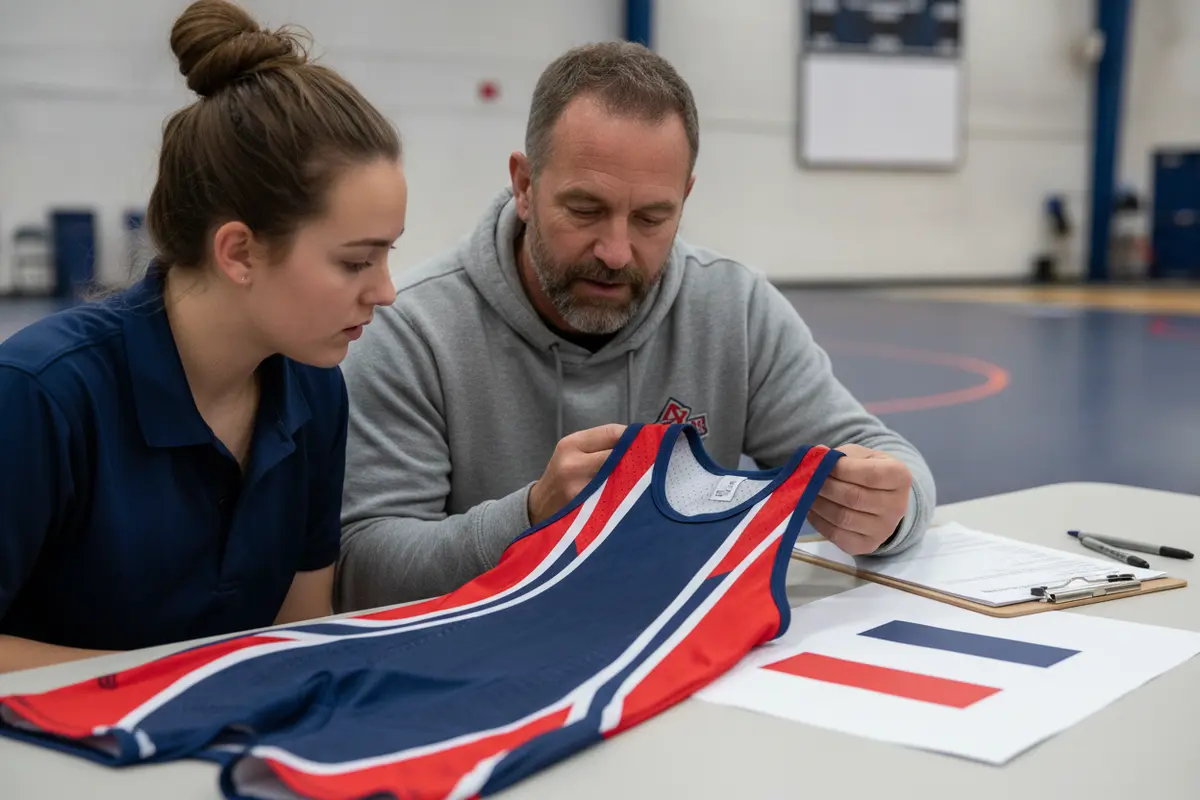
Review a visual mockup on the garment, not just a flat artwork file. Check whether the design appears balanced across the garment panels and whether important elements remain clear at normal viewing distance. A uniform design builder can help explore visual ideas, but its preview should not replace a product-specific proof or a written confirmation of construction, decoration, and order details.
What should the buyer verify on the proof and order confirmation?
Use the proof as a formal checkpoint, not a quick glance. Compare every visible detail with the team’s approved brief and compare every name, size, and quantity with the final roster. Then make sure the written order describes the same product and version that the team approved. Ask questions about anything unclear before giving approval.
Assign separate reviewers if possible. One person can check the identity and artwork: correct logo, colors, wording, orientation, placement, scale, and legibility. Another can compare the roster: athlete names, sizes, personalization, team divisions, and quantities. A single reviewer may miss an error when checking both design and data at once, especially when several versions look similar.
If the order has more than one garment or team variation, review each proof individually. Do not infer that a change shown on one version will appear on all of them. Check the exact file name or version date and remove outdated proofs from the approval thread. When a visual detail is too small to judge or a required element is missing, request clarification or an updated proof rather than approving an assumption.
Next compare the written order confirmation with the approved proof and roster. Verify the garment description, selected options, quantities, size breakdown, personalization, delivery destination, and requested date. If changes are requested after approval, ask how they affect cost, production, and schedule before authorizing them. Retain the final proof and the written response that confirms the order details.
Is the current logo version used in the correct colors and position?
Are spelling, names, and approved personalization accurate?
Does each size and quantity match the signed-off roster?
Are all teams and garment variations shown in the proof set?
Does the order confirmation match the final proof and requested date?
Keep the approval record with the roster and order confirmation. Uniforms Express explains its background and approach on its company information page; for a specific garment or production question, rely on an answer tied to the actual order rather than a general description.
How do you plan timing, delivery, and distribution?
Start from the date athletes must have uniforms and work backward through each decision that could hold up the order. Include roster collection, artwork, proof review, approval, production, and shipping. Timing depends on the product and order details, so ask the supplier for a schedule that applies to your specific request instead of relying on a general turnaround statement.
Set internal deadlines earlier than the supplier’s final dates. Give athletes time to respond, then reserve a short window to resolve missing sizes and duplicate entries. Set a separate proof-review deadline and identify one person who will consolidate corrections. This structure gives the team a chance to fix an error without multiple reviewers sending conflicting instructions.
When contacting Uniforms Express, provide the sport, garment needs, approximate quantity, target in-hand date, and status of the logo and roster. The company states that some custom products can be game-ready in as little as two weeks; that is not a guaranteed schedule for every wrestling-related request. Ask whether the specific product, artwork, and order requirements can meet your date, and confirm any rush option and related pricing directly.
Plan what happens after the order ships. Confirm the receiving address, who will accept delivery, and who will check the package against the order. Sort items by team or athlete, compare the received sizes and quantities with the approved roster, and leave time for athletes to try on their items before competition. Report a discrepancy promptly through the order contact and keep the packaging and order records available while it is reviewed.
For a complicated order, note the decision points that could affect delivery: late roster changes, revised artwork, separate team proofs, or unanswered sizing questions. Ask the supplier how each change affects the schedule before approving it. If the requested date cannot be confirmed, discuss alternatives early, such as adjusting the garment mix or using a staged plan, only if the supplier confirms those choices are available for the order.
When the order is complete, save the approved design, size chart used, roster, confirmation, and delivery notes together. This record makes a reorder more organized and gives the next coach a useful starting point. It does not mean every detail will remain available or unchanged; confirm current product, decoration, and schedule information again before a future purchase.
Teams can use the catalog request page to explore uniform information and the online booking page to arrange a conversation. For ordering terms or process questions, review the terms and conditions and confirm any point that applies to your team directly.
Frequently asked questions
These practical answers cover the most common decisions in a team order: rule checks, sizing, decoration, schedule, and budget planning. The exact product and event requirements matter, so use these points to prepare questions and verify the details for your roster before approving a purchase.
How do we know whether a wrestling uniform meets our event rules?
Identify the organization governing your competition and check its current uniform rules for the relevant level and season. Ask your athletic department or event organizer if a rule is unclear. Do not treat an old uniform, an online example, or a supplier’s general suggestion as final approval.
How should we choose sizes for a wrestling team?
Use the chart and measuring instructions for the exact product under consideration. Collect entries in a single roster, and flag an athlete who is between sizes or uncertain. Ask the supplier for product-specific fit guidance rather than estimating from age or another garment.
Can the team add names, numbers, or a custom logo?
Options depend on the product and artwork. Ask which forms of personalization are available for that garment, what file or roster format is needed, and whether every variation will appear on the proof. Confirm spelling, colors, position, and authorization before approval.
How far ahead should we order custom wrestling uniforms?
Work backward from the date athletes need the items, allowing time for roster collection, design review, approval, production, and delivery. Ask Uniforms Express to confirm the schedule for the specific product and order. Some custom products may be game-ready in as little as two weeks, but timing is not universal.
How can a team manage its uniform budget without pricing surprises?
Set the program’s spending limit before comparing options, then request a quote based on the actual garment, quantities, and customization. Compare complete order details rather than an isolated item. Confirm current terms, shipping, and any rush-related charges directly because pricing and availability can vary.
What should we include when asking for product guidance?
Share your team level, approximate quantity, garment needs, competition date, approved artwork status, and any known event requirements. Include the roster status and questions about fit or decoration. These details help the company determine what information it needs to discuss a suitable option and a realistic schedule.
A thoughtful order starts with current requirements, a dependable roster, and a proof that matches the team’s approved design. Confirming those details and the actual delivery schedule before approval gives coaches a clearer path from planning to distributing uniforms to athletes.
Comments