


Team Uniform Ordering Timeline: Season-Ready Guide

Updated: 7 days ago
The season opener is a fixed deadline, but uniform ordering rarely is. Design revisions, roster changes, payment approvals, production, quality checks, and shipping can each consume time that is difficult to recover later. Start by working backward from the first game, then reserve room for the decisions your staff cannot control.
A practical team uniform ordering timeline begins about 10 to 14 weeks before the first game for a fully custom order. Use that window to confirm the product and design, collect sizes and names, approve the proof. Complete payment or a purchase order, and leave time for production, inspection, shipping, and distribution. Actual timing varies by customization level, order readiness, and capacity.
The safest plan is not simply choosing an early date. It is assigning a clear checkpoint to every handoff, from the first design decision through the moment uniforms reach players. Here is how to map those checkpoints against your season start.
What Does a Team Uniform Ordering Timeline Look Like?
A practical team uniform ordering timeline works backward from the first practice or game, with roughly 10 to 14 weeks as a planning target for fully custom uniforms. The actual schedule depends on the product, customization level, roster readiness, payment, shipping, production capacity, and any requested rush service.
Time before the season | Planning checkpoint | What can affect the timing |
14 to 12 weeks | Set the budget, product scope, team colors, and approval team. | Multiple teams, age groups, campuses, or decision-makers may require more coordination. |
12 to 10 weeks | Request product options, pricing, and initial designs. | Decoration method, product availability, and the level of customization influence the available options. |
10 to 8 weeks | Hold sizing, finalize the roster, and choose the product. | Uncertain rosters, number assignments, or specialty fabrics can add review time. |
8 to 6 weeks | Approve the quote, art proof, roster, and payment or purchase order. | For standard custom orders, the documented six-week on-time delivery guarantee starts from payment receipt, not simply from the first design conversation. |
6 to 2 weeks | Allow time for production, quality checks, shipping, and order reconciliation. | Basic customization generally takes 2 to 3 weeks, semi-custom orders 3 to 4 weeks, and full custom manufacturing 4 to 6 weeks. Imported goods, peak-season demand, or shipping disruptions may extend the schedule. |
Final 2 weeks | Distribute uniforms and resolve shortages or replacement needs. | Keep enough buffer to verify cartons, identify missing pieces, and address a size or roster issue before the first competition. |
These ranges are planning guidance, not universal promises. Uniforms Express documents a 25-business-day average turnaround, while the product and customization tier still determine the appropriate production window. Company-owned manufacturing facilities provide visibility into scheduling, quality assurance, material inventory, and rush prioritization, but capacity remains a factor during busy periods.
Payment timing is another important decision gate. Production can start the same day after payment according to the customer-experience information, so a complete roster and approved details help keep that clock moving. For a closer look at the ordering process, review Uniforms 101 ordering education.
How Early Should You Start the Design and Quote?
Start the design and quote process as soon as your season date, sport, and product needs are known. Early decisions on colors, artwork, decoration, quantities, and approvers give your team time to compare options, resolve feedback, and approve an accurate quote before production timing becomes urgent.
Begin by confirming the sport and the products each athlete needs. Uniforms Express supports a range of sports, and product choice affects the design scope and ordering details. Decide whether you need jerseys, shorts, pants, warmups, or another coordinated set. Then settle on team colors, fonts, logo artwork, layouts, and the decoration approach.
Decoration is more than a visual detail. Standard methods include tackle-twill, sublimation, screen printing, heat press, and embroidery. The right choice depends on the garment, artwork, and look your program wants. Identifying that method early helps prevent a late change that sends the design back for revision.
The Design It configurator gives teams a practical starting point. It supports team colors, fonts, layouts, logo uploads, and real-time 3D rendering. You can save designs and share them for team feedback. Which makes it easier to collect comments in one place instead of relying on scattered screenshots or separate conversations. If your team is designing baseball apparel, the baseball uniform design guide can provide additional product and design context.
Before requesting the quote, identify the likely quantity and the person who can approve the final direction. Include contact information and be clear about the sport, product type, decoration method, and quantity. Those are the inputs requested by the Virtual Quote process, which then sends a quote with free design illustrations. A complete request is easier to review than a general message asking what uniforms might cost.
Give decision-makers a defined review window for colors, artwork, product selection, and the design proof. The final proof should reflect what the team actually intends to order, not an early concept. Have the coach, athletic director, league representative, or purchasing approver review the same version. This simple checkpoint reduces rework caused by conflicting feedback or an overlooked logo change.
Keep the team uniform ordering timeline tied to the product and customization level rather than assuming one universal turnaround. Basic customization generally takes two to three weeks, semi-custom orders three to four weeks, and full custom manufacturing four to six weeks. Starting early creates room for design questions and approval delays before those decisions can affect the season deadline.
When you are ready to move from concept to specifications, build your custom uniform and use the completed design details to support the quote conversation.
When Should You Finalize Sizes, Names, and Numbers?
Finalize the roster, sizes, names, and numbers before approving the art proof and releasing payment or a purchase order. In a practical team uniform ordering timeline, this checkpoint falls about 10 to 8 weeks before the season, with final approval and payment completed around 8 to 6 weeks out.
That timing gives your team room to verify details before production begins. Treat the following as a planning framework rather than a universal deadline. Your product, decoration choices, roster complexity, and supplier capacity can change the schedule.
Confirm the roster before collecting final details
Start with the list of athletes, coaches, and other recipients who need uniforms. Mark additions, cuts, transfers, and duplicate entries before assigning sizes or personalization. A clean roster prevents a small administrative change from becoming a production question later. The customer portal supports roster management, which can give your staff one place to maintain the working list.
Collect and review every size
Record each person's size against the correct name or roster entry, then have a coach, team manager, or designated approver review the list. Do not rely on memory or an informal message thread. Size records in the customer portal can help your team keep this information organized, especially when ordering for multiple groups or managing future fill-ins.
Assign names and numbers deliberately
Confirm spelling, capitalization, number assignments, and any exceptions before personalization is approved. Ask the people responsible for the roster to resolve duplicate numbers or late changes in one pass. Names and numbers are tied to individual garments, so an unresolved assignment can affect more than one order detail.
Approve the design proof and decoration details
Compare the proof with the approved colors, logos, placement, names, and numbers. This is also the right moment to confirm that the selected decoration method fits the intended look and garment. For additional context on material and decoration decisions, review these baseball jersey fabric choices.
Complete payment or provide the purchase order
Once the quote, proof, roster, and sizes are correct, complete the agreed payment step or submit the purchase order. The planning sequence places this gate before production, not after the order has entered manufacturing. Keep the confirmation with the approved roster and proof so your staff can refer to the same version.
Give one person responsibility for final sign-off
Designate the person authorized to make the final approval and document the approval date. After sign-off, changes can require corrections to artwork, personalization, quantities, or production instructions. Even when a change seems minor, it can create rework or uncertainty, so consolidate questions before approval and treat the signed-off version as the production reference.
Build a short review buffer into your schedule instead of using the season start as the approval deadline. If the roster is still moving, tell your uniform representative early and ask what options are available before committing to a final version.
What Happens After the Uniform Order Is Approved?
After payment is received and the order is approved, production can begin, sometimes the same day. The uniforms move through manufacturing, quality checks, decoration, packing, and shipping while status updates track progress. For standard custom orders, the documented six-week on-time delivery guarantee starts from payment receipt, subject to its stated scope.
Production is the point where the approved details become finished garments. Uniforms Express operates company-owned factories, which provides control over production scheduling, quality assurance, material inventory, and rush prioritization. That visibility helps the team manage the work after the design, roster, and payment decisions are complete. The exact path can vary by product and customization, so the approved order details remain the reference point throughout the build.
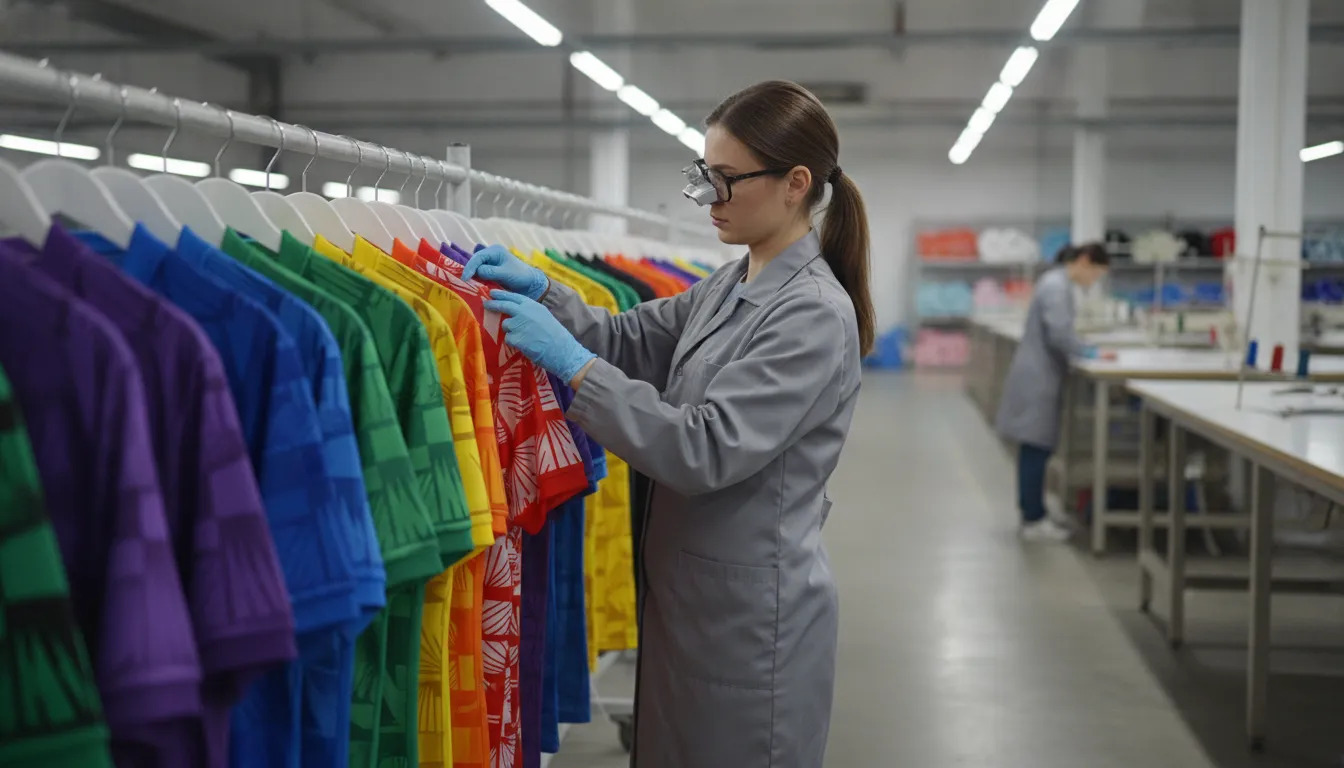
Quality checks and decoration
Before the order leaves production, the garments move through quality checks. The goal is to identify issues while the order is still under control, rather than after cartons arrive at the team. Those checks fit into the broader planning window that can include production, quality review, shipping, and reconciliation during the weeks before the season.
Decoration is then completed according to the approved specification. Depending on the order, that may involve the selected artwork, names, numbers, or other team details. For a closer look at the work behind custom apparel, review the uniform decoration process.
Packing, shipping, and status updates
Once quality checks and decoration are complete, the order is packed for shipment. The customer portal provides production-status updates and estimated completion dates, followed by shipping notifications when the order moves into transit. These updates give coaches and program buyers a practical way to monitor the order without relying on guesswork.
When the cartons arrive, compare the contents with the approved order and roster records. Confirm that the garments, quantities, and player details are accounted for before distribution. The final two weeks before a season can be used to distribute uniforms and resolve shortages or replacements. So an early receipt gives the team time to address discrepancies.
How the six-week guarantee is measured
The documented six-week guaranteed on-time delivery applies to standard custom orders and begins from payment receipt. That wording matters: it is not a universal promise for every product, customization, rush request, or ordering scenario. Treat payment receipt as the formal production trigger, retain the order documentation, and use the portal updates to follow the projected completion and shipping stages.
What If You Need Uniforms on a Short Timeline?
If the season is close, contact the uniform supplier before locking in a design, roster, or shipping method. A short timeline may still be workable, but availability depends on capacity, materials, product choice, customization, and how quickly your team can approve details. Treat any rush estimate as order-specific, not universal.
An early planned order gives you room to choose the exact product, decoration, and roster details your team wants. A rush request requires a faster decision process. An emergency replacement is a narrower situation, focused on getting a matching piece to a player or team after an unexpected loss or damage.
Ask about capacity before changing the order
Start by sharing the hard deadline, sport, quantities, product type, artwork status, and what is already finalized. Multiple teams, age groups, or campuses can add complexity. Custom cut-and-sew garments and specialty fabrics may require more coordination, while uncertain rosters or number assignments can create avoidable holds. Peak-season demand and imported goods can also affect availability.
Company-owned manufacturing facilities can provide visibility into material inventory and rush prioritization, but that does not mean every style can be expedited. Ask which options are realistically available for your date. Documented customer information notes two-week rush possibilities for most items, subject to the order's specifics and current capacity. Do not treat two weeks as a guaranteed standard for every product or customization.
Make practical tradeoffs when the deadline is fixed
If a full custom package cannot meet the date, ask whether a simpler product or customization approach can reduce production complexity. You may also decide to submit the confirmed portion of the roster first and handle late additions separately. That can protect the main delivery while keeping a plan for players whose sizes, names, or numbers are not ready.
For a genuine emergency replacement, documented performance includes some replacements arriving in under one week. That is a documented possibility, not a promise that applies to every garment, size, color, or shipping destination. Confirm exact color and style requirements before approving a replacement, and ask whether the requested piece can be matched from available materials.
Build a shipping buffer into the date you communicate to the supplier. Design changes, incorrect measurements, shipping disruptions, weather, and high seasonal demand can all extend a timeline. Keep one person responsible for approvals, reply quickly to questions, and request status updates through each major checkpoint. If your team is planning ahead, review baseball uniform packages to compare a focused starting point for the order.
When the deadline is close, send the supplier one complete request rather than a series of partial updates. Include the event date, delivery location, roster status, preferred product, acceptable alternatives, and the latest date you can receive the shipment. Clear information helps the production team evaluate the real options and helps your staff make a timely decision.
How Can Teams Prevent Last-Minute Ordering Problems?
The safest approach is to treat delivery as a checkpoint, not the finish line. Inspect cartons when they arrive, compare every item with the roster, distribute by player, and preserve the records needed for future fill-ins. A simple receipt process gives your staff time to identify shortages, sizing issues, or replacements before the first practice.
Use a season-ready receipt checklist
- Inspect each carton.
Check the package count and look for visible damage before putting uniforms into storage. Separate anything that needs review instead of mixing it into the team inventory.
- Compare the shipment with the roster.
Match names, numbers, products, and quantities against the approved roster. The customer portal supports roster management and size records, which gives teams a central place to verify those details.
- Distribute by player.
Sort each athlete's complete set together, then record what was issued. This makes missing pieces easier to identify and prevents a last-minute scramble at practice.
- Record sizes and changes.
Keep the final size information current in your team records. If a player changes, document the replacement need immediately rather than relying on memory.
- Save the artwork.
Retain the approved design, including the color, style, and decoration details. That reference is especially useful when a mid-season addition must match the original order.
- Keep order details together.
Save the order information, roster version, and relevant portal updates. The portal provides production-status updates, estimated completion dates, and shipping notifications, so those records can help staff track what was ordered and when it moved.
- Plan for fill-ins.
Identify likely replacement or late-addition needs early. Uniforms Express supports bulk ordering and fill-in orders, so your process does not have to restart from the beginning for one missing or newly needed item.
Make future fill-ins easier
Uniforms Express documents fill-in orders with a one-piece minimum, exact color and style matching, and 90-day price protection. These are fill-in features, not a blanket promise for every new team order, so retain the original specifications and confirm current terms when you need an addition. A saved design and accurate size record make that conversation more precise.
For broader preparation guidance, review Uniforms 101 ordering education. Then assign one person to own the receipt checklist, roster comparison, distribution records, and follow-up. Clear ownership turns delivery day into a controlled handoff instead of an emergency.
Frequently Asked Questions
How far in advance should a team order custom uniforms?
Work backward from the first practice or game, allowing time for design decisions, roster and size approval, payment, production, quality review, shipping, and distribution. As planning guidance, start 10 to 14 weeks ahead for a fully custom order, then confirm the schedule for your specific products and season.
How long does uniform production usually take?
The timeline depends on the customization level. Basic customization generally takes 2 to 3 weeks, semi-custom orders take 3 to 4 weeks, and full custom manufacturing takes 4 to 6 weeks. These are general ranges, not a universal delivery promise. See the documented turnaround guidance.
What must be approved before production begins?
Confirm the product, colors, artwork, decoration method, quantities, roster, sizes, names, and numbers, then approve the final design proof. Submit payment or an approved purchase order promptly, since the production clock and the documented standard-order guarantee are tied to payment receipt.
What happens if the roster changes after the order is submitted?
Tell your uniform provider as soon as possible. Late changes can affect production or delivery, so keep a current roster and size record during ordering. For later additions or replacements, fill-in orders may be available with a one-piece minimum and exact color and style matching.
Can a team place a rush uniform order?
Rush options may be possible, but they are not automatic. Documented customer guidance notes two-week rush possibilities for most items, subject to production capacity, product selection, and customization requirements. Ask for a date-specific review before relying on a rush schedule.
How much shipping buffer should a team plan?
Build a buffer between the estimated delivery date and your first game or practice. Use the customer portal for production-status updates, estimated completion dates, and shipping notifications. Then inspect and distribute the cartons before the season begins so shortages can be addressed in time.
Ready to Start Your Team Uniform Design?
Starting early gives your team time to make design decisions, confirm roster details, and plan delivery before the season begins. If you need help choosing the next step, start your team uniform design with Uniforms Express. You can review options, begin the custom design process, and move toward an order with the information your program needs.


Comments