


Youth Baseball Uniform Sponsor Logo Rules: League Guide

A sponsor can help a youth baseball league fund uniforms, equipment, or field improvements, but one oversized or unauthorized mark can create a last-minute rework problem. Before sending artwork to production, league administrators should confirm the governing body's rules, local board approvals, placement limits, and the exact proof everyone will use.
Youth baseball uniform sponsor logo rules are league-specific. Start by identifying the governing organization, then verify permitted sponsor content, logo placement, size limits, required patches, decoration method, and approval authority before ordering a proof or releasing the team order.
The goal is not to make every jersey look like an advertisement. A well-managed sponsor mark should support the league financially while keeping the team identity, player information, and required uniform elements clear.
Which Youth Baseball Uniform Rules Apply to Your League?
Identify the governing body and local rulebook before deciding where a sponsor logo can go. Little League, a school association, a travel organization, and an independent recreation league may use different requirements. Treat a general placement idea as a starting point only, and get the current written rule or board approval before production.
The phrase "youth baseball" covers several types of programs. A local Little League affiliate may need to follow Little League International policies and the current Official Regulations and Playing Rules. A school team may fall under a state association that follows National Federation of State High School Associations, or NFHS, rules. A travel or recreation program may instead use its own handbook, tournament rules, or league board policy.
That distinction matters because a rule about a manufacturer mark is not automatically a rule about a sponsor mark. For example, NFHS baseball rules address the number, size, and placement of a manufacturer's logo or trademark on school uniforms. That is a different issue from whether a league permits a local business sponsor on the back, sleeve, or another team-approved area. Read the applicable rule carefully instead of copying a measurement from another organization.
Little League also publishes specific trademark guidance. Its policy explains that Little League trademarks and logos are protected and that use must follow the organization's rules and policies. A local league should not treat a sponsor arrangement as permission to use Little League marks in a new way. If the sponsor wants the Little League name or a protected mark in an advertisement, jersey graphic, or promotional asset, ask the appropriate league or licensing contact before artwork is prepared.
Build a short rule file for each division or program you manage. Include the governing organization, season or tournament, current rulebook link, local sponsor policy, required patches, approved placements, restricted sponsor categories, and the person authorized to approve exceptions. For a school program, compare the applicable policy with the NFHS baseball uniform rules rather than borrowing a youth-league standard. Save the file with the order record. If a question comes up after a proof is prepared, the team can point to the rule that controlled the decision rather than relying on memory.
Also check whether the sponsor policy changes between the regular season and tournament play. A mark that is acceptable on a regular-season jersey may be restricted on a tournament uniform, or a tournament organizer may provide a separate patch or placement instruction. Confirm both schedules if the team will wear the same uniform in multiple settings.
Where Can a Sponsor Logo Go on a Youth Baseball Uniform?
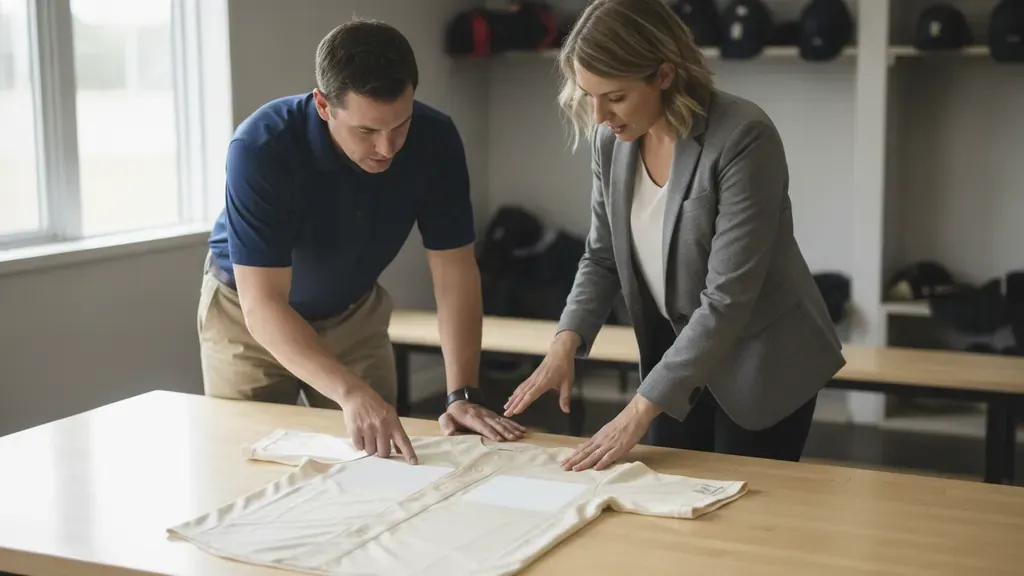
Choose sponsor placement only after the league confirms the permitted zones. Common options may include a back nameplate area, sleeve, chest, cap, or a separate patch, but no location is universal. Keep the sponsor mark away from required numbers, league patches, player names, seams, and other elements that must remain readable.
Placement is both a compliance question and a design question. Start with the uniform areas the rulebook or league board allows. Then map every required element before adding the sponsor: team name, player number, player name, official patch, manufacturer mark, division identifier, and any tournament emblem. A placement that looks open on a blank jersey may become crowded once the full design is assembled.
Little League's uniform purchasing guidance gives leagues a practical sponsorship model: the league name can remain on the front while a sponsor name is placed on the back nameplate area. That is guidance for a particular league context, not a universal rule for every youth program. Use it as an example of how a league can create sponsor visibility while limiting personalization and coordination. Your own organization still needs to confirm whether that arrangement is allowed.
Protect the visual hierarchy. The team identity should remain easy to see from the stands, and the player number should be readable for coaches, umpires, scorekeepers, and families. Keep sponsor colors from blending into the number or creating a low-contrast patch around the player information. If a sponsor has a long name, ask whether a shortened approved mark or a simple symbol is available instead of shrinking the entire mark until it is difficult to read.
Consider movement and garment construction. A sleeve mark may cross a seam or appear differently when the player raises an arm. A back mark may compete with a nameplate or number. A chest mark may need to avoid buttons, piping, or the team's primary wordmark. On a cap, the available decoration area is smaller and may require a different treatment than the jersey. Ask the supplier to show the mark at the intended finished size on the actual product style.
Do not place the sponsor on a required patch or alter a protected mark to make room. If your league requires an official shoulder patch, follow its instructions for the patch and leave the sponsor in a separate approved area. If the sponsor is a school, tournament, nonprofit, or commercial business with its own brand guide, request the current approved artwork and clear-space requirements before the proof is built.
Finally, plan for consistency across divisions. A sponsor may support several teams, but the available placement can change with jersey style, age division, or required patch. Create one placement standard for the program where possible, then document exceptions. Consistent placement reduces proof revisions and gives sponsors a more dependable presentation.
Logo Size Requires a League-Specific Standard
Use the applicable league or association limit, not a generic industry measurement. Some rules specify a maximum size for a particular manufacturer's mark, while sponsor marks may be controlled by local policy or a separate uniform guide. If no written limit exists, ask the league board to approve the finished dimensions before requesting production.
Size questions often cause confusion because different marks are governed by different rules. A manufacturer's trademark, the team's primary logo, an official league patch, a tournament emblem, and a commercial sponsor logo may each have separate requirements. Put them in separate rows on your compliance checklist and record the authority for each requirement.
For school baseball, NFHS rules state that a visible single manufacturer logo or trademark on each uniform item may not exceed 2 1/4 square inches, with no dimension exceeding 2 1/4 inches, subject to the rule text and state association adoption. That measurement addresses the manufacturer's logo or trademark. It should not be presented as a universal sponsor-logo allowance for youth leagues.
Little League guidance also illustrates why required elements must be checked separately. Its uniform buying article notes that the official shoulder patch is required under its rulebook and cannot be screen printed. The league's trademark policy separately explains that protected marks must be used according to the organization's policies. Those details affect how a sponsor is placed around the uniform, but they do not create one universal sponsor size for every local league.
When the league has not supplied a numeric limit, use a readability-first review. Measure the finished logo area, not just the digital file. Check how much clear space surrounds the mark, whether the sponsor name can be identified at normal viewing distance, and whether it competes with the player number. A smaller mark with strong contrast can often communicate more effectively than a larger mark squeezed into a crowded layout.
Ask the sponsor to approve the exact version that will appear on the uniform. A sponsor may provide a horizontal logo, stacked logo, icon-only mark, or one-color version. The league should not redraw or compress it without authorization. If the full mark does not fit the approved area, request a simplified file or written approval for an alternate version. Keep the original and approved production version together so there is a record of what changed.
Use a proof that shows finished dimensions and placement relative to the jersey. A logo that appears balanced on a flat artboard can look too large when placed beside a team name or too small when viewed on a player. Ask for front, back, and sleeve views when more than one area is involved. The final approval should identify the sponsor version, size, location, jersey style, and division.
Screen Sponsor Content Before Artwork Production
Screen the sponsor and its artwork before a vendor prepares the final proof. Confirm that the business is acceptable under league policy, that the mark does not imply an unauthorized affiliation, and that the artwork contains no restricted product, confusing claim, or unapproved protected trademark. Record the board decision before production begins.
A sponsor review should cover more than whether the business has paid. Ask whether the sponsor category is allowed, whether the league's members would reasonably view the partnership as appropriate, and whether the mark can be reproduced clearly on the selected garment. If the league has a written sponsorship policy, apply the same review to every sponsor rather than making ad hoc exceptions.
Little League's fundraising and commercialization guidance says league sponsorships and fundraising materials should not include direct references to alcohol, tobacco products, electronic cigarettes, vaping, marijuana or other controlled substances, firearms, gambling, or adult content. It also notes that local leagues should evaluate donations and sponsorships under local community standards and may have additional rules. Use the current policy for the league you serve and escalate uncertain categories to the board.
Trademark review is another separate checkpoint. A sponsor may be a local business, but its logo could include a professional team mark, school emblem, league name, or other protected design. Little League's trademark policy states that the organization's marks are protected and that use must comply with its policies. USA Baseball's licensing guidance likewise explains that commercial use of its intellectual property requires express, prior written permission. A supplier can reproduce approved artwork, but it cannot grant permission to use a mark that the league does not own.
Check the sponsor's requested wording as well as its logo. Avoid claims that make the league appear to endorse a product, guarantee a result, or represent a formal partnership that was never approved. If the sponsor wants a website address, phone number, or promotional message on the uniform, verify that the league permits that type of content and that the finished mark will remain legible.
Use a two-step approval. First, the league board or authorized administrator approves the sponsor relationship and content category. Second, the sponsor approves its exact artwork, while the league approves the placement and full uniform composition. These approvals serve different purposes. One confirms the partnership; the other confirms what players will wear. Keep both records with the final proof.
Review custom baseball jersey styles and decoration options before sending sponsor artwork for a production proof.
How Should a League Prepare Sponsor Artwork and the Final Proof?
Prepare one controlled artwork package with the approved sponsor file, placement instruction, finished size, colors, division, jersey style, and required uniform elements. Review a full front-and-back proof with the league and sponsor, correct every issue in one revision cycle where possible, and approve only the version tied to the final order details.
Start with the source file the sponsor actually approved. Ask the supplier which formats and resolution are appropriate for the selected decoration method instead of converting the file repeatedly. Supply vector artwork when available, but do not assume that a vector file automatically solves color, clear-space, or placement problems. The finished mark still needs a human review on the actual uniform design.
- Identify the controlling rule.
Record the league, division, season, tournament, and rulebook or board policy that controls sponsor use.
- Approve the sponsor mark.
Confirm the sponsor name, logo version, colors, wording, and any required clear space. Reject unofficial alterations or unapproved protected marks.
- Map the full uniform.
Place the sponsor beside the team name, player number, player name, required patch, manufacturer mark, piping, and other decoration.
- Check finished dimensions.
Review the sponsor mark at the actual intended size and confirm that the mark remains readable without crowding required elements.
- Review every view.
Check front, back, sleeve, cap, and any alternate jersey or tournament version that will carry the sponsor.
- Match the roster and quantity.
Confirm jersey style, colors, sizes, names, numbers, quantities, and division before the order is released.
- Record the final approval.
Save the proof version, sponsor approval, league approval, date, and name of the person authorized to release production.
Use a single file name or version label for the approved proof. For example, identify the league, season, division, jersey style, sponsor version, and approval date. Avoid approving a proof from an email while discussing changes in a separate message. If the sponsor logo, placement, jersey color, or roster changes, issue a new proof and retire the previous version.
Build the Sponsor-Uniform Timeline Backward From Game Day
Start with the first required wear date, then work backward through sponsor approval, league review, proof revisions, roster collection, production, shipping, and distribution. Ask the supplier to confirm the schedule for the exact product and decoration method. Do not treat a general rush statement as a guaranteed deadline for every order.
Timing becomes harder when a sponsor approval is added late. A league may have selected a jersey style, but the sponsor still needs to approve artwork. The board may then need to confirm the placement, and managers may still be collecting sizes and numbers. Build those checkpoints into the schedule instead of treating them as small changes after the order is placed.
Uniforms Express customer materials describe custom jerseys produced in as little as two weeks and also reference a six-week on-time statement for standard custom orders. These are not interchangeable promises for every product. The applicable timing can depend on the jersey, decoration, order completeness, payment, approval date, capacity, shipping destination, and any requested rush service. Ask for the current order-specific schedule in writing.
Use a simple approval calendar:
Set the first required wear date and a distribution date.
Set an internal deadline for sponsor artwork and board approval.
Reserve time for a complete proof and one controlled revision cycle.
Collect the roster, sizes, names, numbers, and quantities before final approval.
Confirm the production and shipping schedule with the supplier.
Leave room to inspect the shipment and resolve an issue before game day.
If the league has regular-season and tournament uniforms, schedule both orders separately. A sponsor may change, the permitted patch may differ, or the tournament organizer may require another uniform configuration. Confirm the sponsor plan for each use rather than assuming a regular-season approval automatically transfers.
Control Sponsor-Uniform Costs Without Losing Compliance
Set the league's uniform budget before choosing placements and decoration, then compare the complete order rather than a blank-jersey price. Include required patches, sponsor decoration, personalization, samples, shipping, roster changes, and possible fill-in orders. A simpler approved sponsor treatment can reduce rework while keeping the league's branding clear.
Little League's uniform purchasing guidance recommends understanding the per-player budget and considering customization costs such as full-color logos, embroidery, screen printing, and required patches. The league should make the same list for sponsor marks. Ask which decoration method fits the artwork and garment, whether multiple locations change the work required, and whether the final proof includes all requested elements.
Do not start with the largest possible sponsor mark. Start with the rule-approved placement and the sponsor's communication goal. A clear mark on an approved back or sleeve position may provide useful visibility without adding a second location or creating a crowded front. If several sponsors are involved, ask the league board to establish a consistent hierarchy and placement policy before vendors prepare separate proofs.
Account for the cost of errors. A late logo change can require a new proof, revised artwork, or a change to the production schedule. A missing size can create a fill-in order. A sponsor name that is spelled differently across divisions can require a correction and reduce sponsor confidence. A controlled artwork package and one authorized approval path are practical budget controls because they reduce avoidable rework.
Ask about samples or a size run when the program has a large roster. Little League advises having a size run available for players to try on, which can reduce reorders. The league should also confirm whether the sponsor treatment changes the garment or decoration method in a way that affects fit, appearance, or care instructions.
Keep the sponsor agreement, approved artwork, rule reference, proof, roster, order confirmation, and shipping record together. That file helps the league answer sponsor questions, repeat the design next season, place a fill-in order, or explain why a requested change could not be accepted. Good records protect both the league and the sponsor.
Frequently Asked Questions
Use the governing rule, approved sponsor artwork, finished placement, and complete order record as the answer to most sponsor-logo questions. Because youth programs follow different policies, verify the current league or association requirements before relying on a size, placement, or trademark assumption.
Are sponsor logos allowed on every youth baseball uniform?
No. Sponsor-logo permission depends on the governing organization, local league policy, division, and event. Confirm the current rulebook and board policy before requesting a production proof. A sponsor arrangement that is acceptable for one recreation league, school association, or tournament may not apply to another.
What is the standard size for a youth baseball sponsor logo?
There is no single universal sponsor-logo size. Some organizations publish measurements for manufacturer marks or required patches, while local leagues may set their own sponsor limits. Record the rule that applies to your program, then approve the finished dimensions and placement on the actual jersey proof.
Which decoration method should a league use for a sponsor mark?
Choose based on the artwork, garment, approved placement, and required durability. Tackle-Twill can suit bold, dimensional athletic lettering, while sublimation can support broad color coverage and detailed artwork. Screen print, heat press, or embroidery may suit other marks. Ask the supplier to recommend a method after reviewing the artwork.
How can a league prevent sponsor-logo approval delays?
Assign one league decision-maker, one sponsor contact, and one current proof version. Confirm the governing rule, sponsor artwork, placement, size, jersey style, roster details, and deadline before approval. If anything changes, issue a new proof rather than approving an older version while discussing revisions elsewhere.
How should a league budget for sponsor-logo uniforms?
Build the budget around the complete order: jersey style, required patches, sponsor decoration, names and numbers, sizes, quantities, samples, shipping, and potential fill-in orders. Ask for an order-specific quote and avoid assuming that a blank-jersey price includes every customization or delivery requirement.
Can a sponsor use a Little League or USA Baseball logo on a jersey?
Not without following the applicable organization's permission and trademark policy. Little League and USA Baseball both publish guidance protecting their names, logos, and intellectual property. Ask the organization or licensing contact before using a protected mark. A uniform supplier can reproduce approved artwork but cannot grant trademark permission.
A sponsor-supported uniform program works best when compliance is settled before design production begins. Confirm the governing rules, approve the sponsor content, document placement and size, review the complete proof, and give the supplier one current roster and deadline. When your league is ready, share those details with Uniforms Express to discuss the right baseball uniform path.


Comments