


Youth Football Uniforms: Budget-Smart Guide for Leagues

Updated: Sep 14
When opening kickoff is only weeks away, a youth league's uniform order can become a high-stakes budget decision. Coaches balance a fixed roster budget, changing player sizes, equipment requirements, and the risk of a rushed replacement order. Compare the complete package, sizing process, decoration, and delivery plan before collecting every player's information.
The most practical way to choose youth football uniforms is to compare complete packages with the required game-day pieces. Confirm sizing, durability, customization, and production timing. A written checklist helps a league compare like-for-like options and avoid missing items.
A complete package does not mean every team needs the same design or material. Growing players need a fit that works with their pads now, while still allowing the league to manage replacements and future rosters sensibly. Jerseys must cover the shoulder pads and reach the top of the pants under NFHS guidance. Uniforms should remain professionally manufactured and unaltered in ways that reduce protection. The right starting point is a clear budget framework that separates essential items from optional upgrades and gives the league a realistic order plan.
How to Set a Budget for Youth Football Uniforms
Set the budget by listing each required uniform piece, customization detail, and likely replacement need before comparing suppliers. Request an itemized total for the same package from each source. This keeps a low initial quote from hiding missing pants, socks, decoration, sizing support, or delivery requirements.
Start with the total number of players, then decide what the league needs each player to receive. A practical budget should account for the uniform itself, required game-day pieces, customization, sizing changes, and the possibility that growing athletes may need replacements. Use the league's approved per-player ceiling as a planning benchmark, not as a guaranteed quote. The final total will depend on the package, design, quantities, and order details.
Next, separate essentials from extras. For many teams, the core uniform includes a jersey, pants, and socks. A complete package can make the budget easier to manage because the league evaluates the required pieces together instead of piecing together separate orders. It also gives coaches and parents a clearer answer when they ask what is included. List any items that are not part of the uniform order, such as pads or other equipment, so families are not surprised by costs outside the uniform budget.
Compare the complete package with the real alternatives
When reviewing quotes, compare like for like. Check whether each option includes the same jersey, pants, socks, decoration, and sizing support. A lower initial number may not represent a lower total if the league later needs to add missing pieces or replace apparel that cannot withstand a full season. Durable fabric matters for youth football because uniforms face high activity and frequent washing. For growing players, a well-considered fit and construction can be more useful than choosing the least expensive item on a page.
Customization should also have a defined place in the budget. Decide which details are essential to team identity, such as colors, numbers, names, or logos, and which can wait for a future season. Sublimation supports substantial customization and team branding, but the league should approve the design and roster details before production. Keep a written record of the approved colors, player names, numbers, and sizes to reduce costly corrections.
Ask how the uniform is made and sold
Manufacturing structure can affect how a league plans its purchase. Uniforms Express describes a vertically integrated, direct-to-customer model that bypasses traditional retail markups. That does not guarantee a particular savings amount, but it gives administrators another factor to compare when evaluating suppliers. Ask who handles manufacturing, what is included in the package, how fit questions are resolved, and what support is available if the roster changes.
Finally, build a small decision checklist before ordering: total players, approved package, customization requirements, size collection process, durability expectations, and season deadline. A clear checklist keeps the budget tied to the league's actual needs and makes parent ordering simpler. It also helps the coach explain why a complete, durable uniform package may be a better long-term choice than assembling the cheapest individual pieces.
How Can Packages Make Youth Football Uniforms More Affordable?
Packages can make youth football uniforms easier to budget because the league evaluates jerseys, pants, socks, and decoration together. The key is to compare identical contents and confirm what remains optional. A complete package is useful when it simplifies ordering without forcing families to buy unnecessary extras.
A complete package should give every player the core pieces needed to look consistent on game day and stay comfortable through practices, games, and repeated washing. For most youth teams, that foundation is a jersey, football pants, and socks. Bundling those items also makes ordering easier for coaches and parents because the league can collect one set of measurements. Approve one design, and distribute a more consistent kit.
The jersey should be properly fitted over the player's protective equipment, while the pants should work with the pads and allow normal movement. Socks finish the basic game uniform and help create a uniform appearance across the roster. When reviewing youth football uniforms, confirm exactly which pieces are included rather than assuming that a product labeled as a package contains every item your league expects.
Package level. | Included items. | Best fit. |
Core game package. | Custom jersey, football pants, and socks. | Recreational leagues and teams replacing the basic game uniform. |
Team-ready package. | Core game pieces plus selected extras, such as a second jersey or additional socks. | Leagues with home and away needs, frequent games, or a larger rotation. |
Extended player package. | Core game pieces plus optional team apparel or replacement items chosen by the league. | Programs that want a simpler family order and a consistent player bundle. |
What belongs in the optional extras?
Optional items should solve a real team need, not inflate every family's order. A second jersey can help when a league needs contrasting colors or wants to reduce laundry pressure between games. Extra socks are practical for muddy fields and wet weather. Some programs may also choose coordinated practice apparel, warmups, or replacement pieces for players who join after the original order. Keep equipment such as helmets, shoulder pads, and other protective gear separate unless the supplier clearly defines those items and the league has confirmed compatibility.
Durability deserves as much attention as appearance. Youth players are active, and uniforms may be washed often, so ask about fabric and construction before choosing the least expensive option. A package that holds its shape and color through a season can be more useful than a lower-cost set that needs early replacement. If the team wants extensive branding or artwork, custom youth football jerseys can provide a more flexible design route. Before approving the order, compare the included pieces, sizing process, decoration, care instructions, and delivery terms side by side.
How Do You Size Uniforms for Growing Players?
Size each player from current measurements taken with the required shoulder pads and equipment, not age or a familiar T-shirt size alone. Follow the manufacturer's current chart, confirm movement and coverage, and keep the approved size record. Growing room matters, but it should not compromise a safe current fit.
Sizing youth football uniforms takes more than collecting a player's usual shirt or pant size. Players grow between seasons, and football pads change the way a jersey fits. Build the order around current measurements, the equipment each player will wear, and a documented review process. That approach gives families a clear way to order while helping the league avoid jerseys that restrict movement or leave protective equipment exposed.
- Collect current measurements.
Ask each family for measurements taken close to the ordering date, following the manufacturer's instructions. Record the player's height, weight, chest, waist, and other measurements requested on the supplier's chart. Do not substitute last season's size or assume that two players with the same age need the same uniform. Keep the measurement date with the roster so unusually old entries can be flagged before the order is submitted.
- Account for the shoulder pads the player will wear.
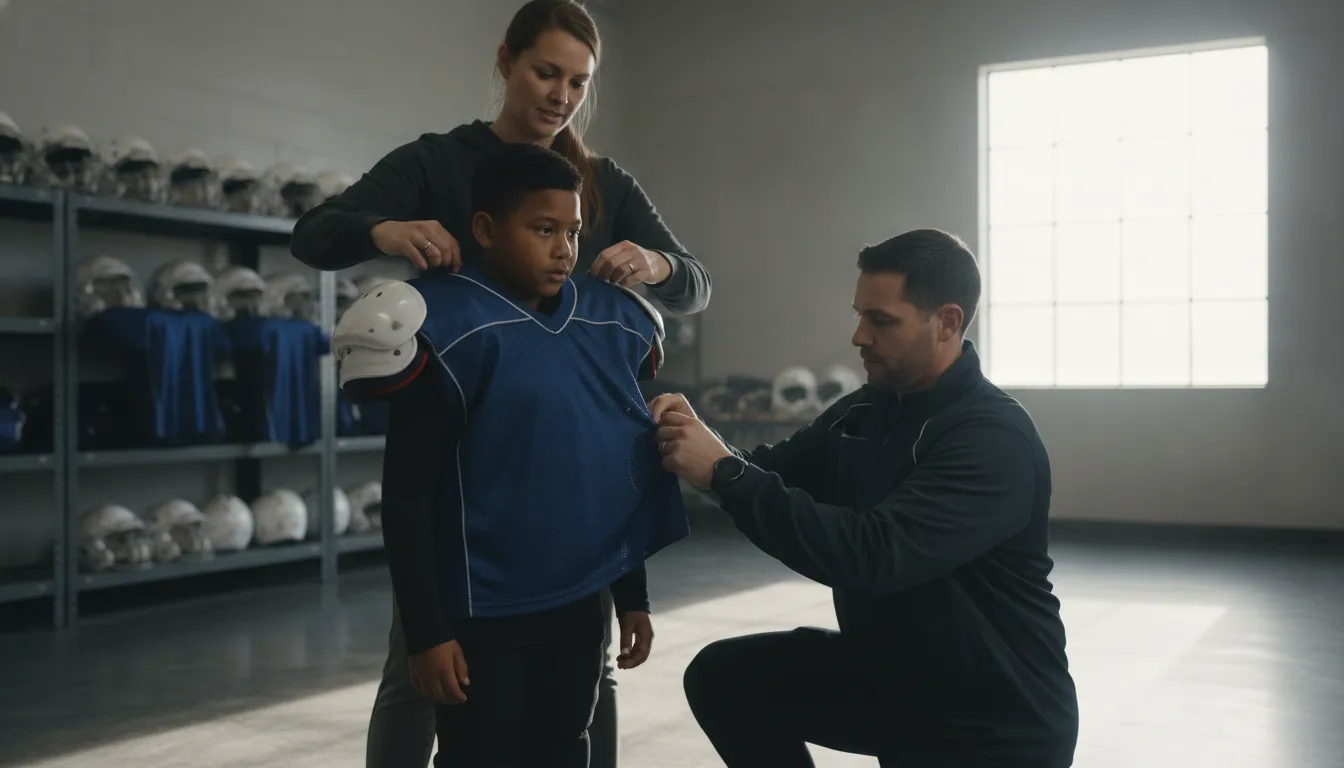
A jersey must fit over the player's actual shoulder pads, not just over a T-shirt. Have coaches confirm the equipment model or pad profile when possible, then use the manufacturer's guidance for selecting the jersey size. Avoid sizing up automatically for growth. Excess fabric can affect movement, bunch under equipment, or create a poor fit during play.
- Use the manufacturer's size chart as the decision point.
Compare every player's current measurements with the chart for the specific jersey and pants being ordered. If a measurement falls between sizes, ask the uniform provider how that garment is intended to fit over pads and whether the league should submit additional information. Save the chart version and the final selected size beside the roster. This creates a record for parent questions, replacement orders, and future seasons.
Check coverage and movement before approving the order.
The player should be able to raise the arms, bend, run, and turn without the jersey pulling uncomfortably across the pads. The jersey must completely cover the shoulder pads and pads worn above the waist on the torso. NFHS rules also require the jersey to reach the top of the pants and be tucked in if it is longer. Review the
NFHS football jersey and pant rules
for the governing details.
- Lock the roster carefully.
Before submitting youth football uniforms for production, have one coordinator compare the roster, measurements, selected sizes, player names, numbers, and quantities. Ask parents to confirm their child's entry by a stated deadline. Keep a separate note for players who may need a different size after a coach's equipment check, rather than changing an order informally. Jerseys should be professionally manufactured and not altered in a way that decreases protection, so resolve fit concerns with the manufacturer before delivery.
Growing room should be a planning consideration, not a substitute for a safe current fit. A documented measurement and approval process gives coaches a reliable sizing record and gives parents a simpler ordering experience. It also makes replacements easier when a player changes teams, equipment, or size during the season.
Which Materials and Custom Details Hold Up Best?
Choose materials and decoration based on the team's activity level, washing routine, design complexity, and expected replacement cycle. Ask how seams, numbers, names, and logos are constructed. Durable fabric and appropriate decoration can protect the team's appearance, but fit and equipment coverage should remain the first priorities.
A durable uniform starts with the fabric, but the best choice is not simply the heaviest material available. Youth football uniforms need to stay comfortable during high-activity games, tolerate repeated washing, and retain their shape through a full season. Ask what fabric options are designed for frequent wear and cleaning, then compare how each option feels, stretches, and handles the movement your players need. Durable fabric is especially important when a league expects uniforms to serve active players through repeated practices and games. Review football uniform options with those demands in mind.
Construction deserves the same attention as the fabric itself. Look for secure stitching at stress points, cleanly finished seams, and strong attachment around the neck, shoulders, cuffs, and pant openings. Reinforced construction can help reduce premature tearing when players pull on jerseys, slide, or make contact. Ask whether the decoration is built to withstand washing rather than merely looking sharp when the uniforms arrive. A practical test is to request care instructions and ask how the manufacturer handles replacement pieces when a player joins late or needs a different size.
Choose Decoration That Supports the Team Identity
Sublimation is worth considering when a team wants broad control over its visual design. This customization approach supports substantial team branding, including coordinated colors, patterns, names, and numbers, without limiting the design to a small isolated decoration. Review custom football jerseys to see how the option can support a complete team look. Before approving artwork, check that names and numbers are correct, colors are consistent across the order, and the design remains clear against the jersey background.
Do not treat customization as a reason to ignore fit or equipment coverage. The National Federation of State High School Associations says jerseys must completely cover shoulder pads and pads worn above the waist on the torso. It also requires jerseys to reach the top of the pants, with longer jerseys tucked in. The equipment should be professionally manufactured and not altered in ways that decrease protection. Confirm that the finished design preserves the original garment's coverage and function. Read the NFHS football uniform rules and verify any local league requirements before production.
For a reliable order, compare fabric performance, construction, care requirements, artwork accuracy, and protective coverage together. That checklist is more useful than choosing a uniform based on appearance alone.
How Can a League Avoid Last-Minute Uniform Problems?
Prevent last-minute problems by working backward from the first practice or game. Confirm rules, roster data, measurements, artwork, proof approval, production timing, shipping, and inspection responsibilities in writing. One designated decision-maker and one complete approval packet reduce avoidable corrections when the deadline is close.
Most uniform emergencies begin before anyone places an order. A league can prevent them by treating the uniform purchase as a sequence of approvals, not a single deadline. Start by working backward from the first practice or game, then build in time for decisions, corrections, and delivery inspection.
Start with rules and roster information
Confirm the league and association requirements before artwork is created. Check jersey colors for home and away games, acceptable decoration, and any rules governing numbers or patches. If NFHS rules apply, the jersey must completely cover the shoulder pads and pads worn above the waist on the torso. It must also reach the top of the pants and be tucked in if it is longer. Uniform pieces should be professionally manufactured and not altered in a way that decreases protection. Review the NFHS football uniform requirements with the league administrator.
Next, collect the final roster, player numbers, sizes, and name spellings in one controlled document. Do not begin production from a partial list. Ask parents to measure players using the supplier's instructions, especially when athletes are growing or wearing substantial pads. Assign one person to resolve duplicate numbers and late roster changes before artwork approval.
Approve artwork before production
Request a proof that shows the jersey, pants, colors, numbers, names, logos, and decoration placement. Compare every detail against the approved roster and league rules. Have the coach, administrator, and whoever controls the budget review the same proof. Written approval should come only after checking spelling, number visibility, color contrast, and sizing assumptions. A complete package may include jerseys, pants, and socks, so verify that the proof and order cover every required item.
Ask direct questions about production
Once the order is approved, ask what information the manufacturer needs to begin. Confirm the production window for the specific order. Ask whether rush capability is available if the season is close. Uniforms Express states that custom jerseys can be made in as little as 2 weeks, subject to order details. That is a useful planning reference, not a promise of a specific delivery date. Rush capabilities can also matter for clubs with short or year-round seasons, so raise the issue early rather than after the standard timeline is no longer workable.
When questions arise, use a service contact that responds quickly. Uniforms Express emphasizes a 15-minute callback guarantee for customer service inquiries. Keep confirmations, proofs, and roster versions together so the league can resolve any discrepancy without reconstructing the order history.
When the shipment arrives, inspect it immediately. Count each item, compare numbers and names with the approved roster, check sizes and decoration, and look for damaged or missing pieces. Photograph discrepancies and report them promptly, before the first game creates an avoidable uniform crisis.
A Simple Youth Football Uniform Ordering Checklist
A practical ordering checklist covers the budget, package contents, measurements over pads, league rules, artwork, and proof approval. It also covers delivery timing and the person responsible for receiving the shipment. Completing each item before production gives coaches and families a shared record and makes replacements easier to manage.
Before placing an order, run through this checklist with the coach, league administrator, and parent representative. A few confirmed details can prevent expensive changes, mismatched equipment, and stressful delivery questions later.
- Set the budget.
Decide whether your team needs jerseys only or a complete package. Jerseys, pants, and socks are commonly bundled together, which can make comparison easier. Use the league's per-player budget as a planning benchmark, then request a clear total for the selected package, decoration, and any extras. The actual total will depend on the selected package, decoration, quantities, and order details.
Confirm package contents.
List every item each player receives, including jersey, pants, socks, and any optional belts or accessories. Do not assume an item is included because it appears in a sample image. Review available
and compare like-for-like packages.
Measure over pads.
Record current height, weight, chest, waist, and inseam measurements while the player wears the shoulder pads and other equipment required for the jersey fit. Check that the jersey fully covers the shoulder pads and pads above the waist, reaches the top of the pants, and will not restrict movement. NFHS guidance also requires properly fitted, professionally manufactured equipment that is not altered in a way that decreases protection.
Review the applicable NFHS uniform rules
, and confirm your league's own requirements.
- Check league rules.
Verify approved colors, numbers, patches, logos, and home-versus-away requirements before artwork begins. Local youth leagues may follow rules that differ from NFHS standards.
Submit complete artwork.
Provide the team name, logo files, colors, player numbers, and any sponsor or memorial details in one organized package. Ask how names and numbers will be placed and whether sublimation is the right choice for your design. See
for customization options.
- Approve the proof in writing.
Check spelling, number assignments, colors, logo placement, sizes, and quantities. Have one designated person give final approval so conflicting revisions do not delay production.
- Confirm the timeline.
Ask when production starts, when the order is expected to ship, and whether rush capabilities are available if your season is close. Custom jerseys may be made in as little as two weeks when order details allow. Get the timing confirmed for your specific order rather than relying on a general promise.
- Name a delivery contact.
Provide one person authorized to receive, inspect, and distribute the shipment. Confirm the delivery address, phone number, tracking process, and what happens if an item is missing or incorrect.
For a deeper planning reference, read this complete guide to youth football uniforms before your team meeting.
Frequently Asked Questions
The questions below address common order decisions. They cover package value, player measurements, durable materials, decoration, and season timing. Use them as a final review before approving a league-wide design and roster submission.
What is the best way to choose budget-friendly youth football uniforms?
Compare complete packages that bundle the essential jersey, pants, and socks instead of pricing each item separately. Review fabric, customization, replacement needs, and delivery support together. A package can simplify ordering for parents and help a league stay within its player budget. Direct-to-customer manufacturing may also help reduce traditional retail markups. See the football uniform options before requesting a quote.
How should youth football uniforms be sized for growing players?
Measure each player while wearing the pads used for games, then follow the manufacturer's current size chart rather than estimating from age alone. Check that the jersey covers the shoulder pads, reaches the top of the pants, and does not restrict movement. NFHS rules require that coverage and proper fit, so do not size up so far that the jersey becomes unsafe or difficult to control. Source: NFHS football jersey and pant rules.
What items are typically included in a complete youth football uniform package?
Most complete packages include a jersey, football pants, and socks. A league may add practice apparel, extra pants, or accessories when its budget and program needs support them. Confirm exactly what is included, whether decoration is part of the quote, and how replacement pieces will match the original set. Review the supplier's football uniform selection before comparing packages.
How often do youth football leagues typically need to replace uniforms?
There is no universal replacement schedule. Review uniforms before each season and replace pieces when fabric, stitching, fit, or pad coverage no longer meets the program's needs. Because young players grow and uniforms face high activity and frequent washing, durable construction and an organized replacement process can reduce avoidable reorders.
What fabric materials are most durable for youth football uniforms?
Choose a fabric designed for high activity, repeated washing, and regular contact, while checking that it remains comfortable over the season. Ask how seams and decoration are constructed, and consider sublimation when the team needs substantial branding and color customization. Compare custom football jersey details as part of the review.
Ready to Plan Your Youth Football Uniform Order?
A league is ready to request uniform guidance when it knows its roster range, required package, measurements process, design direction, and season deadline. With those details organized, a supplier can help compare practical options and identify the production path that best fits the team's schedule.
Choosing uniforms for a growing league is easier when you have a clear package, dependable sizing process, and customization plan before collecting player information. Start by reviewing the available jersey, pants, and sock options, then confirm which details your league needs for a complete order. Uniforms Express can help you compare practical choices for your teams and move from an initial concept to an organized order. Review custom football uniform options and start planning your league order when you are ready to take the next step.
Comments