


Sublimated Football Uniforms: A Coach's Guide to Design and Ordering

When the first kickoff is days away and a roster change exposes a missing jersey, a uniform order stops being a simple apparel purchase. Coaches need a design that looks sharp under stadium lights, fabric that holds up through contact and repeated washing, and a supplier that can give a realistic delivery date. Sublimated football uniforms can solve the design and decoration side of that problem, but only when the team gets the details right before approving production.
This guide explains what full sublimation changes, where it fits in a football program's uniform plan, and how to move from a rough concept to a complete, season-ready order. Use it for youth leagues, high school programs, travel teams, and athletic departments that need one clear process for design, sizing, approval, and delivery.
What are sublimated football uniforms?
Sublimated football uniforms use heat to transfer dye into the fabric fibers, so the graphic becomes part of the material instead of sitting as a separate layer on top. That process supports detailed color blocking, gradients, patterns, names, numbers, and team artwork across the jersey surface without a thick decoration edge.
For a coach, the practical difference is design freedom. A full-sublimation football jersey can carry a complex shoulder pattern or tonal texture without requiring a separate sewn piece for every color change. It can also keep the visual treatment consistent across youth and adult sizes when the artwork is prepared carefully. The result is a clean, coordinated look that can support a team's identity from the first game through the end of the season.
Sublimation is not the same thing as screen printing, heat press, or tackle twill. Those methods apply decoration after the garment is made. Uniforms Express offers both sewn tackle twill and full sublimation on its custom football uniform collection, which lets a program choose the decoration approach based on its design, feel, and maintenance priorities. Some teams even combine a sublimated base with twill lettering or numbers when they want a dimensional traditional detail.
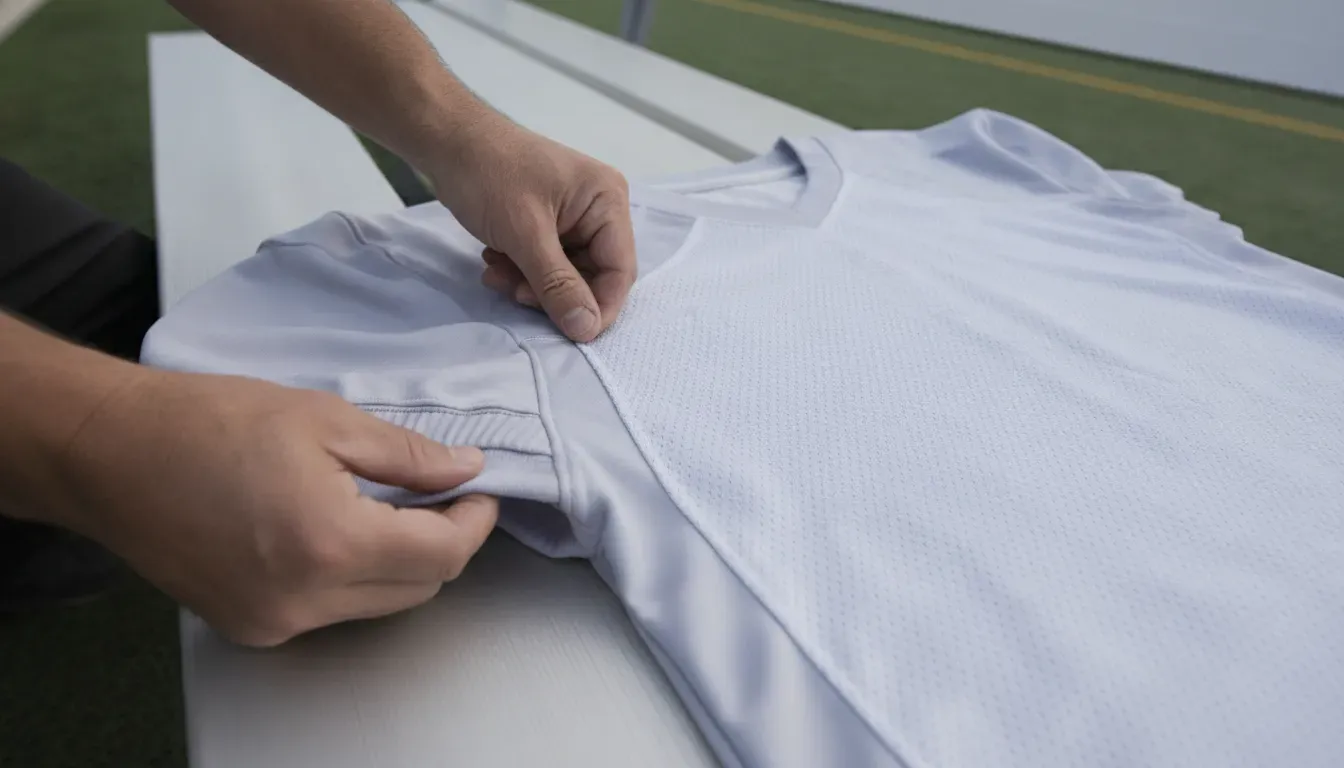
Look closely at the fabric, seams, and sleeve construction before approving a football uniform design.
The decoration method does not replace the garment's construction. A durable uniform still depends on the base fabric, stitching, fit, waistband, and care instructions. Ask for the garment specifications along with the artwork proof. Uniforms Express lists tricot mesh, four-way stretch spandex, and dazzle fabric among its football uniform materials, giving coaches several performance-oriented construction options.
When are sublimated football uniforms a strong choice?
Sublimated football uniforms are a strong choice when a team wants an all-over design, consistent color placement, and decoration that does not add a heavy layer to the garment. They are especially useful for programs that need a distinctive identity, repeat orders with matching artwork, or a single design system across multiple roster groups.
Full sublimation makes sense when your concept includes several colors, gradients, stripes, geometric panels, or a repeating pattern. It is also useful when the team wants the base color, sleeve treatment, side panels, and other visual elements planned as one composition. Rather than asking a decorator to place separate pieces on a finished jersey, the art file can define the entire printable surface before production.
- Complex team identity:
Use detailed color blocking, tonal textures, and coordinated panel artwork to make the uniform recognizable from the stands.
- Consistent repeat orders:
Keep the approved art and color references on file so later additions can match the original order as closely as the garment and materials allow.
- Comfort-focused decoration:
The dye is integrated into the fabric, so there is no large, raised print layer across the chest or back.
- Youth and adult coordination:
Build one team look across different sizes while checking how the art scales on smaller panels and shorter sleeves.
- Visual flexibility:
Design the jersey, pants, and optional sideline pieces as a coordinated system instead of treating each item as an unrelated purchase.
There are also situations where another approach may be better. A traditional program that wants a raised, classic lettered effect may prefer sewn tackle twill. A team with a very small, simple decoration request may not need an all-over sublimated design. Coaches should compare the finished feel, art requirements, reorder plan, and schedule rather than choosing a method because it is popular in another sport.
For a broader look at how decoration methods differ, review the tackle twill, sublimation, and screen print comparison. That comparison is cross-sport and method-focused. This guide stays focused on the football-specific decisions that affect a team's finished order.
View football uniform styles from Uniforms Express before you finalize your sublimated team concept.
How should coaches design a sublimated football uniform?
A coach should design a sublimated football uniform by setting the team identity first, then mapping colors, numbers, names, logos, panels, and garment options onto a production-ready concept. The strongest designs are easy to recognize at a distance, readable in photographs, and simple enough to reproduce accurately on every jersey size.
- Define the visual anchor:
Choose the primary team color and decide whether the jersey should feel traditional, modern, aggressive, or minimal. This prevents the artwork from becoming a collection of unrelated effects.
- Build a controlled color palette:
Select a primary color, secondary color, accent, and neutral if needed. Ask the supplier how color references are handled and approve a physical or production-ready proof when available.
- Place the logo with purpose:
Decide where the mascot, school mark, or team identity belongs before adding decorative elements. Leave enough contrast around the mark so it remains recognizable.
- Plan numbers and names early:
Confirm the number style, outline, front and back placement, player-name treatment, and whether every roster member needs the same personalization.
- Design for the complete uniform:
Coordinate the jersey with pants, socks, and optional warm-up or sideline gear. A jersey that looks good alone can feel unfinished when the pants use a different stripe or accent system.
- Check the smallest sizes:
Review the design on youth and smaller adult templates. A thin stripe or small logo that works on a large jersey may disappear or crowd the seams on a youth size.
- Approve a proof, not a description:
Check spelling, colors, number assignments, logo proportions, sleeve direction, and every garment view before production begins.
Keep the design readable. High-contrast numbers are easier for officials, coaches, broadcasters, photographers, and spectators to identify. Avoid placing a busy pattern directly behind the number area unless the number has enough contrast and a clear border. Also confirm that any school, state association, youth league, or tournament rules allow the planned number treatment and decoration.
For high school programs, use the current rules adopted by the relevant state association. The NFHS 2025 football jersey and pant rules are one useful reference point: they address properly fitted, unaltered jerseys and clearly visible front and back numbers. Rules can change, and state or league requirements control, so treat the document as a check rather than a substitute for your association's current guidance.
Design decision | Coach's check | Why it matters |
Primary and accent colors | Confirm color references and contrast | Reduces surprises between the proof and the finished look |
Numbers | Review front, back, outline, size, and legibility | Supports identification and rule compliance |
Logos and marks | Supply clean artwork and approve placement | Protects team identity and avoids distorted artwork |
Patterns and gradients | Check how artwork scales across sizes and seams | Keeps the visual system consistent across the roster |
Matching pants | Coordinate stripes, panels, and accents | Makes the full uniform look intentional |
What fabric and fit details should you check?
Coaches should evaluate fabric and fit by matching the jersey construction to the player's movement, protective equipment, climate, and preferred feel. Ask whether the garment is athletic cut, semi-compression, or compression, then review the material blend, stretch, breathability, sleeve coverage, and how the jersey is intended to sit over shoulder pads.
Uniforms Express lists several football construction choices. Tricot mesh can support airflow and a structured athletic jersey feel. Four-way stretch spandex allows movement and is used in football pants and selected jersey constructions. Dazzle fabric can add a smooth, reflective visual treatment to panels. The right choice depends on the specific style and the way your team wants the uniform to fit, not on a material name alone.
The football collection includes different silhouettes, including athletic-cut options, a compression-fit option, and a semi-compression option. A compression jersey is designed to sit closer to the body, while an athletic cut generally gives more room. Neither is automatically better for every roster. Ask players to consider shoulder pads, base layers, movement, and whether the jersey will be worn during hot practices, games, or both.
- Check shoulder and sleeve coverage:
The jersey should cover the required equipment and allow a full range of motion without pulling across the shoulders.
- Review torso length:
Confirm how the jersey sits over the pants and whether the team expects players to tuck it according to its governing rules.
- Use a current size chart:
Do not estimate sizes from age alone. Collect chest, waist, height, and other measurements requested by the supplier.
- Separate fit from decoration:
A perfect art proof cannot correct a jersey that is too tight, too short, or incompatible with the team's equipment.
- Plan roster variations:
Keep a record of every player's size, number, name treatment, and any approved exception before the order is released.
Do not approve the roster spreadsheet and art proof as separate tasks. The most common ordering mistakes happen when a late number change, size change, or spelling correction is made in one document but not the other. Assign one person to reconcile the final roster against the proof, and ask the supplier to confirm which file controls production.
When a program needs matching bottoms, review the football pants options at the same time as the jerseys. Check belt loops, pad pockets, waistband construction, panel colors, and the relationship between the pant design and the jersey artwork. Treating the pants as an afterthought can make even a strong sublimated jersey look disconnected on game day.
How long does it take to order sublimated football uniforms?
Order sublimated football uniforms by working backward from the first required game, not from the date the team hopes to submit artwork. A practical schedule includes design, quote, roster collection, sizing, proof approval, production, shipping, inspection, and a buffer for corrections or late additions.
- Set the delivery deadline:
Start with the first game, team photo, tournament, or equipment handout that requires the uniforms to be ready.
- Reserve design time:
Gather logos, color references, sample ideas, number rules, and garment preferences before requesting a final concept.
- Collect the roster:
Confirm names, numbers, sizes, and quantities in one controlled document. Include coaches or staff only if they are part of the same order.
- Review the proof:
Check front, back, side, sleeve, pants, and size-specific views. Correct errors before the order is approved for production.
- Confirm the production window:
Ask for a written schedule based on the actual quantity, garment choice, artwork status, and delivery location. Do not rely on a generic estimate.
- Inspect on arrival:
Compare the shipment against the approved roster and proof. Check sizes, numbers, names, colors, seams, and any missing pieces before the first game.
Uniforms Express states that custom jerseys can be produced in as little as two weeks, with rush capabilities for urgent team needs. That is a useful planning benchmark, not a reason to wait until the last minute. Confirm the current production and shipping schedule for your specific order, especially when the roster is large, the artwork is complex, or the season start is fixed.
Build a buffer for the parts a coach controls. A supplier cannot begin the correct production run if the team has not approved the proof, submitted complete size information, or resolved a logo issue. If your deadline is tight, tell the account manager the actual game date at the beginning of the conversation and ask what milestone must be completed to hold that delivery target.
The team uniform ordering timeline guide can help your staff organize the broader calendar. For a football-specific order, add a separate rule check and a final equipment compatibility review before release.
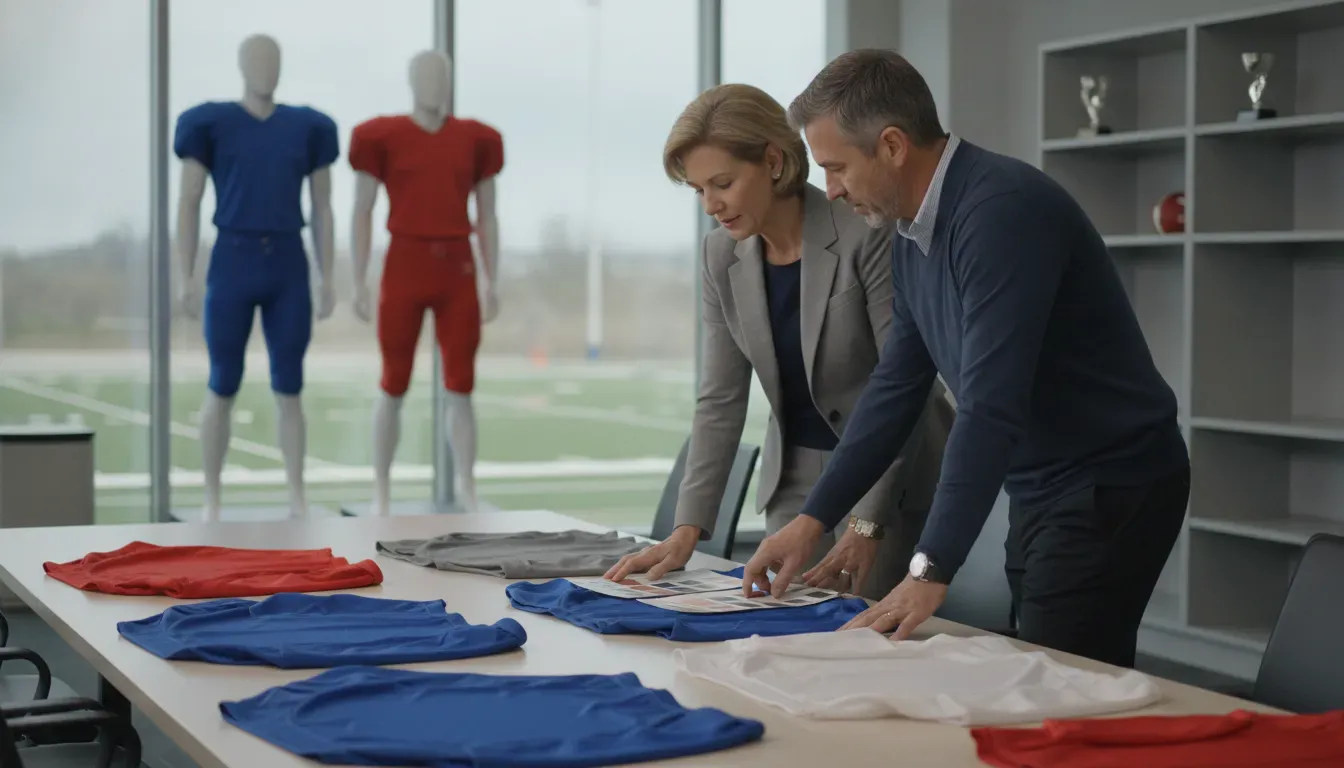
Review garment options, artwork, and the roster together before releasing the order.
What should a coach confirm before approving the order?
Before approving a sublimated football uniform order, a coach should confirm the garment style, complete artwork, applicable rules, player roster, measurements, production timeline, shipping destination, and process for reporting an issue. A short final checklist can prevent the avoidable mistakes that are hardest to fix after production starts.
- Customer and team identity:
Verify the school, league, team name, contact person, and delivery address.
- Garment selection:
Confirm the exact jersey and pant styles, cut, material, color options, and whether the order includes complete uniforms or jerseys only.
- Artwork:
Check logo files, colors, pattern direction, sleeve treatment, number style, player names, and every proof view.
- Roster:
Match each player to the correct size, number, name spelling, and quantity. Look for duplicate numbers and missing players.
- Rule review:
Confirm current state association, school, league, and tournament requirements before final approval.
- Timing:
Get the expected production and shipping dates in writing, along with the milestone that starts the production clock.
- Reorder plan:
Ask how future additions, replacements, and size changes will be matched to the approved design.
- Inspection plan:
Assign a person to inspect the shipment promptly and report any discrepancy with photos and the order record.
For programs that need a full team solution, Uniforms Express has resources covering custom football uniforms for high school and youth teams and budget planning for youth football uniforms. Use those broader guides for program planning, then use this sublimation checklist for the decoration and production decision.
Frequently Asked Questions About Sublimated Football Uniforms
Sublimated football uniforms work best when the decoration method, garment construction, roster, rules, and delivery plan are considered together. The answers below address the questions coaches and athletic directors should resolve before approving a team order.
What is a sublimated football jersey?
A sublimated football jersey has its custom dye graphic integrated into the fabric fibers through a heat-transfer process. This allows all-over colors, patterns, gradients, names, and numbers without a separate thick decoration layer. The final feel and durability still depend on the jersey fabric, seams, fit, care, and production quality.
Are sublimated football uniforms durable?
Sublimated football uniforms can be durable for regular team use because the design is part of the fabric rather than a separate surface application. Durability also depends on the base garment and construction. Ask about the material, stitching, care instructions, and any warranty or quality commitment, then inspect the finished order when it arrives.
Can sublimated football uniforms include names and numbers?
Yes, full sublimation can include team colors, patterns, names, numbers, and other approved artwork. Coaches should still check the current requirements of their school, league, state association, or tournament. Review number placement, contrast, size, spelling, and roster assignments on the final proof before production.
What is the difference between sublimation and tackle twill?
Sublimation dyes the design into the fabric and is well suited to complex, all-over artwork. Tackle twill is a separate sewn decoration that creates a more dimensional, traditional look. The better choice depends on the desired appearance, garment feel, artwork complexity, maintenance expectations, and ordering timeline. Some football programs use a combination of both methods.
How early should a team order sublimated football uniforms?
Order as soon as the game date and roster planning are clear. Give the supplier time for design, sizing, proof approval, production, shipping, inspection, and corrections. Uniforms Express says some custom jerseys can be produced in as little as two weeks, but the actual schedule depends on the order. Confirm the current timeline in writing rather than relying on a general estimate.
How can a team avoid mistakes in a sublimated uniform order?
Use one final roster, one approved artwork proof, and one person responsible for reconciling them. Check every name, number, size, logo, color, sleeve, pant, and delivery detail before production. Keep the approved files for future additions, and inspect the shipment promptly so any discrepancy can be addressed before game day.


Comments