


High School Football Uniform Packages: Plan the Full Order

The first kickoff is on the calendar, but a high school football uniform order has many deadlines before game day. If the roster, sizes, numbers, artwork, approvals, or purchase order is late, the entire package can become a last-minute problem for your athletic department.
Plan your high school football uniform package with Uniforms Express, or call 888-661-7044 to discuss your season deadline.
The best way to plan high school football uniform packages is to treat the order as one coordinated project. Define the game-day package, match every item to the roster, choose decoration that fits the program, approve one final proof, and work backward from the first game. Keep a written record for reorders and midseason changes.
This guide focuses on the full order process for high school coaches, athletic directors, and team managers. It is not just a list of uniform parts. It is a practical way to keep school approvals, player information, production, and delivery moving together.
What belongs in a high school football uniform package?
A complete high school football uniform package normally starts with game jerseys and football pants, then adds only the accessories and sideline pieces your program will actually use. The right scope depends on the roster, home and away needs, equipment rules, budget, and whether junior varsity or freshman teams are included in the same order.
Start with the game-day core
Begin with a simple product matrix for each team in the program. List the team level, player count, jersey quantity, pant quantity, colorway, and decoration requirements. If the varsity, junior varsity, and freshman teams use different designs, keep those rows separate. A single combined total can hide a missing set or an incorrect color.
For many programs, the core package includes:
One or more game jerseys for the approved colorways.
Football pants that coordinate with the jersey design and equipment setup.
Player names, numbers, team name, school mark, or other approved decoration.
Any required practice or alternate pieces that need to be ordered at the same time.
Order area | Decide before the proof | Owner | Keep in the record |
Game uniform | Jersey, pants, colorway, quantity | Coach and athletic director | Product and quantity matrix |
Player details | Sizes, names, numbers | Equipment manager | Final roster file |
Decoration | Artwork, font, method, placement | School approver | Approved proof |
Delivery | In-hand date and address | Order contact | Confirmed schedule |
Some programs need home and away jerseys. Others need a single jersey with different pants or a second color for special games. Decide this before the quote and proof stage. Changing the package after artwork is approved can affect both the production schedule and the records used for fulfillment.
Add accessories with a clear purpose
Accessories can make a package more useful, but they can also make the order harder to manage. Add socks, belts, undershirts, warm-ups, team jackets, or coaches' gear only when the staff knows who needs each item and how it will be distributed. Separate player gear from staff gear so the roster cannot be confused with the coaching order.
Do not assume that a complete package means every available product. A better package is one that gives every player the correct game pieces, supports the season plan, and leaves a clean path for replacements. If an item is optional, mark it as optional in the order worksheet rather than allowing it to become an untracked add-on.
Separate game, practice, and sideline needs
High school programs often manage more than one clothing need at once. Game uniforms must follow the approved team look. Practice gear may prioritize movement, repeat use, and easier replacement. Sideline apparel may serve coaches, managers, trainers, and staff who are not part of the player roster.
Use separate sections for those categories. This makes it easier for an athletic director to review the request, for a coach to confirm the roster, and for the supplier to quote the correct quantities. Uniforms Express also offers a guide to custom team warm-ups and sideline apparel when those items are part of the broader program order.
How should a school plan sizes, names, and numbers?
Build the player portion of the order from a controlled roster, not from estimates. Collect each athlete's size, jersey number, name spelling, position or team level, and required quantity. Hold a supervised fitting, resolve exceptions before the final proof, and assign one person to approve the final roster file.
Use one roster file as the source of truth
Create one working roster with a row for every player. Useful fields include first and last name, team level, jersey number, jersey size, pant size, quantity, and notes about a special fit or replacement. If a player is waiting on a number assignment, label the row as pending rather than leaving the cell blank.
Blank fields create avoidable questions. A blank name might mean no name is wanted, or it might mean the information was missed. A blank number might mean the player has not been assigned one, or the person entering the data overlooked it. Use clear status labels and remove them before the final approval.
Fit players in the equipment they will wear
A football jersey should be evaluated with the shoulder pads or other required equipment in mind. A pant size should be checked for the athlete's intended belt and pad setup. Have players try the relevant sample or use the supplier's measurement guidance, then record the selected size in the roster.
Do not let one player's preference become the sizing rule for the entire team. Growth, body shape, equipment choices, and comfort can vary. The goal is a consistent method that gives the staff a defensible record for every selection. If the program has returning players, compare prior records with current fittings rather than copying an old list without review.
Lock names and numbers before artwork approval
Names and numbers affect decoration, proof review, and fulfillment. Confirm whether the school wants last names, no names, captain marks, a school mark, or another approved detail. Then verify spelling, number range, duplicate numbers, and any rules used by the athletic department.
When the roster changes, update the master file and identify the revision date. Never send multiple versions to the supplier without labeling which file is final. The same discipline helps with future fill-in orders because the staff can show what was originally approved instead of reconstructing the order from memory.
For additional school purchasing controls, review the team uniform purchase order checklist for schools. It covers the administrative side of the order and can be used alongside the player roster.
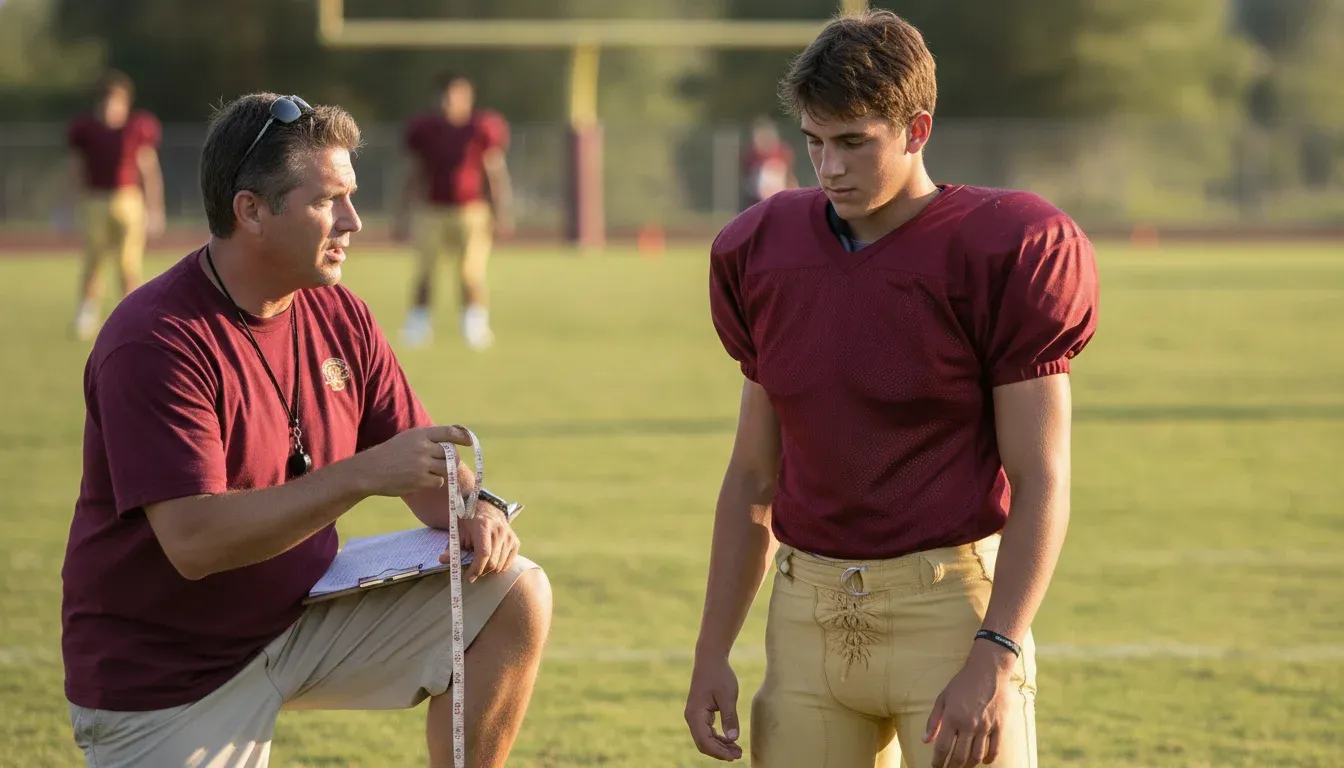
A supervised fitting gives the school a stronger record for jersey and pant selections.
Which decoration and construction choices fit a high school program?
Choose construction and decoration by matching the design to the season, equipment, maintenance expectations, and school identity. Tackle-twill can create a traditional raised look, while sublimation supports complex artwork and a light feel. Ask for a proof that shows the complete team design before approving production.
Choose the decoration method after the design is clear
Decoration should follow the job the uniform needs to do. Tackle-twill is associated with a bold, dimensional athletic look and can be a strong choice when the school wants a traditional appearance. Sublimation places the artwork into the garment and can support detailed color transitions or complex graphics without adding a separate layer.
Screen print, heat press, and embroidery may also have a place in a broader team order. For example, an embroidered mark may suit a coach jacket, while a heat-pressed name or number may suit a limited accessory. The right choice depends on the garment, the artwork, the wear pattern, and the result the school wants to maintain across seasons.
Review the parts that are easy to overlook
A proof should show more than the front of one sample. Review the front, back, sleeves, pant treatment, color placement, number style, name treatment, and any alternate colorway. Confirm that the school mark is approved for use and that the artwork is legible at the intended size.
Ask how the decoration will be applied and reinforced for the selected garment. Uniforms Express provides in-house decoration options including tackle-twill, sublimation, screen printing, heat press, and embroidery. Discuss the appropriate method with an account manager rather than assuming every mark should use the same treatment.
Design for the whole program, not only the sample
A design can look excellent on one jersey and still create problems across several teams. Check that the colors are consistent between varsity and lower levels, that alternate jerseys are clearly identified, and that the numbering system works for the entire roster. If the school plans to add players later, record the exact style, color, font, and decoration method.
Uniforms Express has a team uniform design tool for exploring options before the order is finalized. Treat the design as a starting point, then use the formal proof and roster approval as the final decision point.
How do you build the order around a fixed kickoff date?
Work backward from the first game, then place a checkpoint on every decision that can delay production. Set dates for design, sizing, roster lock, proof approval, purchase order or payment, production, quality review, shipping, and distribution. Keep buffer for corrections and ask about rush capacity before relying on it.
Set the season deadline first
Start with the date the athletes must receive the uniforms, not the date the order feels convenient. Then work backward through distribution, shipping, quality review, production, proof approval, and the administrative approval process. If the uniforms are needed for equipment handout before the first game, use that earlier date as the real deadline.
The season-ready team uniform ordering timeline provides a useful framework for assigning these checkpoints. Your actual schedule will depend on the product, decoration, roster readiness, shipping destination, and production capacity.
Make the approval handoff explicit
Schools often have more than one decision-maker. The coach may approve the design, the athletic director may control the budget, a district office may issue a purchase order, and an administrator may need to approve the school mark. List who owns each decision and set one final sign-off date.
Production should not begin from an informal message that says the design looks good. The school should approve the final proof, roster, sizes, quantities, and order terms in one clear handoff. If the supplier needs a deposit, payment, or purchase order, make that requirement part of the timeline rather than treating it as an afterthought.
Ask for qualified rush options when time is short
Rush service can be useful when a roster changes or a season deadline moves, but it is not a substitute for a complete order file. Ask which items and decoration methods can meet the requested date, whether capacity is available, and whether rush pricing or other conditions apply. Get the expected timing in writing before the school commits to the plan.
Uniforms Express is built around direct manufacturing and supports rush conversations for eligible orders. A representative can help separate the urgent need from the items that can follow a normal schedule. Do not promise families or staff a rush date until the supplier confirms the scope and timing.
Your uniform plan should also sit alongside the school's heat-safety procedures for athletes and staff. The Centers for Disease Control and Prevention heat-health guidance provides general information that schools can review with their athletic and medical personnel.
What should the final school approval packet include?
The final approval packet should let a second person understand exactly what the school ordered without reopening the design conversation. Include the approved product scope, colorways, artwork proof, roster, sizes, quantities, delivery address, deadline, purchase order or payment status, and the name of the final approver.
Use a final order checklist
Before submitting the order, confirm each of these items:
Team levels and player quantities are separated correctly.
Home, away, alternate, practice, and sideline items are identified.
Jersey and pant sizes match the final fitting record.
Names and numbers are spelled, assigned, and approved.
Artwork, colors, fonts, logos, and decoration methods match the final proof.
Delivery address, contact person, and required-in-hand date are correct.
Purchase order, payment, or other approval requirements are complete.
One person is named for final questions and changes.
Protect the record after approval
Save the final roster and proof together. Use a consistent file name with the school, team level, and approval date. If an item changes, keep a short revision record that says what changed and who approved it. This makes it easier to resolve questions before delivery and to place an accurate fill-in order later.
Athletic departments should also share the final distribution plan with coaches and equipment staff. The order may be correct, but a weak handoff can still lead to players receiving the wrong item or a replacement being requested unnecessarily.
Control the quote and purchase order versions
Keep the approved quote, purchase order, and final proof tied to the same order reference. If the scope changes, ask for an updated document instead of relying on a chain of informal emails. Compare the revised quantities, decoration, delivery date, and any rush conditions before the school approves the change.
This version control matters when a district buyer, booster club, or school administrator reviews the order separately from the coach. It also gives the supplier a clear record of which terms the school accepted. Mark older files as superseded and keep only one document labeled final for the production handoff.
Plan the receiving and distribution check
Assign someone to receive the shipment and compare the cartons with the final order record. Before the team distributes the uniforms, check the team level, garment type, colorway, quantity, names, numbers, and sizes. Separate any issue immediately and photograph or record the problem while the order details are available.
Then give coaches and equipment staff a short distribution list. A player should receive the pieces assigned to that row in the roster, not an item selected from a mixed pile. This final check protects the season launch and creates a useful exception log if a replacement or correction is needed.
How can programs protect reorders and midseason changes?
Keep the approved design, roster, measurements, and decoration details together so the next order can match the original package. Record the exact style and color information, identify the player or team level, and ask about current availability before promising a replacement date.
Plan for the roster you have and the roster you may add
High school rosters can change after the initial order. New players may join, athletes may change sizes, or a uniform may be damaged. A clean order record helps the staff explain what is needed without sending a new design request for every fill-in piece.
Keep the original approval packet available to the coach, athletic director, and equipment manager. When requesting a replacement, include the team level, garment, size, name, number, color, decoration, and required date. Ask the supplier to confirm that the new piece will match the original order before it is approved.
Use one owner for uniform records
Assign responsibility for the order record even if several people help with fittings and distribution. That owner can maintain the current roster, archive approved proofs, and direct questions to the supplier. A consistent record reduces duplicate requests and gives the next season's staff a usable starting point.
Uniforms Express also publishes a practical guide to custom team uniform reorders. Use it when your program needs additional players, replacements, or a repeat order that must stay consistent.
Make every replacement request specific
A replacement request should identify the original order, team level, garment, size, colorway, decoration method, player name, number, quantity, and required date. Add a short reason such as new player, size change, damage, or receiving error. This detail keeps the request focused and helps the supplier determine whether the original specification can be matched.
Ask for availability and timing before telling the player or family when the replacement will arrive. If the request is urgent, say so at the start and ask about eligible rush options and any conditions. A clear request is faster to review than a message that only says a player needs another uniform.
Keep an exception log through the season
Use a simple exception log for missing pieces, exchanges, damaged garments, number changes, and late roster additions. Record the date, player, item, action taken, supplier response, and resolution. Close the row only when the replacement is received and checked against the roster.
At season end, review the log with the athletic director. It can show which sizes, styles, or accessories created repeat issues and help the next program order improve its fitting, quantities, and package scope. The goal is not more paperwork. It is a reliable record that makes the next order easier.
Review football uniform package options with Uniforms Express or call 888-661-7044 to discuss your roster, design, and target delivery date.
Frequently Asked Questions
High school football uniform packages are easiest to manage when the school finalizes scope, roster data, decoration, and timing before production begins. The questions below address the decisions that most often affect fit, quality, budget control, and delivery readiness for a school football program.
What should a high school football uniform package include?
Start with the game jerseys and football pants required for each team level. Add home or away pieces, practice gear, socks, warm-ups, or coaches' apparel only when the program has a clear quantity and distribution plan for them.
How should a school collect football uniform sizes?
Use a supervised fitting or the supplier's measurement guidance, and record each player's jersey size, pant size, name, number, team level, and quantity in one roster file. Review exceptions before the final proof is approved.
Which decoration method is best for a high school football order?
There is no single best method for every program. Tackle-twill can suit a traditional raised look, while sublimation can suit detailed artwork and a light feel. Review the garment, design, wear expectations, and proof with the supplier.
How early should a school order football uniforms?
Start with the required in-hand date and work backward through fitting, roster lock, proof approval, school purchasing, production, quality review, shipping, and distribution. Ask the supplier for a schedule based on your actual products and decoration.
Can a high school request a rush uniform package?
Ask about rush availability as soon as the deadline is known. Rush options depend on the products, decoration, order readiness, production capacity, and destination. Confirm the eligible scope and timing in writing, and ask whether rush pricing applies.
How can a school control the uniform package budget?
Define the required game-day core first, then price optional practice, sideline, and staff items separately. Keep team levels and quantities distinct, approve one final proof, and avoid changing scope after the order is released unless the impact is understood.
What should the school keep for future reorders?
Keep the approved proof, roster, sizes, color details, decoration method, quantities, supplier contact, and revision history together. Those records help the program request matching fill-ins instead of rebuilding the design from memory.
Comments